 Guide On Map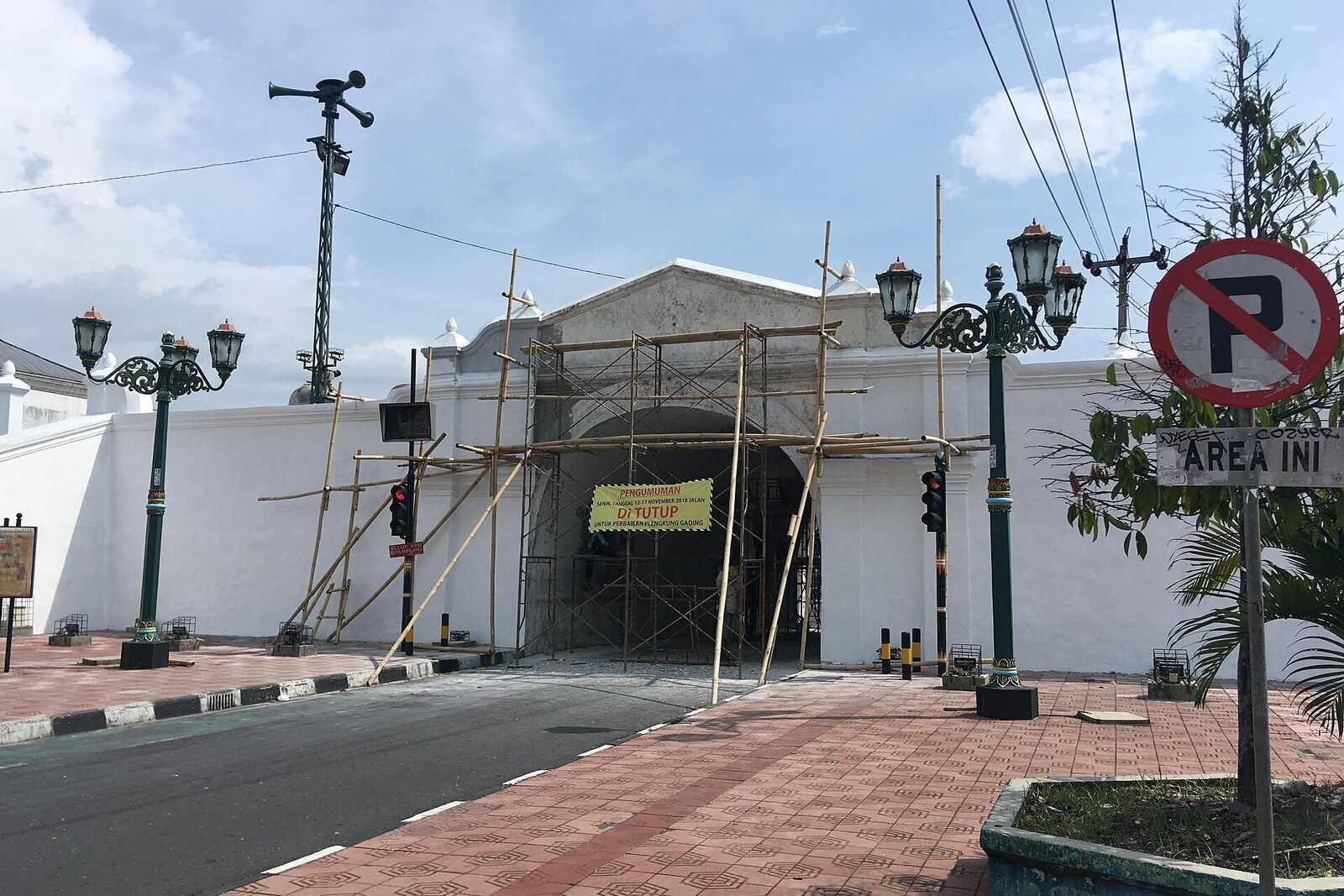
Look around first
What to notice
- White arch
- Southern fortress wall
- Passage beneath the gate
- South Alun-alun
The story of the place
At the end of South Alun-alun, in the outer wall of Kraton Yogyakarta, a broad, pale passage remains open. It is one of the five exits from the palace complex; only one other gate preserved its original arched form along with it. Beneath its vault, townspeople leave the square to the south: the passage belongs to an ordinary city road, not to a closed palace courtyard. Its popular name is tied to the color of ivory, while palace servants call the gate Nirbaya—free from danger.
The white arch is the southern gate in the outer wall of Kraton Yogyakarta. Of the five palace gates, only two have retained their original arched form. “Plengkung” means an arch, and “Gading” means ivory: the popular name arose from the color of the facade. Its palace name is Nirbaya, “free from danger.”
On October eighth, nineteen eighty-eight, the body of Hamengkubuwono IX, the sultan who had occupied the throne for forty-eight years, was brought to these gates. He had died six days earlier in the United States, and palace servants returned him to Kraton Yogyakarta for burial.
That morning, they carried the coffin out of the Bangsal Kencana pavilion, across the southern courtyard, and placed it in the Roto Praloyo funeral carriage. Hamengkubuwono X walked beside it—the deceased's son and the senior among the palace princes, who was to take over his father's affairs. The carriage crossed South Alun-alun, passed between the two sacred banyan trees, and entered beneath this arch.
For Hamengkubuwono IX, this was the only permitted way to use the southern gate. An unwritten palace rule forbids a reigning sultan to pass through Nirbaya alive: this is where the burial road to the royal necropolis of Imogiri begins. For townspeople, the rule works the other way around: the living may pass through, while an ordinary funeral procession is traditionally led around it.
Beyond the gate, the servants accompanied the carriage to Imogiri. At Masjid Pajimatan, they removed the coffin, said the funeral prayer, and buried the sultan in the Astana Saptarengga mausoleum. On March seventh, nineteen eighty-nine, the prince was crowned as Hamengkubuwono X. Along with the throne, he inherited the ban: the arch beneath which he led his father remains a road closed to him.
Useful on site
Exterior viewing is available around the clock; the arch remains part of the active street network.
Checked: June 24, 2026. Check the official source before visiting.Do not assume you will necessarily be able to pass beneath the arch: traffic patterns, work, and barriers may change. View the monument only from the open public side, and do not step into the roadway for an overall photo.