 Guide On Map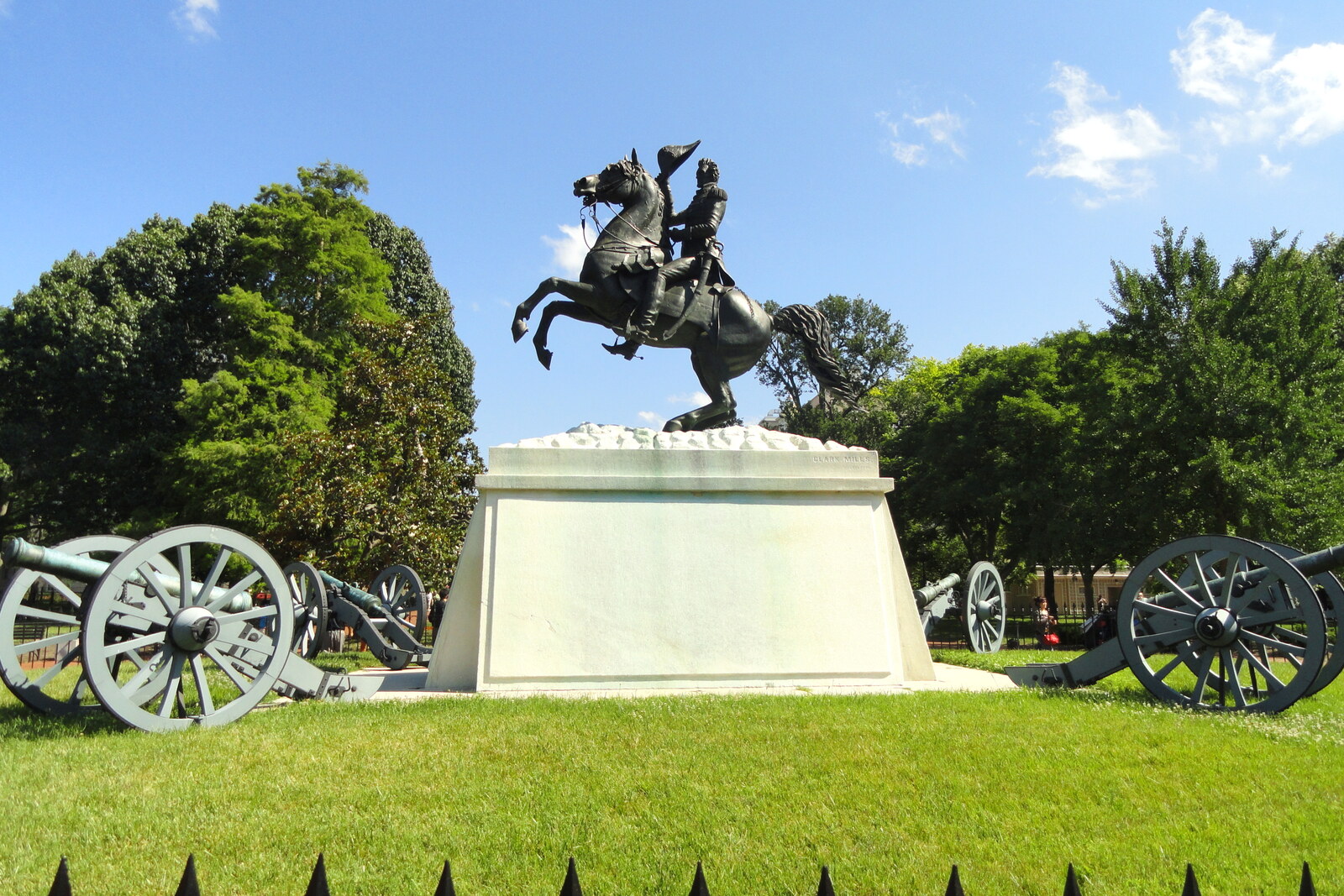
Look around first
What to notice
- Bronze figure of Lafayette
- Female figure with a sword
- Pedestal
- Paths through the square
The story of the place
On February twenty-seventh, eighteen fifty-nine, Philip Barton Key, the federal prosecutor for the District of Columbia, walked through Lafayette Square waving a white handkerchief. This was how he summoned Teresa Sickles, the wife of New York congressman Daniel Sickles, with whom he was meeting in secret.
At the time, the square was a prestigious residential address. The Sickles house stood on the west side, while at the eastern edge, near Madison Place, was The Washington Club, a private gathering place for the capital's elite. An open public park lay between the house and the club. The lover's signal was visible from the windows.
Three days earlier, Daniel Sickles had received an anonymous letter. Its author reported the affair and identified a house Key had rented for their meetings. The congressman demanded a written confession from Teresa. Then, seeing Key with the handkerchief, he took two pocket pistols and a five-shot revolver, crossed the park, and caught up with the prosecutor at the intersection of Pennsylvania Avenue and Madison Place.
The first shot did not stop Key. He grappled with Sickles, but he was unarmed; his pockets held only opera glasses. Sickles broke free and fired several more times, including at point-blank range. Key was carried into The Washington Club, where he soon died.
Sickles surrendered and admitted that he had fired the shots. His lawyers argued that he had been temporarily insane at the time of the killing. The jury deliberated for a little over an hour and found him not guilty. The verdict did not state which argument had persuaded them, so the phrase “the first acquittal on grounds of temporary insanity” is a later characterization of this trial.
Sickles went free and remained a congressman until eighteen sixty-one. He reconciled with Teresa, but her confession, written under pressure, had already been printed in the newspapers, and many former acquaintances turned away from the couple. Sickles then became a general, lost a leg at Gettysburg, and took up the preservation of the battlefield.
An object that was here during the killing is connected with that later work. Lafayette Square was surrounded by a cast-iron fence. In eighteen eighty-eight, Sickles secured its transfer to the Gettysburg Battlefield Memorial Association. Parts of the fence still separate Soldiers' National Cemetery from Evergreen Cemetery there.
The square itself was named for the Marquis de Lafayette as early as eighteen twenty-four, when the first paths were laid here. Lafayette was a French officer who, at nineteen, crossed the Atlantic Ocean at his own expense despite the king's prohibition and joined the army of the American colonies. He was wounded at Brandywine, helped secure the dispatch of French troops, and commanded one of the divisions in the Yorktown campaign, which ended with the surrender of the British army. When Lafayette returned to America in eighteen twenty-four, he was received as the nation's guest and became the first foreigner to address the United States Congress.
In eighteen ninety-one, his bronze figure was placed in the square's southeast corner—at the same intersection where Sickles fatally wounded Key. On the pedestal, America raises a sword to Lafayette, asking for French help; the old fence from that corner now stands in Gettysburg.
Useful on site
An open city square beside President's Park; access may be temporarily closed because of security, events, and demonstrations.
Checked: June 30, 2026. Check the official source before visiting.Stay on the open paths and do not try to approach temporary barriers. It is convenient to listen to the story where both the monument and the presidential façade are visible at once.