 Guide On Map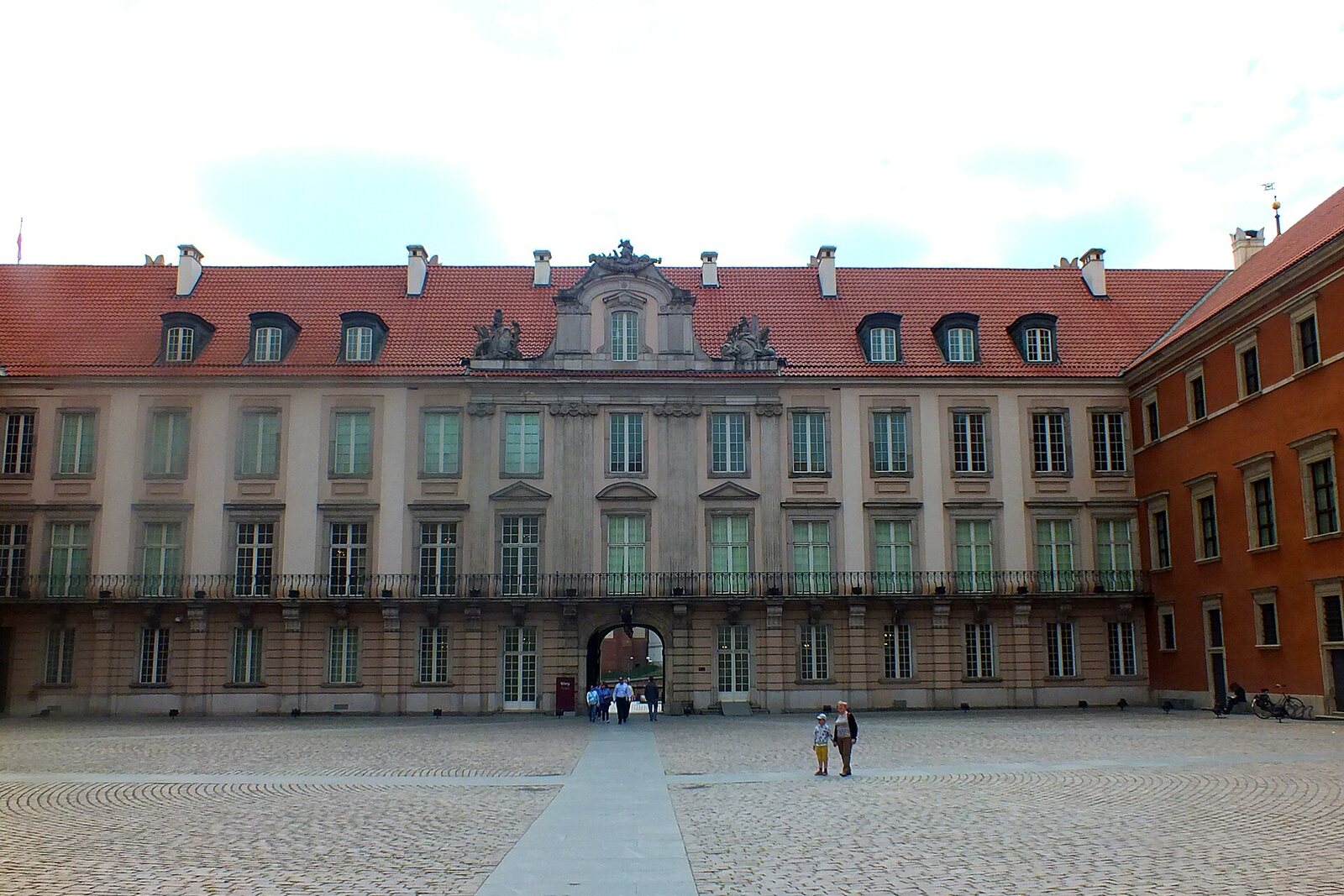
Look around first
What to notice
- Clock Tower
- Tower clock
- Symbolic grave by Grodzka Gate
The story of the place
On September fifth, nineteen thirty-nine, the staff of the presidential chancellery left the Royal Castle in Warsaw. Kazimierz Brokl, the curator of the castle collections, remained there with his wife and two daughters. He had one aim: to hide or remove everything that could still be saved.
Brokl had been preparing for war since spring. He drew up a plan to evacuate the collections, adapted the underground rooms of the Royal Library as shelters, and chose a storage place in the old Grodzka Tower. These preparations concerned the castle itself, because it housed both museum collections and the residence of the president of Poland. The name “Royal” remained from its former function: Polish monarchs lived here, the Sejm and Senate met here, and state decisions were made here. The German command chose the building as one of its targets because it was a recognizable symbol of the Polish state.
On the morning of September seventeenth, artillery shelling and air raids caused a fire. The Clock Tower, the neighboring Władysław's Tower, the roof above the Senator's Hall, and the wing on the Vistula River side caught fire. The hands of the tower clock stopped at eleven fifteen.
Firefighters, the city guard, and residents of Warsaw Old Town fought the fire. Brokl directed the removal of the collections. On the stairs near Grodzka Gate, he was carrying down another valuable object when he was struck by a fragment of an artillery shell. The curator died on the spot. His body was first placed on the lawn by the gate; his symbolic grave is there now, while Brokl himself is buried at Powązki Military Cemetery.
At the same time, museum workers and restorers led by Stanisław Lorentz, director of the National Museum in Warsaw, carried out paintings, furniture, and parts of the halls' decoration. They removed panels, stucco, and other architectural details because they already knew of the occupiers' intention to destroy the building. The rescued items were hidden in different places around Warsaw. Most of them survived the war.
In September nineteen forty-four, German sappers blew up the castle walls. After the war, the Polish government of the time postponed reconstruction for twenty-five years. Throughout that time, Lorentz gathered supporters and persuaded officials to restore the castle. Permission was granted in January nineteen seventy-one. The architects restored the former layout and placed the surviving details back in their original locations. Almost all costs were covered by donations from the residents of Poland and Polish communities abroad. In nineteen eighty-four, the halls opened as a museum.
The tower clock also had to be made anew. Warsaw clockmakers built a new mechanism without payment. On July nineteenth, nineteen seventy-four, when the dome of the Clock Tower was installed above the restored walls, the craftsmen started the clock at exactly eleven fifteen—the position at which the old hands had stopped on the day Kazimierz Brokl died.
Useful on site
Open urban space; choose a viewing point that does not obstruct pedestrian flow.
Checked: date not specified. Check the official source before visiting.The historic interiors are accessible only with a separate museum visit, which is best planned independently of the walk. Without entering, the stop still makes sense thanks to the facade and the building's connection with the square.