 Guide On Map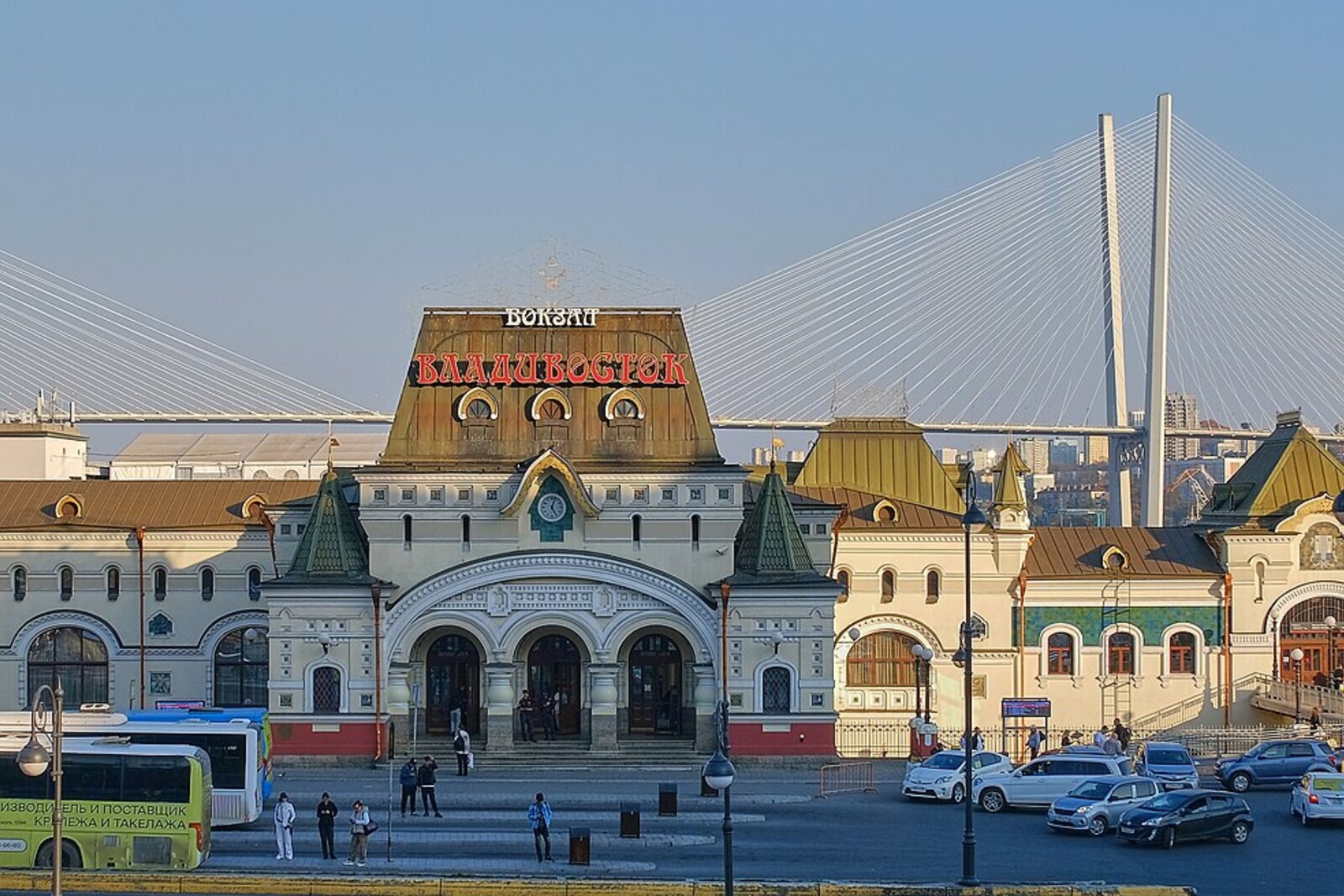
Look around first
What to notice
- The station building
- Dead-end railway sidings
- Tracks in the port district
- The Vladivostok Main Post Office building opposite
The story of the place
Behind the station façade begins the railway yard, with dead-end sidings and connections to the city’s tracks. Here, train sets could stand apart from traffic, while the locomotives determined who would have the ability to send trains onward. Vladivostok Fortress Headquarters once stood opposite; Vladivostok Main Post Office now occupies its site. The present station building and these tracks already existed at that time.
Vladivostok Railway Station stands where the eastern end of the Trans-Siberian Railway reaches the seaport. In November nineteen nineteen, this proximity made it possible to locate the headquarters of a coup right on a train.
Radola Gajda’s troops had been stationed in a dead-end siding behind the station for several months. Gajda was a Czechoslovak military commander who had only recently commanded Kolchak’s Siberian Army. After the army’s retreat, Kolchak removed him from his post, stripped him of his Russian general’s rank and decorations. Gajda came to Vladivostok, from where he was to leave the country. Instead of staying at a hotel, he lived in a staff car and sought supporters among opponents of the Kolchak administration. He wanted to remove its leaders and create a government of autonomous Siberia.
On the morning of November seventeenth, a white-and-green flag was raised over the train. Gajda’s associates announced that the new government was already meeting in the railcars. His men seized all the locomotives in the central railway yard, trapped the government armored train in a dead-end siding, and began registering volunteers beside the train. Traffic stopped. At the terminal station of the Trans-Siberian Railway, locomotives meant the ability to move people and weapons, while the exits from the yard meant access to the city and port.
Sergei Rozanov, chief administrator of Priamurye Territory, sought to preserve the Kolchak administration. Troops loyal to him occupied the heights above the tracks and part of the station. A gunboat fired on the railway yard from the bay. At night, fire was already directed at the station building; Gajda’s men found themselves pinned between the station and the tracks.
At half past five in the morning, the wounded Gajda surrendered together with several Czechoslovak officers. About two hundred fifty of his supporters came out of the station with their hands raised. The American consul reported that they were first lined up in front of Vladivostok Fortress Headquarters opposite the station, then taken to the railway yard; rifle volleys rang out from there. Rozanov’s order required the execution without trial of everyone captured with weapons. Gajda himself was handed over to the Czechoslovak command. Allied representatives secured his release, but he was expelled from Russia.
The present station building had already stood for seven years by the time of the fighting—the fire was directed at this structure and the adjacent tracks. The fortress headquarters opposite has not survived: Vladivostok Main Post Office now stands on its site. Gajda’s train has disappeared, but the dead-end sidings and railway yard behind the station remain.
Useful on site
Open around the clock; the schedule of individual halls and platforms depends on station operations.
Checked: June 24, 2026. Check the official source before visiting.The station remains in operation: do not hold up passenger traffic, and follow the current rules for access to the platform. The stele and steam locomotive can be viewed from outside.