 Guide On Map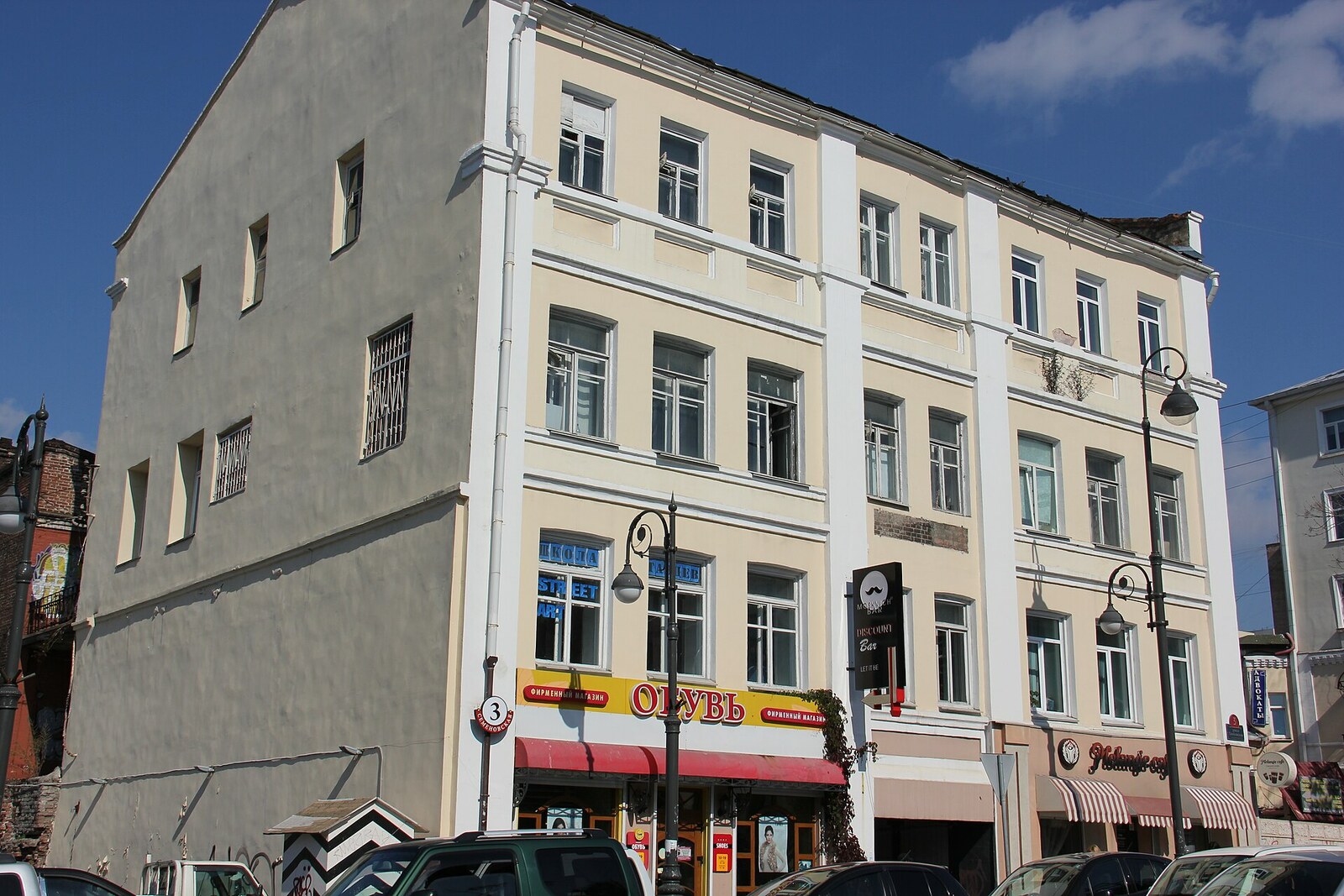
Look around first
What to notice
- Rectangular passage-through courtyard
- Open galleries on the upper floors
- Arched passageways
- Annexes between the buildings
The story of the place
Arched passageways lead into a narrow courtyard between several buildings, where open galleries have survived on the upper floors and additions can be seen deeper inside. When the district was densely populated, men who had come without their families and were seeking work at the port, on construction sites, and at the bazaar lived upstairs. Shops and eateries occupied the ground floor, while workshops and a theater operated nearby: everyday life fit inside this tangled courtyard. The old name of one building later became the name of an entire district.
In nineteen thirty-three, the police tried to count the residents of the building at present-day Pogranichnaya Street, twelve. The janitors reported one hundred fifty apartments and more than one thousand inhabitants. Seven shops operated in the building. It was only part of a passage-through complex connected to the building at Semyonovskaya Street, three, and to the neighboring Chinese theater.
Chinese dockworkers, masons, artisans, and small traders rented rooms here. Many came to Vladivostok without their families to earn money at the docks, on construction sites, and at Semyonovsky Bazaar. They needed cheap lodging for the night and a place from which they could quickly reach an employer in the morning. Property owners divided floors with partitions, installed bunks, added annexes, and linked the buildings with galleries. Traders occupied the lower level, selling food, tools, and small household goods. Workshops, eateries, and a theater operated nearby. Within several courtyards, a person could find a bed, get work, eat, and spend a free evening.
The city's residents nicknamed this complex Millionny Dvor. No exact document explains how the name originated. According to the most widespread version, it exaggerated the number of residents; according to another, the poor were ironically called millionaires. Both versions arose from the same overcrowding. The name of one courtyard then spread to neighboring buildings, and by the end of the nineteen twenties Millionka already referred to a significant part of central Vladivostok.
In May nineteen thirty-six, employees of the People's Commissariat for Internal Affairs (NKVD) began liquidating the district. They searched rooms, arrested unregistered residents and keepers of dens, and confiscated the property of Chinese citizens. The rest were evicted. From the start of the operation through December, more than three and a half thousand people left Vladivostok and its surroundings for China. Officials reported that Greater and Lesser Millionka no longer existed. The vacated rooms were repaired and assigned to employees and workers of other organizations.
The rectangular passage from Semyonovskaya Street, the open galleries of the upper floors, and the buildings on Pogranichnaya Street remain from that very Millionny Dvor. The Chinese residents, shopkeepers, and artisans have disappeared from here; the name coined because of their crowding has survived and now refers to quarters far beyond the original courtyard.
Useful on site
Public passageways are accessible year-round; individual courtyards and premises may be closed by their owners.
Checked: June 24, 2026. Check the official source before visiting.Part of the space remains residential and is used by establishments. Do not enter closed entrances and service premises, do not make noise in the courtyards, and do not photograph people without consent.