 Guide On Map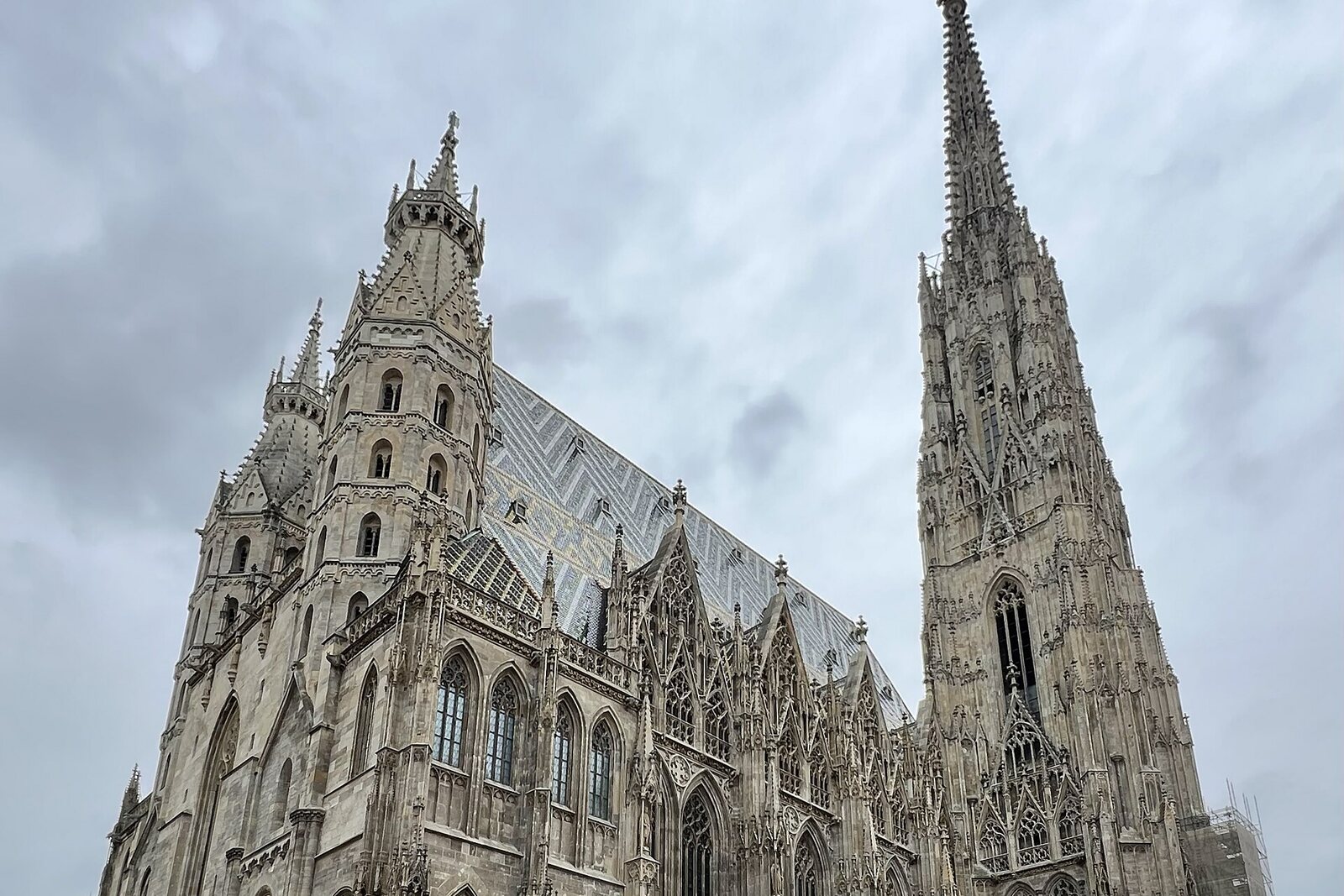
Look around first
What to notice
- Western façade
- Figure with a model of the church
- Southern tower
- High altar
The story of the place
A copy of a medieval figure holding a small model of a church has survived on the western façade. The southern tower and the enlarged building grew around the old parish church, consecrated in honor of Saint Stephen in the twelfth century. A family burial vault was created beneath the choir, and noble patrons were placed on the façades beside saints. The Archbishop of Vienna now serves here, and the permanent college of priests takes part in administering the cathedral.
In thirteen sixty-five, Rudolf IV, Duke of Austria, established a chapter at this church for a future cathedral. A chapter was a permanent college of priests: they conducted solemn services, managed church property, and helped the bishop administer the diocese. Vienna had no bishop of its own at that time. The city's main church remained a parish of the Bishop of Passau.
This dependency is recorded in St. Stephen's Church's very name. The first large church here was consecrated by the Bishop of Passau in eleven forty-seven, and he gave it the patron saint of his own cathedral: Saint Stephen. According to the Book of Acts, Stephen was a servant of the early Christian community: he was entrusted with distributing aid among widows who were being overlooked in the daily distribution of food. After his speech before the high council, he was led outside the city gates and stoned to death. Christians venerate Stephen as the first martyr. Inside Vienna's cathedral, his execution is depicted on the high altar.
Rudolf IV wanted to end Vienna's subordination to Passau. His position rested on the hereditary lands of the House of Habsburg, but in rank he remained a duke. His father-in-law, Emperor Charles IV, had turned Prague into a residence with an archbishop, St. Vitus Cathedral, and a university. Vienna was Rudolf's residence, but its main church was still listed as an ordinary parish of another diocese. The Bishop of Passau resisted: a new episcopal see would have meant losing part of his territory.
Rudolf failed to obtain a bishop. He then removed the chapter he had established from Passau's oversight and placed it directly under the pope. Twenty-four priests wore red vestments, and their head, the provost, gained the right to appear in attire resembling a bishop's. Rudolf gave the western gallery to the chapter for meetings and the central choir for communal prayer. Vienna still had no bishop, but St. Stephen's Church already had clergy of cathedral rank.
The duke ordered the southern tower to be built and the church to be enlarged, created a family burial vault beneath the choir, and designated a place there for himself in advance. Images of him appeared on the façades: Rudolf held a model of the church he intended to leave to his dynasty. The duke placed his own figure beside saints and his noble relatives, so that parishioners would see who had given St. Stephen's Church its new status.
A few months after establishing the chapter, Rudolf traveled to Milan to arrange his brother's marriage and secure dynastic claims in Italy. He died there before reaching the age of twenty-six and left no children. His body was brought to Vienna and placed in the burial vault he had prepared beneath the choir. His stone tomb monument inside the cathedral remained empty: his remains lie beneath the floor, separate from the duke's recumbent figure.
After Rudolf's death, his brothers lost interest in the enormous building project, and the people of Vienna had to continue it. Only more than one hundred years later did Emperor Frederick III obtain from Pope Paul II the establishment of the Diocese of Vienna. St. Stephen's Church received the bishop whom Rudolf had never managed to obtain for it.
The Archbishop of Vienna now serves here, and the chapter founded by Rudolf has existed without interruption to this day. It has twelve priests; they take part in administering the cathedral and in decisions of the Archdiocese of Vienna. On the western façade, a copy of Rudolf's figure still holds a model of the church. The original is kept at Wien Museum, the duke's body lies beneath the choir, and the cathedral bears the name of the saint, which once came here from Passau.
Useful on site
WienTourismus / Stephansdom: the church is usually open Mon–Sat 06:00–22:00, Sun/holidays 07:00–22:00; the towers, catacombs, and tours follow separate schedules.
Opening hours by day
First, look at the cathedral from the square. Inside, keep quiet and do not enter areas used for worship; the towers, catacombs, and tour sections may have separate access arrangements.