 Guide On Map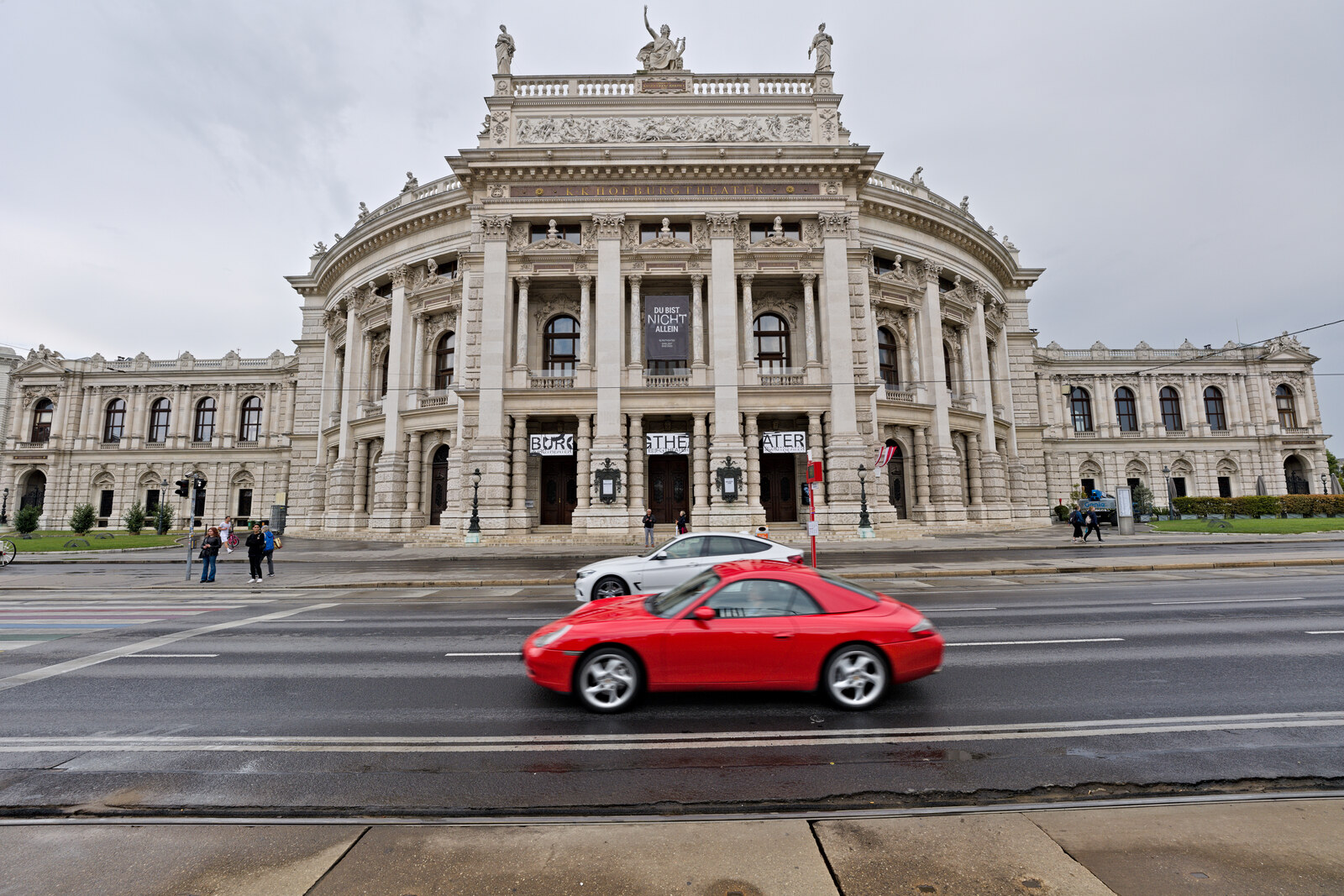
Look around first
What to notice
- Ceremonial facade
- Main entrances
The story of the place
The Burgtheater stands opposite City Hall, although its name points to a different address. In seventeen forty-one, Maria Theresa allowed the theater entrepreneur Josef Sellier to convert an unused ball-game hall next to Hofburg Palace. Later, the institution was called the Court Theater by the Burg—by the imperial palace. In eighteen eighty-eight, the company moved here, to the Ringstrasse, and the old name moved with it.
A hundred years later, Burgtheater director Claus Peymann commissioned playwright Thomas Bernhard to write a play for this building's anniversary. Peymann ran the state theater and sought a new production worthy of the country's leading German-language stage. Bernhard chose another anniversary from the same year: fifty years since the Anschluss—the annexation of Austria by Hitler's Germany.
In the play “Heldenplatz,” the Jewish professor Josef Schuster flees the Nazis to England, returns to Vienna after the war at the mayor's invitation, and then throws himself from the window of an apartment above Heldenplatz. His wife continues to hear the crowd that welcomed Hitler there in nineteen thirty-eight. These are fictional people, but Bernhard gave them lines about the antisemitism that persisted in the country.
It was decided not to publish the manuscript before the premiere. During rehearsals, excerpts reached the newspapers, and accusations torn from the play were debated by people who had not yet seen the performance. Politicians demanded that the production be canceled; the press argued over whether it was acceptable to pay for it with state funds and whether Peymann should be dismissed early. The director received death threats. He continued rehearsals: at stake were his position and his right to determine the repertoire of the theater he ran.
On November fourth, nineteen eighty-eight, manure was unloaded in front of the facade, and police stood watch at the entrances. In the auditorium, actors were interrupted by shouts. After the finale, applause and whistling continued for about half an hour. The seriously ill Bernhard came onto the stage; it became his last appearance before an audience. A few months later, he died.
Peymann was not dismissed: he remained director of the Burgtheater until nineteen ninety-nine. His production stayed in the repertoire here for ten years. In February two thousand twenty-four, “Heldenplatz” was staged again behind this facade—thirty-six years after the premiere for which the director had once commissioned an anniversary play.
Useful on site
Check the theater's website for current performances, tours, and access
Checked: date not specified. Check the official source before visiting.The paintings by the young Klimt brothers are inside and cannot be seen from the street. To see the staircases, find out the conditions for a tour or attending a performance in advance.