 Guide On Map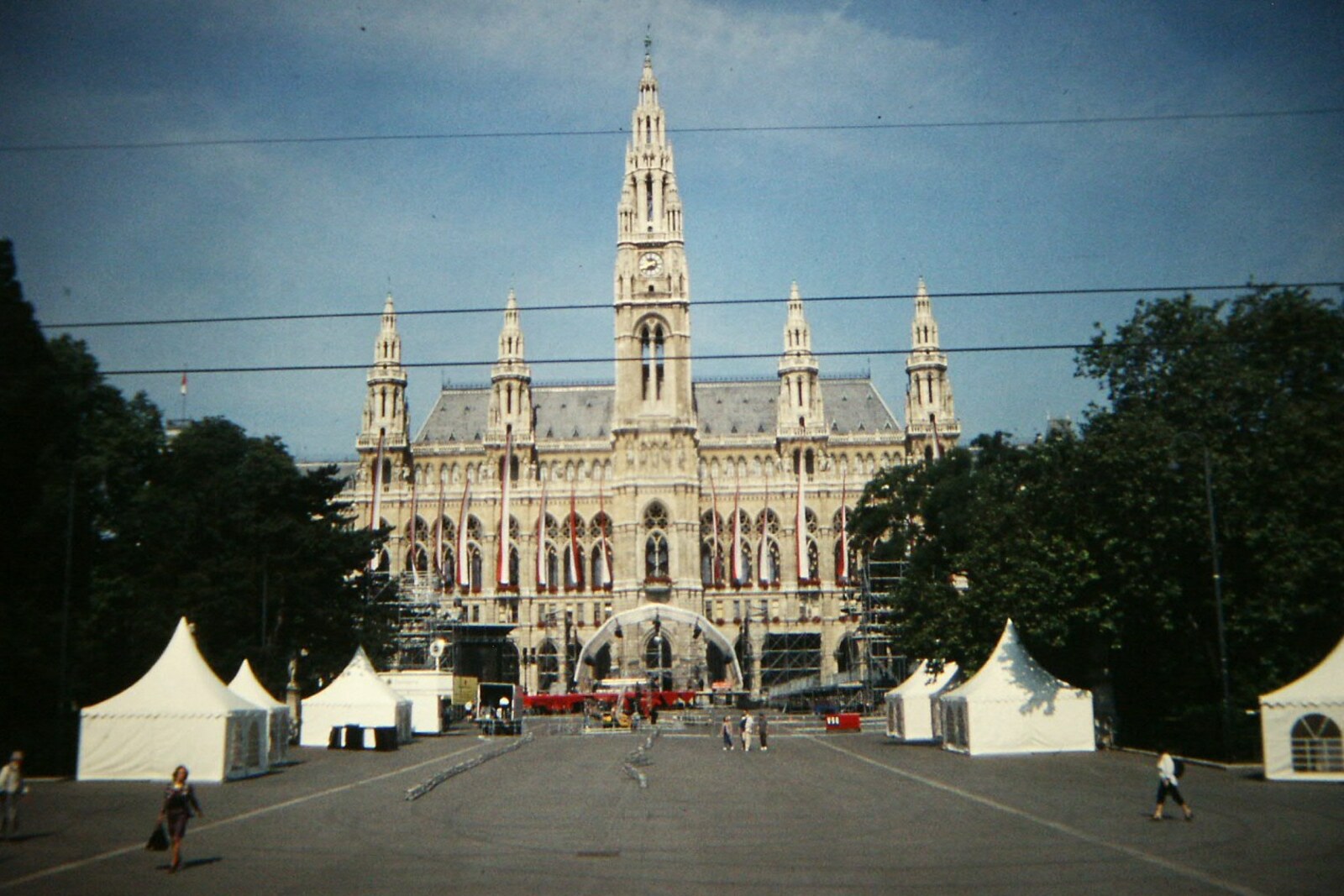
Look around first
What to notice
- City Hall tower
- Rathausmann
- Gothic facade
- Park in front of the facade
The story of the place
The Gothic windows and narrow spires belong to the building where the city council and the Vienna state parliament meet. Vienna is both a city and a federal state, so the mayor, elected representatives, and city services work under one roof. Its appearance echoes medieval city halls, when a separate council house became a symbol of municipal self-government. Above the park in front of the facade, an armed iron townsman holds a banner, while fairs, an ice rink, and summer film screenings are held on the broad strip of square below.
Cajetan Felder used to walk through this place even when there was no City Hall here. Where the tower, park, and square now stand lay the Josefstadt glacis—an open field in front of the demolished city fortifications. The imperial military used it for parades and drills. Felder lived in the Josefstadt district and crossed the parade ground on his way to the center: dusty in dry weather, muddy after rain.
Felder made his career as a courtroom lawyer, and in eighteen sixty-eight he became mayor of Vienna. By then, the staff and city council no longer fit into the old City Hall on Wipplingerstrasse. A site near the city park, on the other side of the center, was chosen for the new building. Most councilors wanted to build there.
Felder sought this parade ground. It had room for a much larger building, and the University of Vienna, the imperial parliament, and the city administration could be brought together nearby. Councilors and military officers, who did not want to give up the drill ground, opposed him. The mayor then put his proposal to a vote. Some of the opponents supported it in expectation that Franz Joseph would refuse: as they saw it, the emperor would keep the parade ground for the army anyway.
But Felder had already informed Franz Joseph of the plan. The emperor agreed, and the military were given a new place for drills in Schmelz, then on the outskirts. The permission came with one condition: the City Hall tower must not exceed ninety-nine meters—the height of the already familiar Votive Church.
The architect Friedrich von Schmidt designed a tower just under ninety-eight meters high. At its top, he placed an iron standard-bearer more than five meters tall. The imperial condition was formally observed: the tower itself remained lower than the Votive Church, while the figure raised the entire silhouette above it.
This standard-bearer is called the Rathausmann—“the City Hall man.” He does not depict any particular Viennese man. Schmidt used an old image of an armed townsman associated with the independence of medieval cities. For the same reason, the facade resembles a Gothic city hall: the architect referred to the era when city councils acquired their own buildings and the right to conduct the city’s affairs.
The victory cost Felder dearly. The original estimate of eight and a half million gulden was approved, but the final expenses reached thirteen and a half million. The city borrowed money, and the construction debts became one of the reasons Felder was not re-elected in eighteen seventy-eight. City Hall was completed five years after he left office, and the city council moved here even later.
Today, members of the city council and the state parliament meet inside: Vienna is both a city and a separate federal state. The mayor’s office and city services are located here, while the ceremonial halls host concerts, balls, and official ceremonies. The former military parade ground in front of the facade is divided by a park; fairs, an ice rink, and summer film screenings occupy the open strip down the middle. Above it stands the Rathausmann, thanks to whom Felder’s tower did end up higher than the permitted ninety-nine meters.
Useful on site
Check the current schedule of City Hall, tours, and events at Rathausplatz
Checked: date not specified. Check the official source before visiting.Step back from the facade to see the entire tower; the figure at the top is very small from the ground. The interior halls require separate access.