 Guide On Map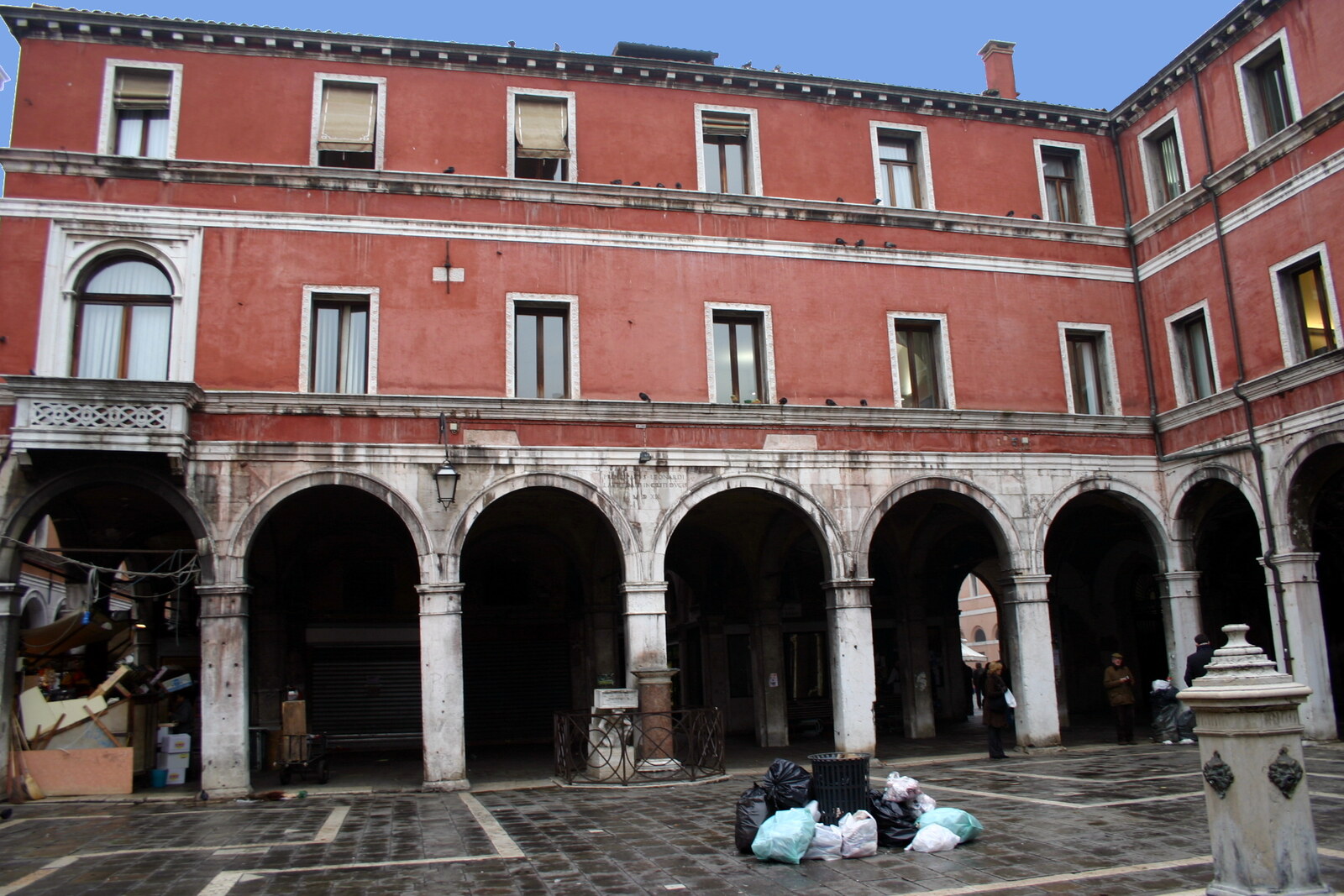
Look around first
What to notice
- The façade of the Church of San Giacomo di Rialto
- The long Bancogiro portico
- Arcades around the campo
- The portico's stone columns
The story of the place
Along the square at Rialto runs the long Bancogiro portico; its stone columns and arcades still outline the place where banking tables once stood crowded together. Beneath its vaults, they accepted money from merchants, city institutions, and families that entrusted bankers even with their daughters' dowries. Coins could be left here, while payment to another merchant was made by an entry in an account book, without carrying bags of money in varying denominations.
The campo is named after the small church of Saint James the Greater, one of Christ's twelve disciples. Its dedication is probably connected with the already familiar reconciliation between Pope Alexander III and Frederick Barbarossa: the agreement was concluded on July twenty-fifth, eleven seventy-seven, the feast day of Saint James. This is a researchers' hypothesis, not the established history of the church's foundation.
In fifteen fifty-nine, the patrician bankers Vettor Pisani and Girolamo Tiepolo opened a private bank at Rialto. They sought the essential thing for people accepting others' money: trust. Pisani and Tiepolo put a large quantity of gold and silver coins on display, gathered their relatives for a solemn Mass, instructed the relatives to dress in scarlet, and held a dinner for more than five hundred guests—members of both families and merchants. This showed depositors which fortunes and family names stood behind the new bank.
Banking tables stood beneath the porticoes around the church. A merchant left money here, then paid another merchant by an entry in an account book. There was no need to carry bags of coins of varying denominations or check their weight every time. Depositors included traders, city institutions, and families that entrusted bankers with their daughters' dowries.
In fifteen eighty-four, news spread through Venice that the Pisan merchant Andrea dell'Oste, who had business ties with Pisani and Tiepolo Bank, had suffered major losses. Depositors rushed to withdraw their money. The bank could not pay everyone and declared itself insolvent; its liabilities exceeded a million ducats.
For Martolo de' Giorgi, a commercial intermediary from Ragusa—present-day Dubrovnik—this collapse destroyed his main source of income. Through the bank, he transferred money between Ragusa, Venice, and international fairs, receiving a commission on each transaction. On July sixth, a bank bill of exchange for two thousand seventy-eight ducats appeared in his ledger, returned unpaid. Twenty days later, Martolo loaded his household belongings and the goods remaining in the warehouse onto a ship and left Venice forever. In fifteen eighty-eight, his own family company also went bankrupt; officials in Ragusa had to establish a special office to sell off its property and settle with creditors.
For several years after the bankruptcy, there was no bank at Rialto. Merchants told the senators that they were ready to trust even a private individual without guarantors: without transfers between accounts, trade fell apart into unpaid deals. Senator Tommaso Contarini, who was advocating for a reliable settlement system, set out the arguments for a state guarantee. In fifteen eighty-seven, the senators established Banco della Piazza di Rialto. Its manager was chosen by the Venetian Senate, while money continued to be transferred between accounts by entries in a ledger.
Later, these operations passed to Banco Giro. The banking tables and account books have long since disappeared from the campo, but the long portico opposite the church is still called Bancogiro.
Useful on site
Open urban space; choose a viewing spot that does not obstruct pedestrian flow.
Checked: June 27, 2026. Check the official source before visiting.All the key details of the finale are outside. View them from the square without blocking the entrance to the church or the passages to the market.