 Guide On Map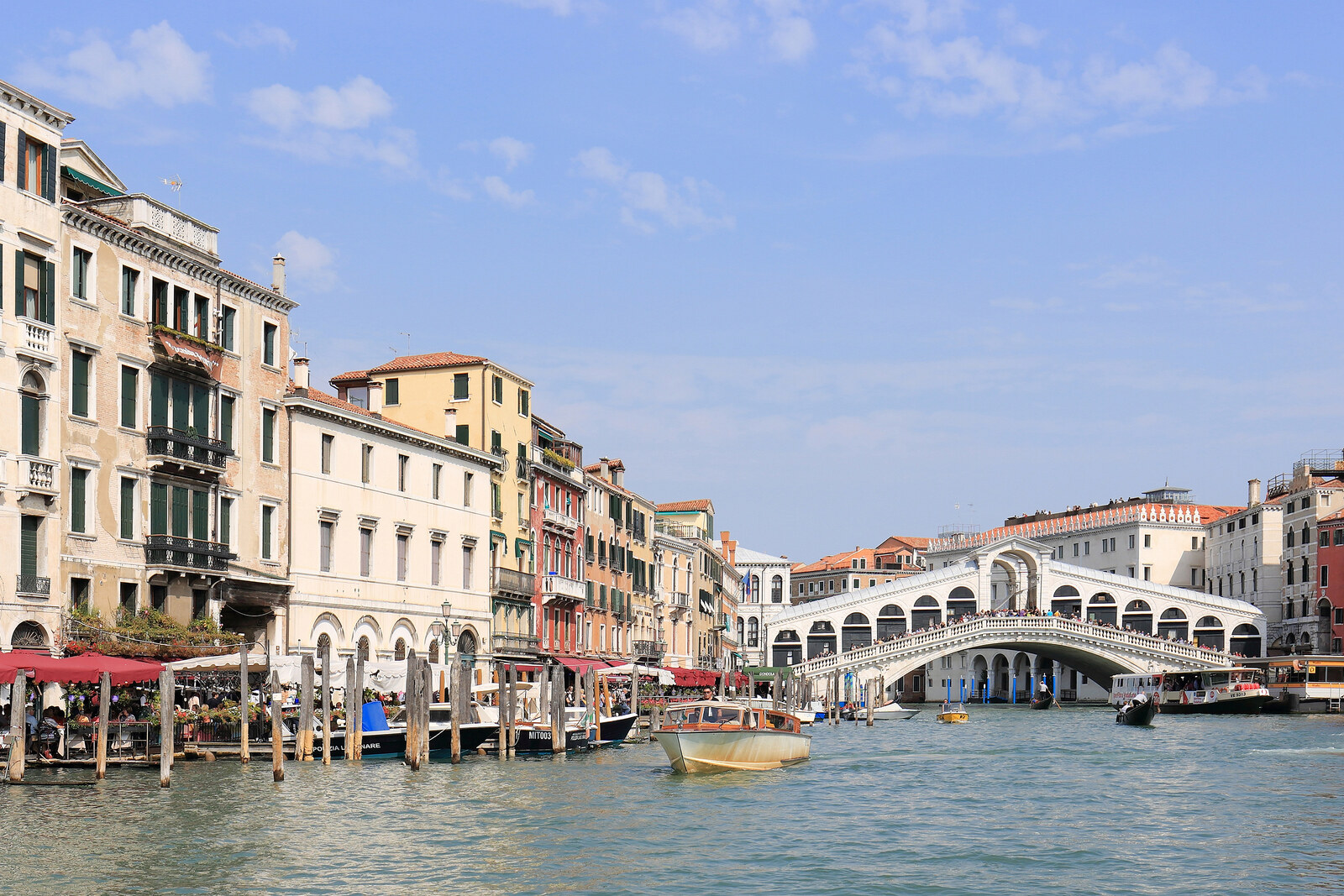
Look around first
What to notice
- Stone arch
- Two outer passageways
- Two rows of shops
- Grand Canal
The story of the place
A shopping street crosses the Grand Canal on one wide stone arch. Outer passageways run along the sides, while shops stand closely packed in the middle; their income once helped maintain the crossing. The stone Rialto replaced a wooden bridge and preserved its familiar arrangement: a market on one bank, a route across the canal among merchants. The present arch was built in the late sixteenth century, yet it still links two parts of the city where people have gathered for centuries to shop and exchange news.
On June fifteenth, thirteen ten, Bajamonte Tiepolo, one of the leaders of an armed conspiracy against Doge Pietro Gradenigo, crossed the Grand Canal at this spot twice. In the morning, he led men toward the Doge's Palace. The second time, he was returning, pursued by Gradenigo's supporters.
Beneath their feet was a wooden structure: two sloping ramps were linked by a lifting central section, which was opened for tall vessels. At that time, no other bridge across the Grand Canal existed in Venice. It led directly to Rialto Market, from which it later received its name. For the conspirators, this meant that the road to the city center and the only overland route back passed through one narrow point.
The senior leader of the conspiracy was Bajamonte's father-in-law, the patrician Marco Querini. The Querini family lived chiefly from landed estates near Ferrara and in Polesine; maritime trade mattered less to them. When Doge Gradenigo began the war for Ferrara, Querini was risking precisely the property that brought him income. The campaign ended in defeat. Marco commanded one of the fortresses, left it without authorization, and was taken captive. Some Venetian patricians feared further losses and confiscations, while others demanded that Querini be tried for treason. Added to this was a long-standing dispute over which families should sit in the Great Council.
Marco Querini decided to get ahead of his opponents. He, Bajamonte Tiepolo, and Badoero Badoer assembled three detachments. Two were to set out from Rialto, cross the bridge, and approach San Marco Square by different streets. The third was expected from the mainland across the lagoon. The conspirators planned to seize the Doge's Palace, kill Gradenigo, and change the order of government in the republic.
The warned doge had time to post guards. A storm delayed Badoero's boats. Marco Querini's detachment met armed supporters of Gradenigo; Marco and his son Benedetto were killed. Bajamonte's men also failed to break through to the palace and retreated along the Mercerie toward Rialto.
After crossing the canal, they set fire to the wooden bridge and put it out of service. This was a calculated act: by destroying the only crossing, Bajamonte delayed the pursuers and had time to fortify himself among the market buildings, where the Querini houses stood. He still counted on Badoero's detachment. But Badoero was captured and then executed. By evening, Bajamonte agreed to lay down his arms and went into exile. The houses of the Tiepolo and Querini were ordered destroyed. A few weeks later, the Great Council established a special commission to try the participants—the Council of Ten, which later became a permanent institution.
Nothing remained over the water of the bridge burned by Bajamonte's men. In its place stands a stone arch built by Antonio da Ponte between fifteen eighty-eight and fifteen ninety-one. There were no shops on the bridge during the conspiracy: they began to be leased to merchants on a later wooden crossing, so that the rent would cover the upkeep of the crossing. The builders of the present Rialto preserved this arrangement—between the two outer passageways runs a street with two rows of shops.
Useful on site
The bridge is open as a city street; nearby is Rialto Market: vegetables and fruit Mon–Sat 07:00-20:00, fish stalls Tue–Sat 07:00-14:00, closed Sunday.
Checked: June 27, 2026. Check the official source before visiting.In the middle of the bridge, the canal is almost invisible, while crowds quickly form at the edges around the views. Stop before the ascent or after the descent.