 Guide On Map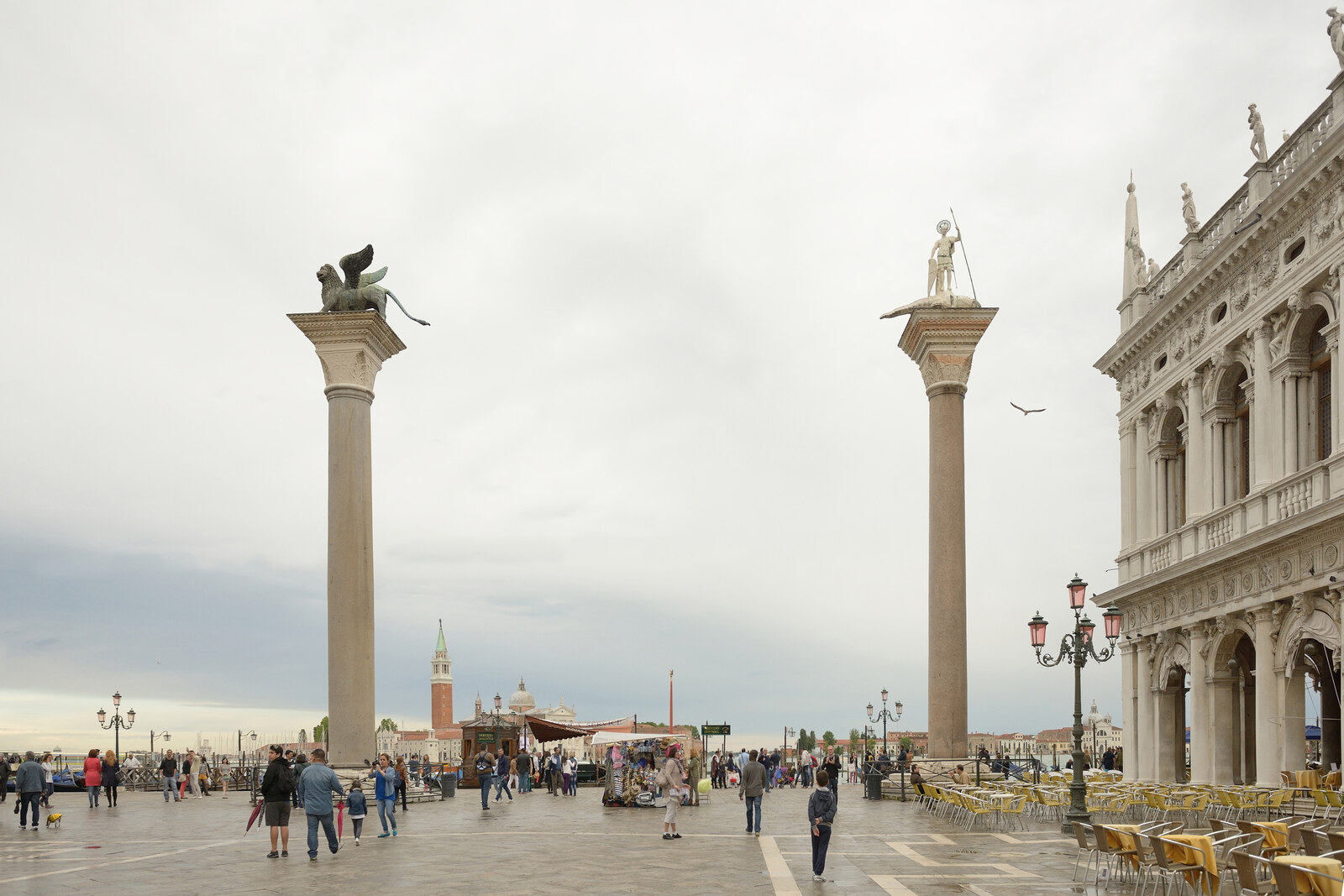
Look around first
What to notice
- Two columns by the water
- Winged lion
- Statue of the warrior Theodore
- Red porphyry head
The story of the place
Molo is called a quay. Official guests moored here from the water, then walked from the shore to Piazzetta San Marco and on to St Mark's Basilica and the Doge's Palace. Two columns mark this route from the lagoon: one shows the winged lion of Saint Mark the Evangelist, while the other bears the warrior Theodore, Venice's former patron. At the corner of the basilica's balustrade, a red porphyry head wearing a crown has survived.
Between the two columns by the water, on May fifth, fourteen thirty-two, Francesco Bussone da Carmagnola was beheaded. He was known as Carmagnola after his hometown. He commanded Venice's land army and came here, convinced that he had been summoned to discuss the continuing war with Milan.
Bussone was a condottiere—a military commander who made a contract with a ruler or a city, brought his own troops, and received money, land, and titles for his service. His entire prosperity depended on military success and the trust of his employer. At first, he served the Duke of Milan and helped him recover lost possessions. When the duke removed him from the army, Bussone went over to the enemy.
In fourteen twenty-five, Venice appointed him its commander-in-chief. Two years later, he routed the Milanese at Maclodio; after that campaign, Venice gained Brescia, Bergamo, and neighboring lands. Then his luck ran out. Bussone was defeated at Soncino, failed to support several operations, and, despite the Venetian Senate's demands, withdrew his troops to winter quarters too early. At the same time, he continued exchanging messages with the Duke of Milan, his former master. In Venice, they decided that the commander was either deliberately dragging out the war or had already come to an agreement with Milan.
The senators continued sending him assurances of their trust, while resolving to arrest him. Bussone was invited to Venice supposedly for a military council. Here he was met by an honorary escort, taken to the Doge's Palace, and his men were dismissed, with the explanation that the conversation would take a long time. Instead of a council, Carmagnola was taken to prison.
He was tried by the Council of Ten—a body that dealt with treason and other crimes dangerous to the republic. The commander was tortured and found guilty. Little is known about the proceedings themselves, so historians have never been able to establish whether he really betrayed Venice. Before the execution, a gag was fixed in his mouth, depriving him of the chance to address those gathered. Then he was led out of the palace and beheaded between the columns.
Molo means quay. From here, official guests came up from the water to Piazzetta San Marco and walked between the columns toward St Mark's Basilica and the Doge's Palace. One column bears the winged lion of Saint Mark the Evangelist, while the other bears a statue of the warrior Theodore, Venice's former patron. This passage served as the city's gate from the lagoon and also as a place of public executions: sentences were carried out where those arriving in the city were meant to see them.
At the corner of the basilica's balustrade facing Piazzetta San Marco, a red porphyry head wearing a crown still remains. After the execution, Bussone's head was displayed on the south side of the church, and the Venetians nicknamed the old sculpture Carmagnola. It was made many centuries before the commander and probably depicts a Byzantine emperor. Bussone's real head disappeared; his name remained with someone else's stone face, and the place of execution remained in the passage between the two columns.
Useful on site
Open urban space; choose a viewing spot that does not obstruct pedestrian flow.
Checked: June 27, 2026. Check the official source before visiting.By the water, watch for wet stone and the movement of people. For a view of the columns, it is better to step aside rather than stop in the passage between them.