 Guide On Map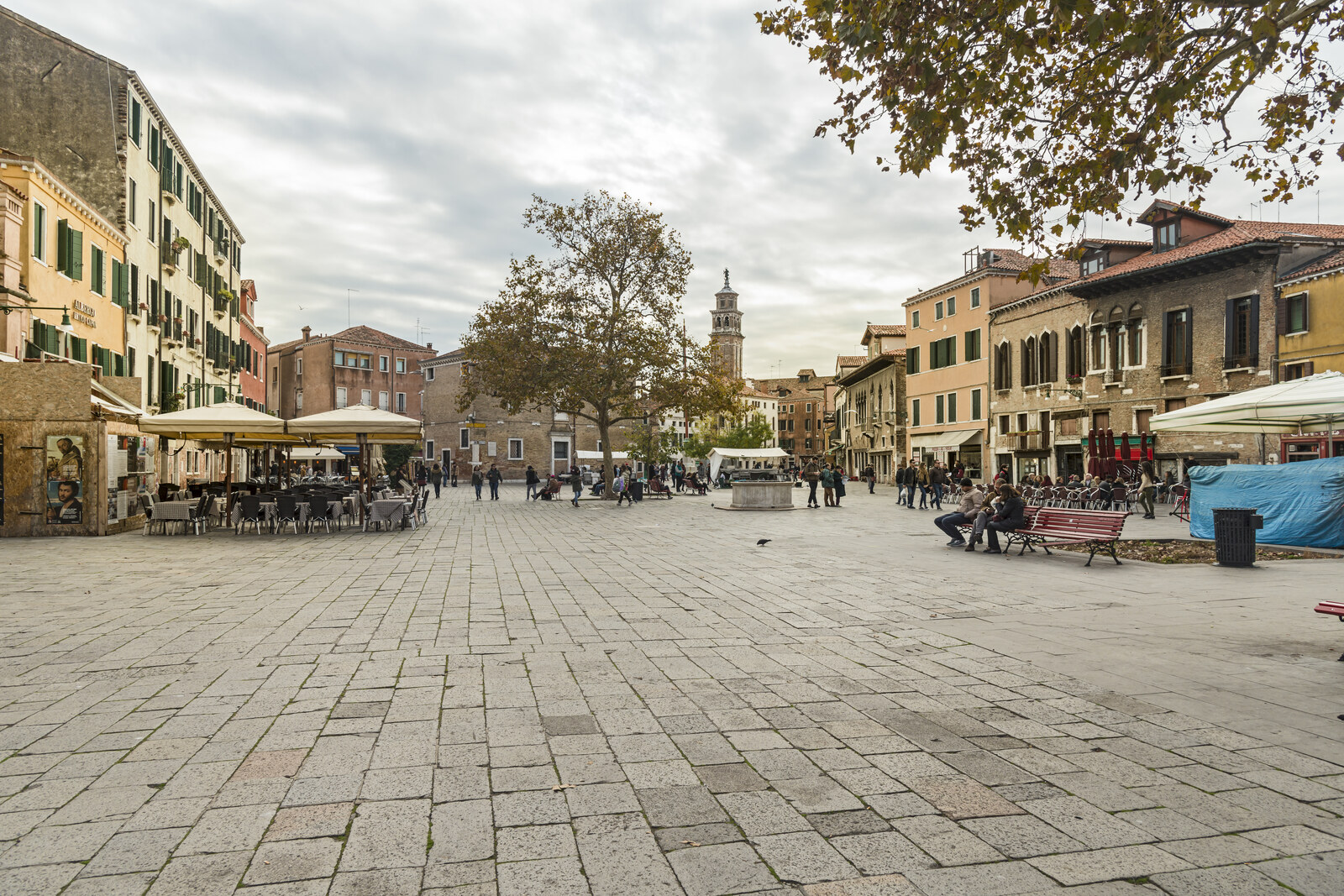
Look around first
What to notice
- Truncated campanile
- Former church building
- Red façade of Caffè Rosso
- Municipal police building
The story of the place
During the day, market stalls operate in Campo Santa Margherita; by evening, students from nearby universities occupy the open space. One of the university halls is right here, in the former church by the truncated campanile.
Venetians named the campo after this parish church. It was dedicated to Margarita of Antioch—an early Christian martyr whom church tradition made the patron saint of women in childbirth. The Napoleonic administration abolished the parish in eighteen ten. The building had time to serve as a tobacco warehouse, a marble storehouse, and a movie theater. But another transformation matters more to the square’s history: in nineteen ten, the Chamber of Labour—an association of local trade unions—moved in here.
It was here because of the people living around it. The maritime station and port were nearby; many families depended on loading and unloading ships. One of the places where dockworkers gathered was the tavern of the sailor Giuseppe Scarpa “Capon”. Scarpa went to sea for twenty-five years, then decided to preserve both himself and the money he had saved: he came ashore and opened an establishment on the campo.
Angelo Vianello, an organizer of port dockworkers, began arranging communal lunches at Capon’s. The dockworkers provided regular revenue, while city affairs and socialist ideas were discussed at the tables. In nineteen thirteen, the regulars proclaimed the “Republic of Santa Margherita” in the tavern.
They had no intention of separating from Venice. It was a parody of the old Republic of Venice, in which offices once held by patricians were handed out to people from the campo. Fishermen were elected doges—the heads of the republic. Port dockworkers were appointed avogadors—officials who watched over compliance with the laws. Ambassadors appeared, and even their own executioner. Across the square stood Caffè Rosso; its regulars declared themselves Capon’s opponents, and the two groups staged bloodless campaigns between the establishments.
After the First World War, the old joke took on a dangerous meaning. The nickname “republic” stuck to the working-class neighborhood, while socialists and fascists were already seriously contesting its public centers. On October thirtieth, nineteen twenty-two, fascist squads seeking to destroy socialist organizations attacked the local Casa del Popolo. Only two socialists were inside; the leaders had ordered them in advance not to resist. The attackers occupied the premises without a fight, and the workers’ associations lost their open center on the campo.
Soon, the small building of the former furriers’ guild in the middle of the square was handed over to the School of Fascist Mysticism, where party cadres were trained. It now houses the municipal police. The former church with the Chamber of Labour became a university auditorium, while Antico Capon and the red façade of Caffè Rosso still stand opposite each other.
Useful on site
Open square; it becomes noisier in the evening because of students and bars.
Checked: date not specified. Check the official source before visiting.The square follows its own rhythm, so the market, outdoor tables, and student noise change throughout the day. Look at the façades without expecting to enter the former church, which is used by the university.