 Guide On Map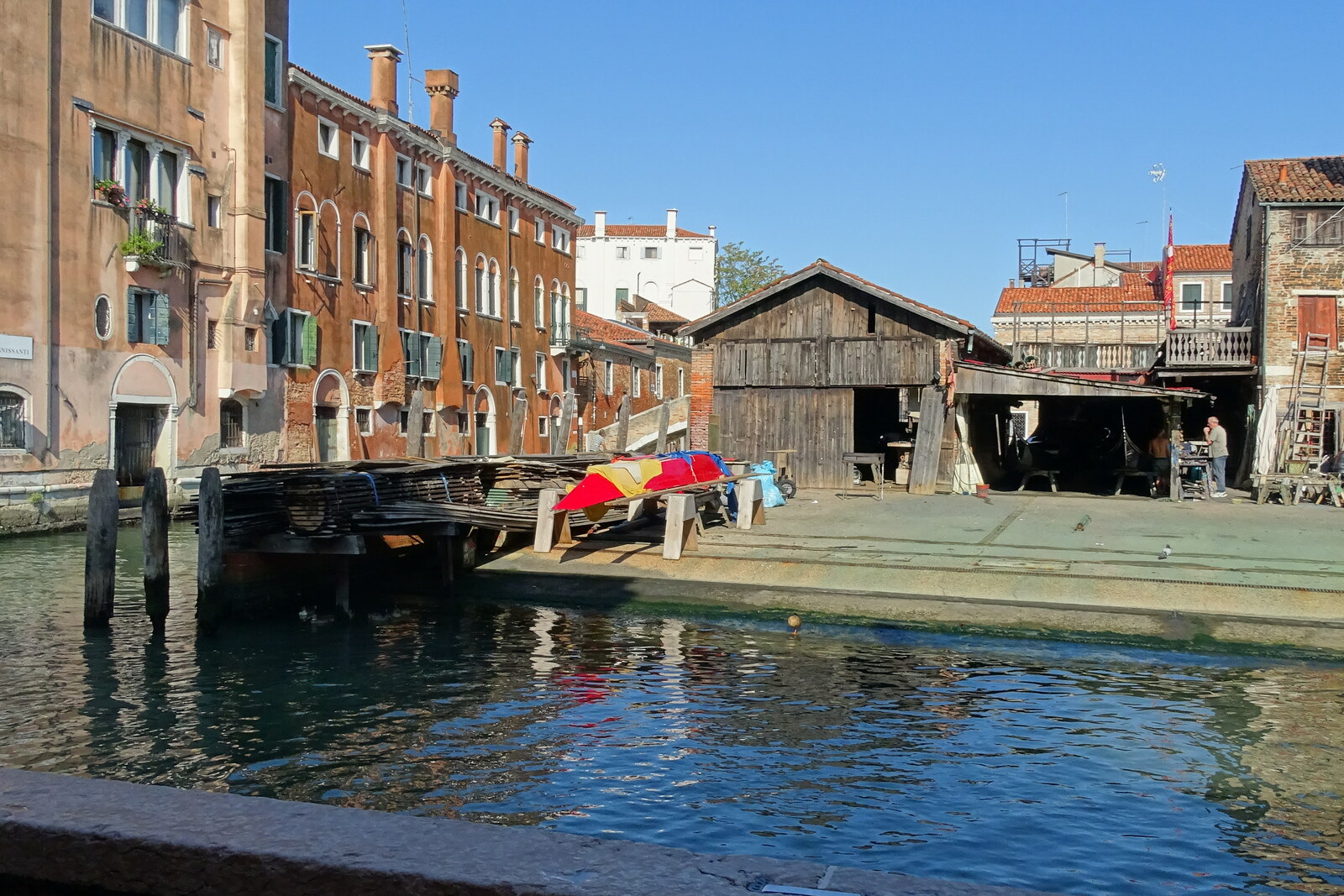
Look around first
What to notice
- The sloping slipway
- Wooden sheds
- Steep roofs
- Rio di San Trovaso
The story of the place
On May first, nineteen fifty-six, four identical wooden galleons were lined up at once on the sloping yard of this boatyard. They were built by Giovanni “Nino” Giuponi, the master builder of Squero di San Trovaso. Squero is the Venetian name for a small boatyard; Giuponi earned his living building and repairing boats for the Daniele Manin Cooperative.
This time, the order was not for gondolas. Venice, Pisa, Genoa, and Amalfi were establishing the Palio of the Ancient Maritime Republics—a race for eight-oared crews in vessels resembling ancient galleys. To ensure that the result depended on the rowers rather than the boat, the builders were given identical dimensions and weight, with permitted tolerances. The Venetian cooperative's design was selected from several proposals, and Giuponi had to make four identical hulls where builders usually made one-off boats.
An eight-man crew from Pellestrina came to the selection. These men made their living by fishing and competed in regattas: they learned to row standing up, Venetian-style, when they went out for fish and carried their catch to market. In a galleon, they had to sit on a fixed bench and use a paired oar. None of them had tried this kind of rowing before. They trained all day, then beat the team from Treporti, considered the favorite, in Giuponi's boats. A loss would have left them without a trip to Pisa.
On July first of the same year, the first Palio took place on the Arno. The Venetian eight from Pellestrina came in first. The four identical hulls lined up on this slipway in the spring gave rise to a competition that is still held today.
The broad slope in front of the wooden buildings serves as a slipway: boats are manually lowered into the canal on rollers and hauled back out along it. Under the shelters, they are built, dried, and repaired. Work here is documented from before the seventeenth century. The carpenters, like the construction timber, came to Venice from Cadore and Val di Zoldo, so the tese—the squero's work sheds—were given steep roofs and wooden galleries resembling buildings in Dolomite villages.
San Trovaso is also a trace of compressed Venetian speech. There is no saint with that name: it combines the names of Gervasius and Protasius, Milanese martyr brothers to whom the neighboring church is dedicated. From the church, the name passed to the canal and the boatyard.
Giuponi's galleons are no longer here. The first wooden vessels of the Palio are kept in another Venetian yard, while competitors race in new fiberglass hulls. Gondolas are now brought down to the water along the slope where four identical boats stood in the spring of nineteen fifty-six.
Useful on site
The working boatyard is closed to unrestricted entry; it can only be viewed from the public bank opposite.
Checked: date not specified. Check the official source before visiting.View the squero from the opposite side of the canal. This is a working private workshop: do not enter the yard, call out to the builders, or block their working access.