 Guide On Map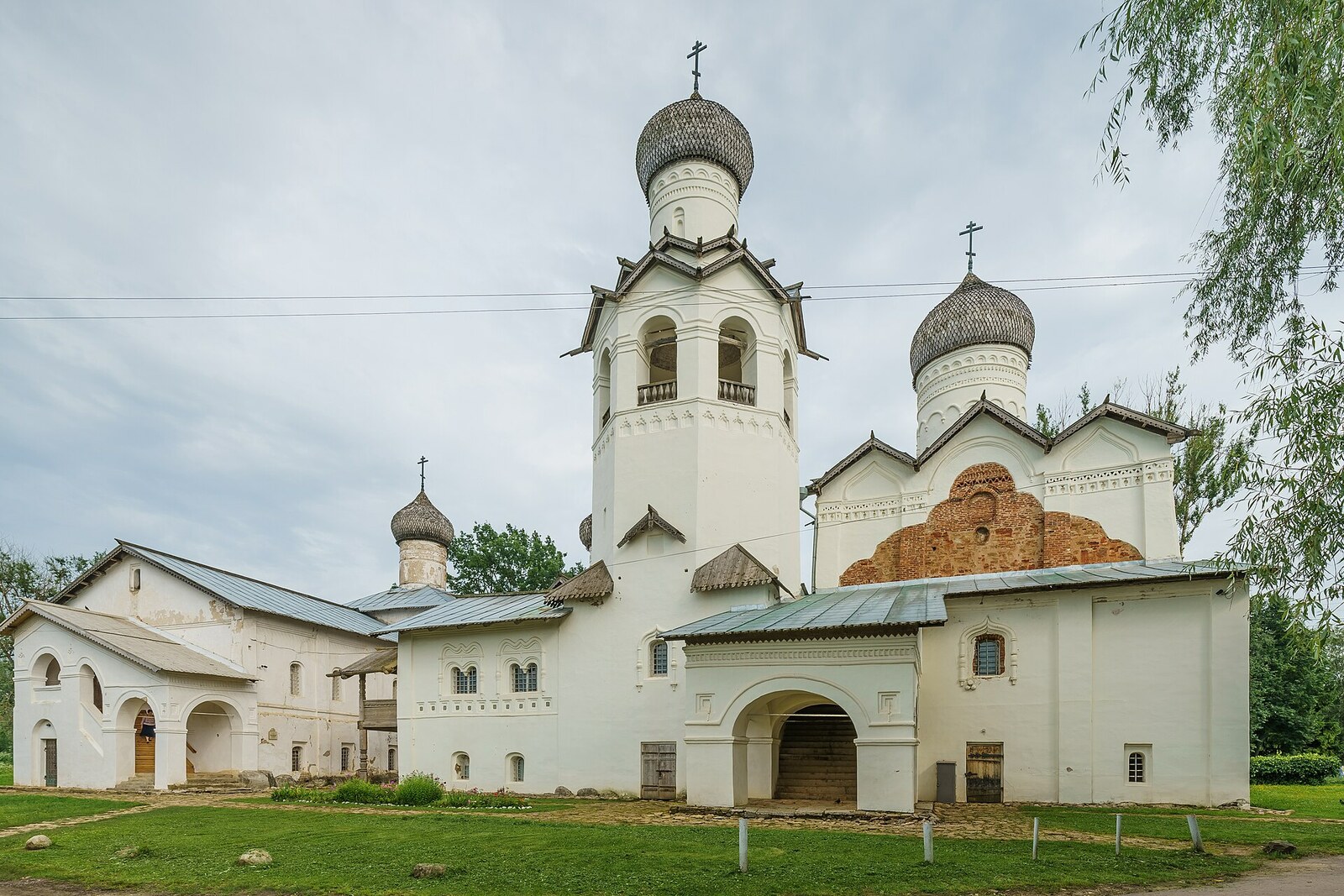
Look around first
What to notice
- Transfiguration Cathedral
- Bell tower
- Windows and portals from different periods
- A section of ancient masonry
The story of the place
The museum galleries occupy the former Transfiguration Monastery: the cathedral, the Church of the Nativity of Christ, and the bell tower were once parts of a single community with cells. The monastery grew from a wooden church, and a stone church later rose in its place; later generations altered and rebuilt it more than once. Window openings, portals, and pieces of brick masonry from different periods can be seen on the cathedral walls. Inside are birch-bark letters, styluses for writing letters, and objects used by Staraya Russa salt makers.
In nineteen sixty-one, the architect-restorer Tamara Gladenko was given four unsafe buildings here. Gaping holes opened in the walls of Transfiguration Cathedral, and through-cracks ran across the masonry. Nothing remained of the Church of the Nativity of Christ but a stone shell. The bell tower and the Church of the Presentation had lost their roofs and upper sections.
Gladenko worked as a staff architect at the Novgorod Scientific Restoration Workshop. She was responsible for the research and the project under which the workers were to reinforce the ensemble and adapt it for museum use. First, however, it was necessary to decide exactly what to restore. A removed layer of masonry could not be put back.
The confusion had begun long before the destruction of the twentieth century. In eleven ninety-two, a local monk named Martiry built a wooden Church of the Transfiguration and several cells on this site. A chronicler called the community he founded a refuge for Christians. When the church burned down, Martiry, by then Archbishop of Novgorod, ordered a stone church to be built. More than two centuries later, the weathered walls were dismantled and rebuilt on the ancient foundation. Alterations of the seventeenth and nineteenth centuries followed. There was no single original appearance to which the complex could return.
Gladenko chose the rebuilding of the sixteen twenties as her basis, but preserved the discovered details from other centuries. On different facades of the cathedral, the workers uncovered windows, portals, and sections of masonry from the fifteenth, seventeenth, and nineteenth centuries. The restorer did not make them conform to one chosen period.
The top of the bell tower proved especially difficult. The investigation revealed an altar niche, niches for liturgical objects, and a narrow shaft through which clock weights once moved. It emerged that in the seventeenth century this had been a church beneath the bells, equipped with a chiming clock. Of its upper finish, the lower row of keel-shaped brick arches and the impressions of the next row in the mortar had survived. Gladenko found the overall height in an archival document. Using these remains and the record, the workers rebuilt the top.
The work continued for twelve years. In nineteen seventy-three, the restoration was completed. By then, the city museum had recently been revived after the near-total loss of its prewar collection; it was crowded into the Church of St Nicholas. In nineteen seventy-four, the exhibitions were moved to the monastic complex prepared by Gladenko.
Today, a section of the original stone masonry is open in the cathedral, and fragments of fifteenth- to seventeenth-century paintings remain on the walls. Nearby are birch-bark letters, styluses for scratching letters, and equipment used by Staraya Russa salt makers. Details from several rebuildings still stand side by side on the facades—the very layers that Tamara Gladenko decided not to reduce to a single century.
Useful on site
On weekdays 10:00–18:00, on Saturday and Sunday 09:00–17:00. Closed Tuesday; the last Thursday of the month is a sanitation day.
Checked: date not specified. Check the official source before visiting.The exterior ensemble can be viewed independently of the exhibitions, but check access inside separately. Distinguish between the age of the buildings and the objects on display: the museum brings together several distant periods.