 Guide On Map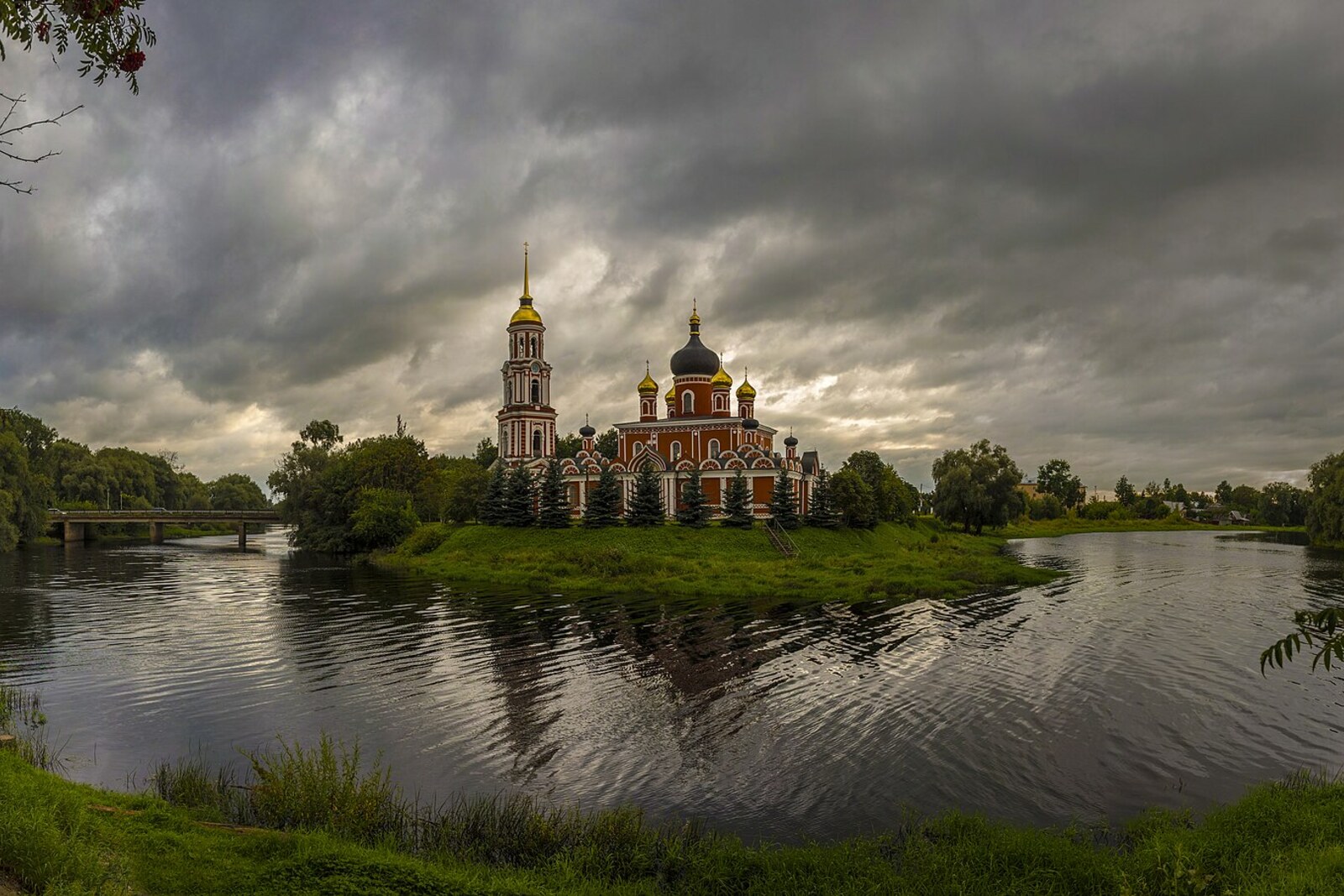
Look around first
What to notice
- The confluence of Pererytitsa and the Polist
- Bell tower
- North chapel
- Broad galleries
The story of the place
The broad Resurrection Cathedral stands on a narrow strip of land between Pererytitsa and the Polist; the bell tower and galleries reveal the building's later expansion. The first stone church was built when the earlier building had become dilapidated and could no longer hold the parishioners; it was later enlarged again, leaving only three walls of the early quadrangular block. After its closure, it served as a museum, a club, a movie theater, and warehouses, and services are now held in the cathedral once more.
This is already Staraya Russa. The final urban stretch of Porusye is called Pererytitsa; beside the cathedral, it flows into the Polist. In the seventeenth century, a stockade occupied this spit of land. Behind its oak walls stood the voivode's house, the treasury, a powder storehouse, granaries, shops, and a small wooden Church of the Intercession of the Mother of God.
In sixteen twelve, Swedish soldiers built their own fortress here—probably around a church that already existed. An inventory from sixteen twenty-five reports that the church had not been devastated. Another city cathedral was lost, and the surviving Church of the Intercession of the Mother of God received its parishioners. Thus, the church on the military promontory became the principal church of Staraya Russa.
By the end of the century, the wooden building had become dilapidated, and the townspeople no longer fit inside. Mikhail Fyodorovich Somrov took on the task of building a new cathedral—a merchant who made his living through trade and the cathedral's churchwarden, that is, a layman elected by the parishioners to manage the church's affairs and money. Somrov worked to secure a spacious stone church for the community. He contributed a substantial sum, collected donations, and involved parishioners in the construction. The money was spent irrevocably: the expense promised the merchant no income.
Work began in sixteen ninety-two. Four years later, the parishioners received a stone cathedral with three altars. The north chapel was dedicated to the Intercession of the Mother of God, preserving the name of the dismantled wooden church. The south chapel was dedicated to Ioann the Forerunner in memory of another lost city church. The main altar was dedicated to the Resurrection of Christ, inheriting the name of the former Resurrection Church. The cathedral's name is therefore connected not with liberation from the Swedes, but with the Gospel event and the memory of a church that has long ceased to exist.
In the nineteenth century, the clergy again asked for the cathedral to be enlarged: the side chapels were deteriorating, and there was not enough room for people on feast days. From eighteen twenty-eight to eighteen thirty-three, the architect Vasily Stasov expanded the building so radically that only the north, south, and west walls of Somrov's original main quadrangular block remained. The windows in them were altered, and the old decoration was hewn away and covered with plaster. The present broad structure with galleries arose for the same reason as the first stone church: the city cathedral had again become too cramped for its community.
After it was closed in nineteen thirty-six, the building housed a museum, a club, a movie theater, and warehouses. In nineteen ninety-two, it was returned to the diocese; services are now held here again, including episcopal services. The stockade and the wooden Church of the Intercession of the Mother of God are gone. The site they occupied is outlined by the two rivers, while the name of the small church survives in the north chapel of the active cathedral.
Useful on site
Accessible outside at all times; entry inside depends on services. On weekdays, the liturgy usually begins at 08:00; on Sundays and holidays, at 09:00.
Checked: date not specified. Check the official source before visiting.The cathedral is active: speak quietly inside, do not disturb the service, and follow the photography rules. It is easier to imagine the historical alterations from outside—the earlier sections are concealed by the later appearance.