 Guide On Map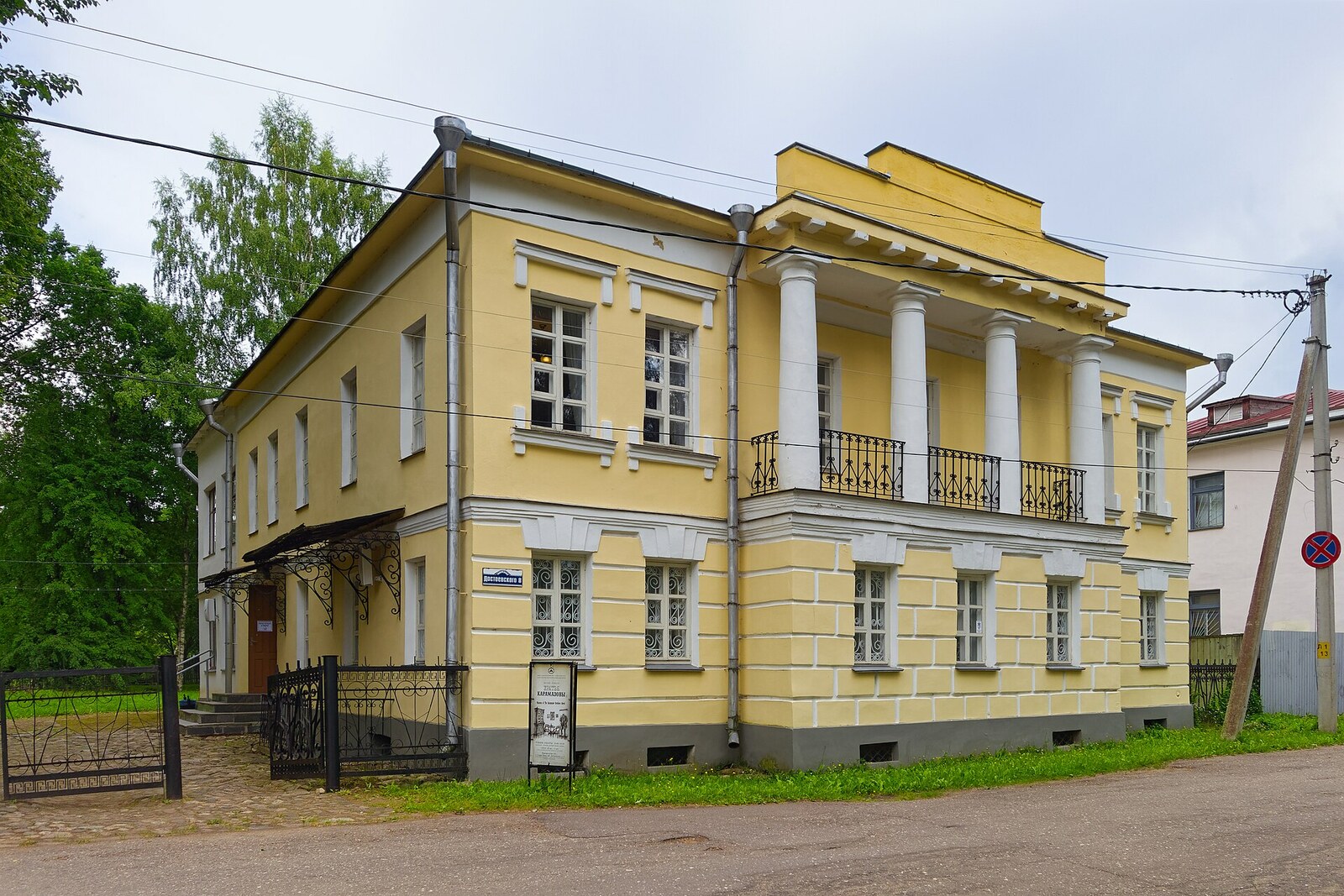
Look around first
What to notice
- A two-story mansion
- Map of Staraya Russa
- Issues of The Russian Messenger
- The novel's first separate edition
The story of the place
For more than thirty years, the museum-reserve staff assembled a dedicated museum of the novel The Brothers Karamazov here. In the rooms of the two-story mansion, they set up a living room, a tavern, a cell, and a schoolboy's room; these are interiors created for the exhibition, not surviving domestic settings. Among the custom-made furniture are the author's calling cards, issues of The Russian Messenger, where the novel was first printed, and the first separate book edition, published during Dostoevsky's lifetime. In the first hall hangs a map of Staraya Russa, created after its handmade predecessor disappeared.
Dostoevsky did not live in this mansion, nor did the Karamazovs: they are fictional characters. The house was built in the first third of the nineteenth century. The name “Beklemishevsky House” became attached to it after its first documented owner, the first-guild merchant Nikolai Beklemishevsky, who owned the mansion in the eighteen eighties. The building has no direct connection with the writer. That connection came about thanks to a man who did not live to see the museum open.
The school history teacher and Staraya Russa local historian Georgy Smirnov wanted to establish how much of the real Staraya Russa Dostoevsky transferred into the city of Skotoprigonyevsk—the setting of The Brothers Karamazov. The brothers in the title are Dmitri, Ivan, and Aleksei, the sons of the landowner Fyodor Pavlovich Karamazov. Each has his own score to settle with his father; after Fyodor Pavlovich's murder, Dmitri is put on trial, though the crime was committed by Smerdyakov, Fyodor Pavlovich's servant and unacknowledged son. Smirnov was interested in where Dostoevsky placed this family and its story on the real city plan.
For several years, the local historian walked around Staraya Russa with the text of the novel, checked distances, and searched for old plans and archival documents. He marked the presumed location of Fyodor Pavlovich's house, the fence that Dmitri climbed over on the fateful night, Smerdyakov's bench, the tavern, and the characters' routes. It was a research reconstruction: Smirnov did not prove that the Karamazovs existed—he showed how the writer assembled a fictional city from familiar streets, houses, and turns.
In nineteen sixty-nine, Smirnov and the artist Vasily Fyodorov placed a handmade map of this literary city in the first Staraya Russa exhibition about Dostoevsky. There was not yet a permanent director's position; according to contemporaries' recollections, Smirnov spent his own pension on the museum, traveled to collect the writer's belongings, and gathered materials. In nineteen eighty-one, the Fyodor Dostoevsky House Museum opened. Smirnov wanted to continue the work and create a separate complex devoted to The Brothers Karamazov, but he died two years later.
In nineteen eighty-five, the museum-reserve acquired Beklemishevsky House, which stands not far from the Dostoevskys' dacha. The staff returned to Smirnov's idea and prepared a separate exhibition for more than thirty years. The Museum of the Novel opened in July two thousand eighteen.
The rooms inside are an artistic staging, not preserved dwellings of the characters. They include Fyodor Pavlovich's living room, Katerina Ivanovna's living room, a schoolboy's room, a tavern, and the cell of Elder Zosima. Among the furniture and specially made details are authentic objects from the period: Dostoevsky's calling cards, issues of The Russian Messenger containing the novel's first publication, and its first separate edition published during his lifetime.
Smirnov's map has not survived. The first hall contains a new one: the museum staff abandoned the large model and recreated the very idea of the lost map—Staraya Russa is once again marked out on it with the houses and roads of Skotoprigonyevsk.
Useful on site
Daily, except Tuesday, 10:00–18:00. The last Wednesday of the month is a cleaning day. Group tours are announced for Saturdays at 13:00 and Sundays at 15:00.
Checked: date not specified. Check the official source before visiting.Do not treat the rooms as authentic dwellings of the characters: they are a museum interpretation of the text. Plan your visit to the exhibition separately from the writer's house.