 Guide On Map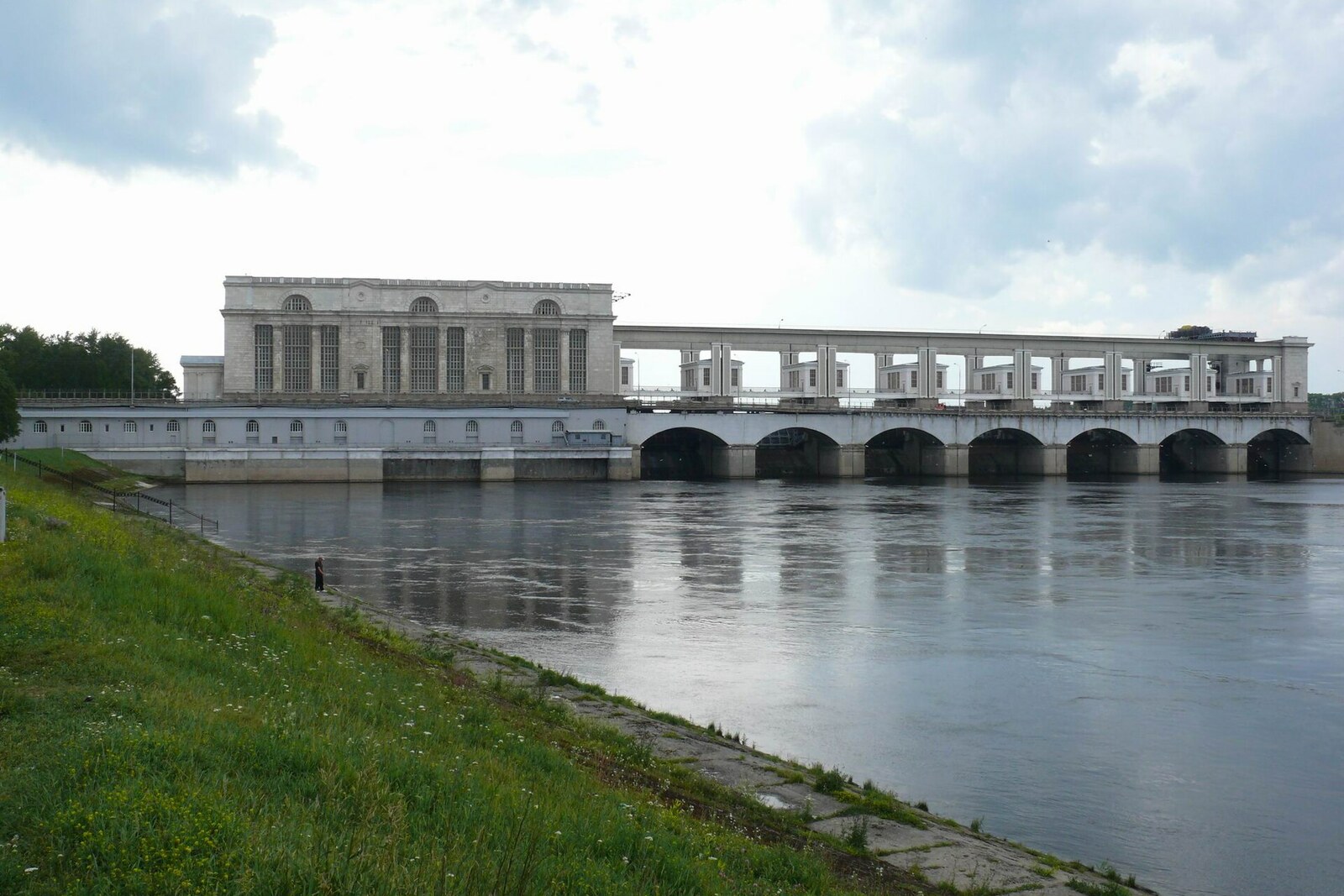
Look around first
What to notice
- Four-bladed turbine runner
- Former station administration building
- Dam
- Volga below the station
The story of the place
In the courtyard of the Museum of Hydropower Engineering stands a four-bladed turbine runner. Nine meters in diameter, one hundred twenty tons. For seventy years, almost no one saw it: the runner turned beneath the machine hall of the Uglich Hydroelectric Power Station, taking the pressure of the water and, through a common shaft, turning an electric generator.
It appeared because of a dispute over where to dam the Upper Volga at all. In the mid-nineteen thirties, hydroelectric power stations were planned for Kalyazin, Myshkin, and the village of Norskoe near Yaroslavl. Preparatory work was already under way near Yaroslavl when calculations showed that the flooding would be extensive while the energy output would be comparatively low.
The hydraulic engineer Georgy Chernilov led the design calculations and pressed to replace this scheme with two more productive hydropower complexes—Uglich and Rybinsk. His group proved that the expected output would more than double. The earlier project was closed, and the new dam was decided to be built upstream of Uglich. There was no natural waterfall here: the engineers created the drop themselves by raising the Volga with a dam. Now water from the reservoir passes through the turbines and returns to the riverbed below the station.
However, Chernilov's calculations required machines that the country did not yet know how to make. He went to the Leningrad Metal Plant to negotiate over turbines of unprecedented size. The designer Nikolay Kovalyov was given the task of turning a comparatively low head, about thirteen meters, into the power of a large electric power station. He designed a vertical Kaplan turbine: the angle of its four huge blades could be adjusted to the water flow so that the runner would not lose efficiency as the level of the Volga changed.
The plant made the first such turbine in nineteen thirty-nine. Its nine-meter-diameter runner became the largest in the world. On December eighth, nineteen forty, the first Uglich generating unit produced electricity, and the second was launched on March twentieth of the following year. The station received a capacity of one hundred ten megawatts and became the second hydroelectric power station in the country after the Dnieper Hydroelectric Power Station. In nineteen forty-six, Kovalyov and his colleagues received the State Prize for creating these turbines.
The runner in the courtyard worked in the second generating unit until nineteen eleven. After the machine was replaced, it was not sent for melting down but put on display beside the museum, housed in the former station administration building. In February one thousand twenty-five, power engineers replaced the first old generating unit as well. Now two modern turbines with a combined capacity of one hundred thirty megawatts turn inside the hydroelectric power station, while outside remains the runner of the machine for which Chernilov had to persuade the plant to take on technology that did not yet exist.
Useful on site
Tuesday—Sunday from 09:00 to 18:00; Monday is a day off. Individual sessions are listed for 11:00, 14:00, and 16:00.
Checked: June 24, 2026. Check the official source before visiting.Visiting the museum requires separate approval and registration. The station remains a restricted facility: stay on permitted routes and do not go beyond the barriers.