 Guide On Map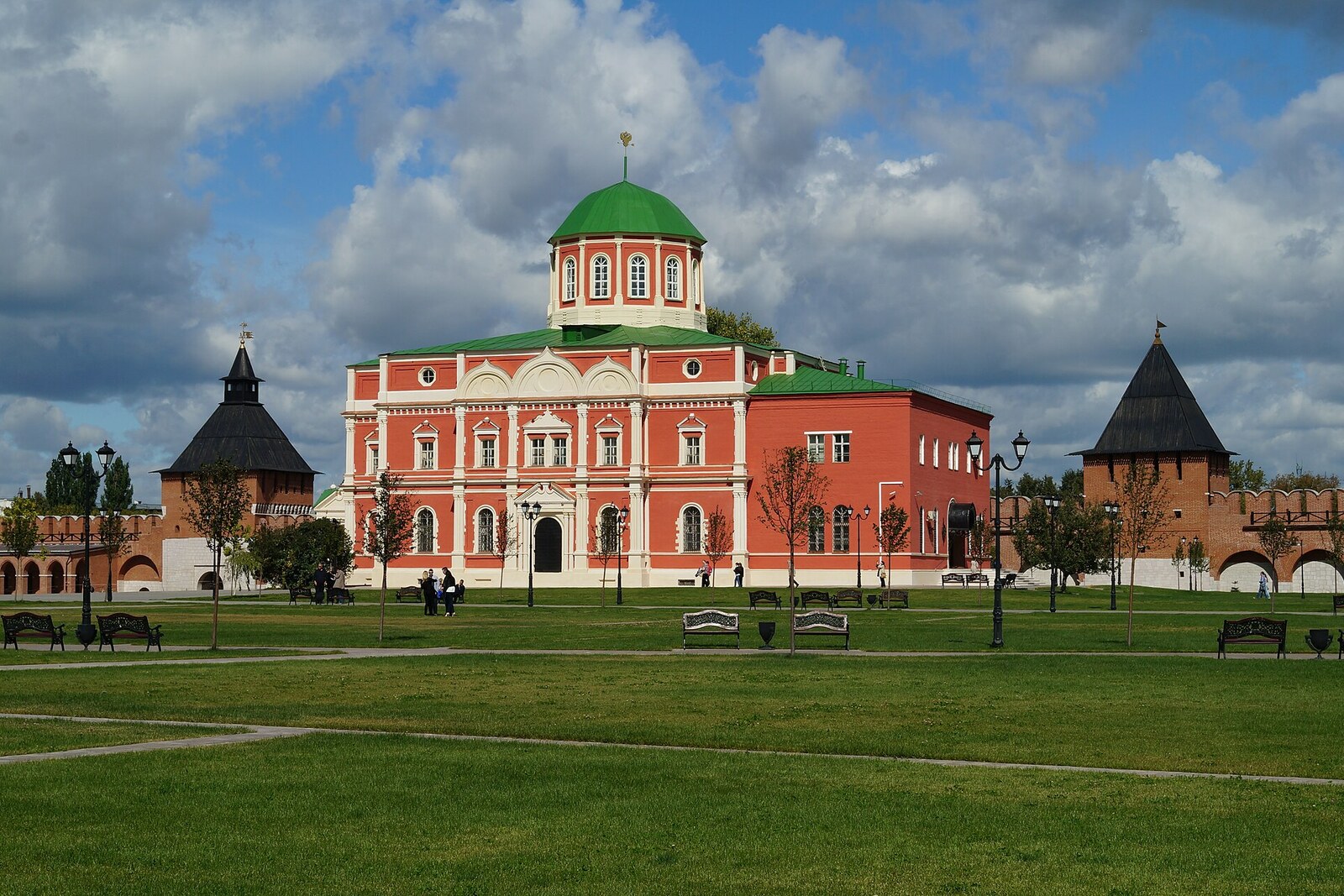
Look around first
What to notice
- The only surviving dome
- Low green cap
- Staircases at the museum entrance
- Floor slab between stories
The story of the place
The Exhibition Centre of the Tula State Museum of Weapons now operates in the former cathedral. One dome with a low green cap survives above the brick walls, although there were originally five; the bases of the others are still visible in the attic. The museum entrance was cut through the former altar wall, and the added staircases lead into a volume that was once a lofty church space.
In eighteen forty-nine, the Tula merchant Vukol Kuzovlev returned to a plan on which the city had already once lost both time and the money it had raised. Kuzovlev was a churchwarden—a layman who managed the affairs and donations of Assumption Cathedral. He proposed building a large heated structure in the Kremlin for winter services. It is the building that stands here now.
The first attempt had been made as early as eighteen seventeen. After Emperor Alexander the First visited, representatives of the city’s estates decided to build a warm cathedral in honor of Aleksandr Nevsky, the emperor’s heavenly patron. Tula residents also linked this church with the memory of fellow townspeople who had died in the war with Napoleon. They began collecting money by subscription.
The emperor did not like the project sent from Tula. Its revision was entrusted to the St. Petersburg architect Vasily Stasov. While the drawings went back and forth between Tula and the capital, the governor and the leadership of the Tula Diocese changed. In eighteen twenty-one, it emerged that there was not the slightest amount of the donated sum in the cathedral. There was no money for construction, and the new leaders did not investigate the vanished collection.
Twenty-eight years later, Kuzovlev proposed starting again. The existing Assumption Cathedral was closed in winter because it was unheated. The small warm church in the lower tier of the bell tower could not accommodate the clergy and parishioners, so ceremonial services had to be moved among different city churches.
This time, the collection was entrusted to one person. Kuzovlev was authorized to accept money, bricks, timber, and any other donations, spend them at his own discretion, and submit no accounts. For the merchant, such freedom also meant a personal stake: he answered with his own name for every amount that went missing. One hundred ten representatives of the city signed the decision to build a new cathedral and preserve the old Assumption Cathedral without alteration.
The name changed as well. Kuzovlev proposed dedicating the main altar to the Epiphany—the name Christian tradition gives to Jesus’ baptism in the Jordan and the manifestation of the Trinity. The documents do not say why he chose this particular feast. The original plan was retained in one of the side altars, dedicated to Aleksandr Nevsky.
The project was drawn up by Mikhail Mikhaylov, architect of the Tula Arms Plant. Construction began in eighteen fifty-five, at the same time as the consecration of the flags of the Tula Militia, which was setting off for the Crimean War. Three years later, the walls and roof were ready, and then the money ran out again. Kuzovlev continued the collection. The main sum came from twenty-five of the wealthiest merchant families, while less wealthy townspeople made smaller donations. In eighteen sixty-two, the cathedral was consecrated. Kuzovlev received the Order of Saint Anna, and Tula residents received a spacious winter church with five domes and stoves in the basement.
After the cathedral was closed in the nineteen thirties, it housed an aviation club, then a club for physical culture enthusiasts. In nineteen sixty-seven, members of the regional party committee decided to transfer the building to the Tula State Museum of Weapons. Builders cut an entrance through the former altar wall, added staircases, and poured a reinforced-concrete floor inside, dividing the lofty church space into stories. The permanent exhibition opened in nineteen eighty-nine.
The main weapons collection was later moved to the helmet-shaped building. The Exhibition Centre of the Tula State Museum of Weapons now operates here: the former cathedral displays weapons and equipment of the defenders of the southern frontiers and hosts temporary exhibitions. Of the five domes erected under Kuzovlev, only one remains outside, with a low green cap. The brick bases of the other four survive only in the attic.
Useful on site
Mon–Fri 10:00–18:00; Sat 10:00–20:00; Sun 10:00–18:00; the ticket office usually closes one hour before closing time.
Checked: June 25, 2026. Check the official source before visiting.The building’s history is clear even without going inside. Treat the exhibition as a separate addition: the main weapons collection is not here, but in the helmet-shaped building.