 Guide On Map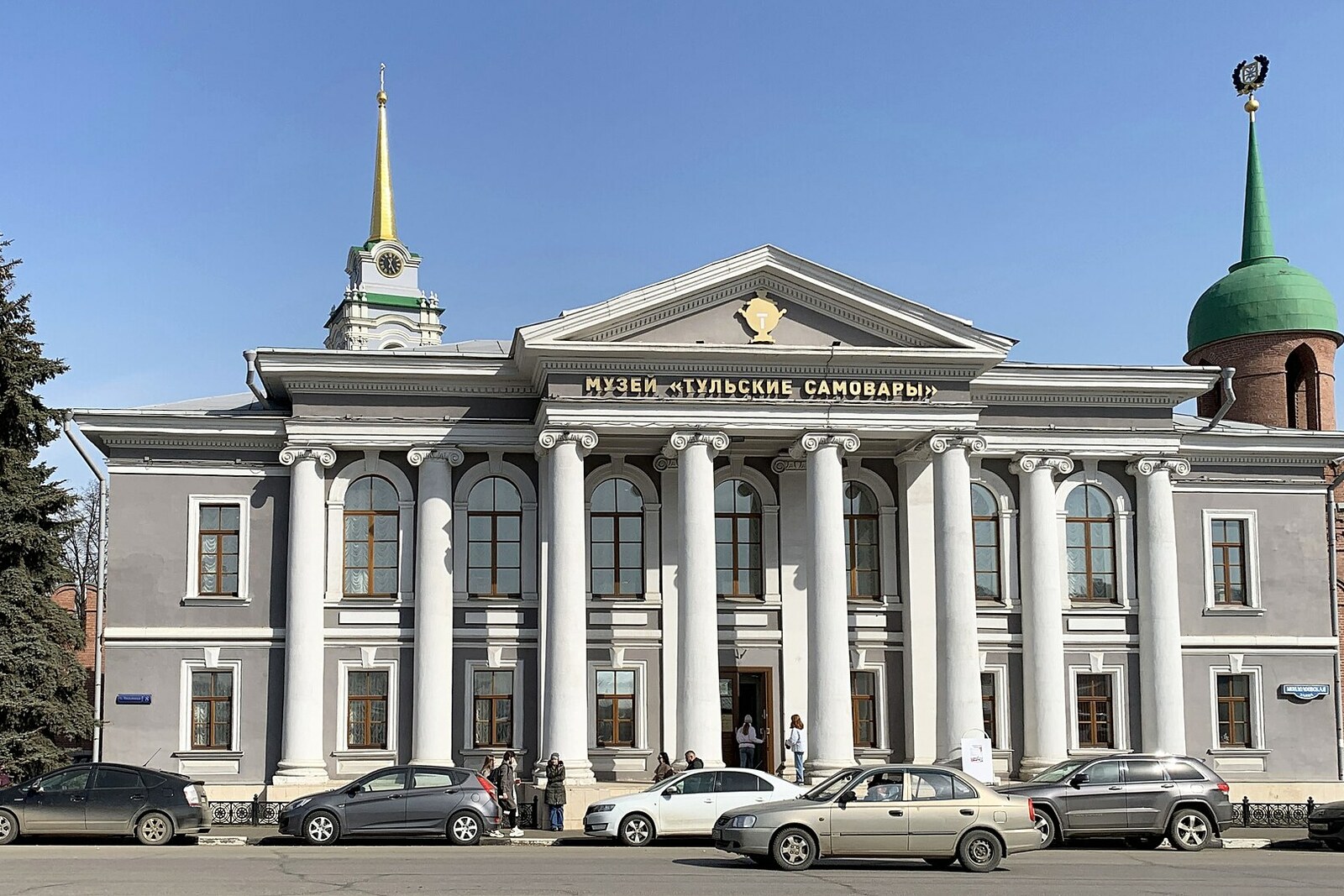
Look around first
What to notice
- White colonnaded portico
- Skyphos Samovar Vase
- Charcoal-heated and electric samovars
The story of the place
The museum with white columns has a specific creator. Tula local historian Alevtina Sergeyevna Tikhonova worked to ensure that the history of the samovar would have a museum of its own. She had worked at the local history museum since nineteen fifty-four: collecting old objects was her profession, not a private hobby.
In nineteen seventy-eight, museum staff mounted an exhibition for the two-hundredth anniversary of the first Tula samovar factory. Visitors kept asking why a city whose name had become part of the expression “to Tula with one's own samovar” had no separate samovar museum. Preparations began the following year.
The future museum was to open in the Church of the Annunciation. When Tikhonova and her colleagues examined the collections, they discovered that beautiful water-heating vessels were not enough. Without tools, factory documents, and the names of craftsmen, the result was a collection of objects with no explanation of how an entire city earned money from them. The staff placed notices in newspapers and on the radio and traveled to villages where the samovar-making trade had existed before the Revolution. The collection received craftsmen's tools and medals from the Batashev Factory. Tikhonova studied archival documents and factory price lists: at that time, there was almost no systematic history of Tula samovar production.
The work continued for about ten years, while the building prepared for the museum still did not open. The church's restoration dragged on, and in nineteen eighty-eight it was transferred to the Tula Diocese. The museum workers had assembled objects, a finished history, and no longer had premises.
Tikhonova then mounted the exhibition To Tula with One's Own Samovar here together with the artist Sergey Kalinin. At the time, the building was called the House of Defence; it served as a branch of the local history museum. The exhibition proved more convincing than the original plan: city leaders decided to keep the collection in these halls and open a permanent museum here. On the seventh of November, nineteen ninety, the Tula Samovar Museum began operating, and Tikhonova became its first head.
There was never a samovar factory at this site. This address became the museum's home because the earlier plan had fallen through, while Tikhonova had already managed to turn the assembled objects into a coherent story in these very rooms. The permanent exhibition now contains more than two hundred models, from early charcoal-heated vessels to electric ones.
Among them stands a Skyphos Samovar Vase from the Lisitsyn Brothers' Factory. A skyphos was an ancient Greek cup whose shape this copper vessel repeats. It is one of four known surviving samovars from that factory. Tikhonova found it for the collection before the museum had a home of its own.
Useful on site
Mon–Thu and Sun 10:00–18:00; Fri–Sat 10:00–20:00; the ticket office closes 45 minutes before closing; the last Wednesday of the month is a sanitation day.
Checked: June 25, 2026. Check the official source before visiting.You can view the facade without entering, but the workings of a samovar and the difference in scale can only be seen in the exhibition. Plan your visit inside as a separate museum stop.