 Guide On Map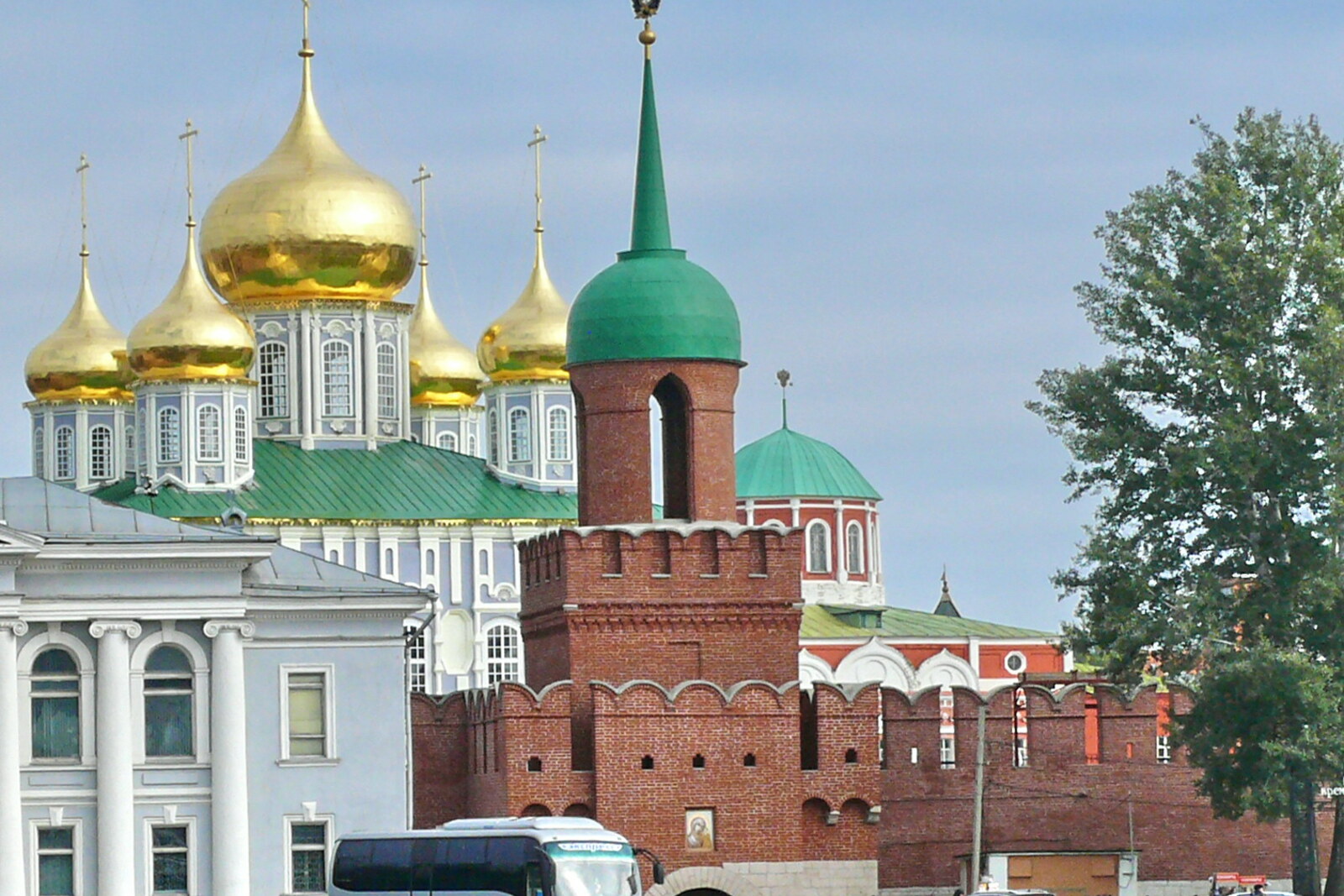
Look around first
What to notice
- Grooves for the lowering portcullis
- Ornate dome
- Tall spire
- Coat of arms of Tula
The story of the place
Odoev Gate was named after the road that began at the Kremlin’s southern wall and led to Odoev. Its direction is preserved by present-day Lenin Avenue. In the sixteenth century, guards closed the passage with heavy oak leaves and lowered an iron portcullis; the grooves for it remain in the tower walls.
Two and a half centuries later, there was no longer any need to defend this passage. The Kremlin was falling into disrepair, and no money was allocated for its upkeep. Mikhail Krechetnikov, the first head of the newly established Tula Viceroyalty—a provincial administration of that time—was responsible for arranging the new regional center and monitoring expenditure. He did not want to pay for repairs to the old fortress and decided to demolish it.
The decision reached Empress Catherine the Second. She ordered the Kremlin preserved and, for the first time, allocated state funds for its major repair. Krechetnikov’s plan was canceled, although the viceroy himself was not removed from office: he governed the province until seventeen ninety-one.
The work was completed by seventeen eighty-four. The craftsmen did not restore its sixteenth-century appearance, but remodeled the fortress to suit the taste of their own time. Above Odoev Gate, they built a brick drum with pointed arches, a dome, and a spire. They placed a double-headed eagle on the spire—a sign of gratitude to Catherine for the funds, after which repairs began instead of dismantling.
In June eighteen thirty-four, a major city fire destroyed or damaged almost all the domes from Catherine’s remodeling. Only the dome of Odoev Tower remained intact. That is why its tall ornate top differs from the finishes of the other Kremlin towers.
The double-headed eagle remained until nineteen eighteen. Then, in succession, the spire bore a hammer and sickle, a gilded flag, and, at the end of the sixties, the coat of arms of Tula. It still crowns the tower today. Beneath it remains the passage from which the road to Odoev once began.
Useful on site
Museum schedule: Mon–Thu and Sun 10:00–18:00; Fri–Sat 10:00–20:00; the ticket office closes 45 minutes earlier; the last Tuesday of the month is a sanitation day.
Checked: June 25, 2026. Check the official source before visiting.This stop can be fully read from outside. Do not look for a surviving entrance to a secret passage to the river: the wooden structures were destroyed long ago, and today what matters is the very logic of such a water route.