 Guide On Map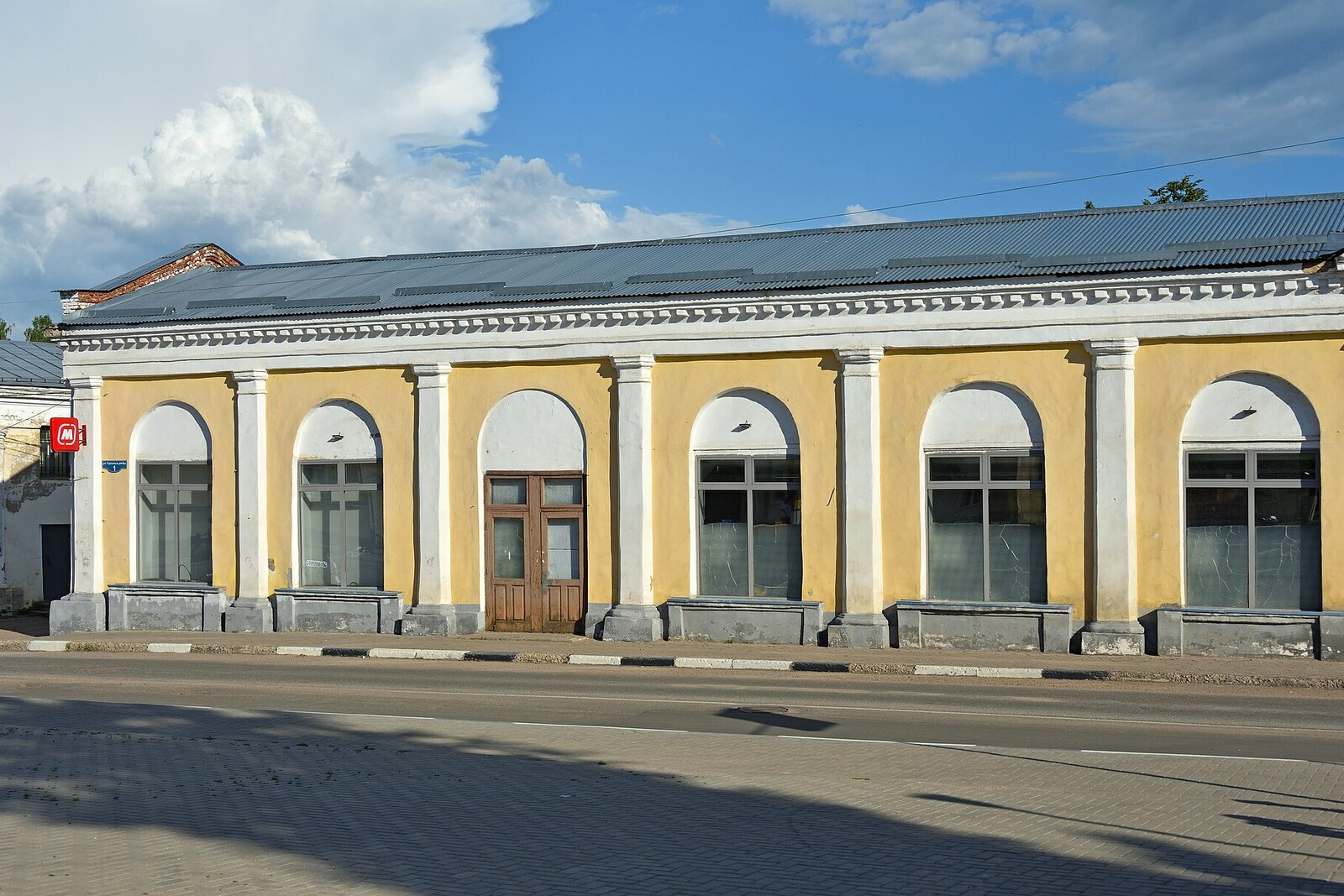
Look around first
What to notice
- Long stone building
- Basement arches
- Open space of the square
- Public garden
The story of the place
Goods were received here from the Zdorovets side: when the stream carried more water, vessels came up to the arched basements, and cargo was carried straight into the storerooms. Trade went on above them, and the long stone building functioned as part of a large market. In the nineteenth century, it replaced an earlier Gostiny Dvor. After wartime destruction, part of the complex disappeared, giving way to a public garden, while museum finds from Torzhok took the place of goods in the surviving building.
After the fire of seventeen sixty-six, Torzhok merchants were left without stalls, storehouses, and goods. Many also lost their homes. They made their living from grain, flax, hemp, tallow, and hides: buying them in Moscow and neighboring governorates, selling them in Torzhok, and sending them farther on to the port of Saint Petersburg. While the trading center lay in ashes, they had nowhere to store their purchases or receive visiting sellers.
Before the fire, there was no square here. A paved street about four meters wide ran through what is now the open space. It led to the crossing over the Tvertsa, and trading stalls had been built along it since the fifteenth century. Archaeologists established this: beneath the modern square, they found the street's paving, remains of houses, coins, and trade seals.
After the fire, the city began to be built up according to the plan approved in seventeen sixty-seven. The Novgorod city administration allocated fifty thousand rubles to Torzhok on the condition that they be repaid within four years. Architects cleared the site of the burned houses for a regular square, and the merchants created a new Gostiny Dvor—a complex of shops and warehouses.
The rows were built along the Zdorovets to unload goods. At that time, the stream carried more water. Vessels came up to the basement arches, loaders carried purchases straight into the storerooms, and traders went up to the shops. By seventeen eighty-three, the Gostiny Dvor contained one hundred eleven stone shops. Contemporaries estimated all Torzhok trade at about half a million rubles and called the Gostiny Dvor the city's finest building. Behind that praise lay a very practical result: the merchants had regained their warehouses, counters, and income.
In the middle of the nineteenth century, the old Gostiny Dvor began to be replaced by new stone buildings. The building of the present-day Museum Rows was erected from eighteen sixty-four to eighteen sixty-five. After the bombings of nineteen forty-one, the entire complex was not rebuilt: some damaged buildings were demolished, and a public garden occupied the cleared space. A movie theater operated in the surviving building, which was then transferred to the All-Russian Historical and Ethnographic Museum. The Trading Rows became Museum Rows, and coins, birch-bark documents, and artisans' objects found in Torzhok took the place of the former goods.
The present official name of the space is Ninth of January Square. It recalls January ninth, nineteen oh five, when troops in Saint Petersburg fired on a procession of workers carrying a petition to the Winter Palace. Earlier, the square was called Red Square, Market Square, and Hay Square.
Museum Rows are now closed for restoration. Beneath the long building, the white-stone foundation of the former rows remains, while the broad basement arches face the Zdorovets—where loaders received goods from vessels.
Useful on site
Museum Rows have been closed for restoration and adaptation since 15 April 2024; work was continuing in early April 2026.
Checked: June 24, 2026. Check the official source before visiting.If the buildings are closed for restoration, do not go beyond the barriers: the history can be read in the square's external structure. Plan to visit the exhibition inside only after checking access.