 Guide On Map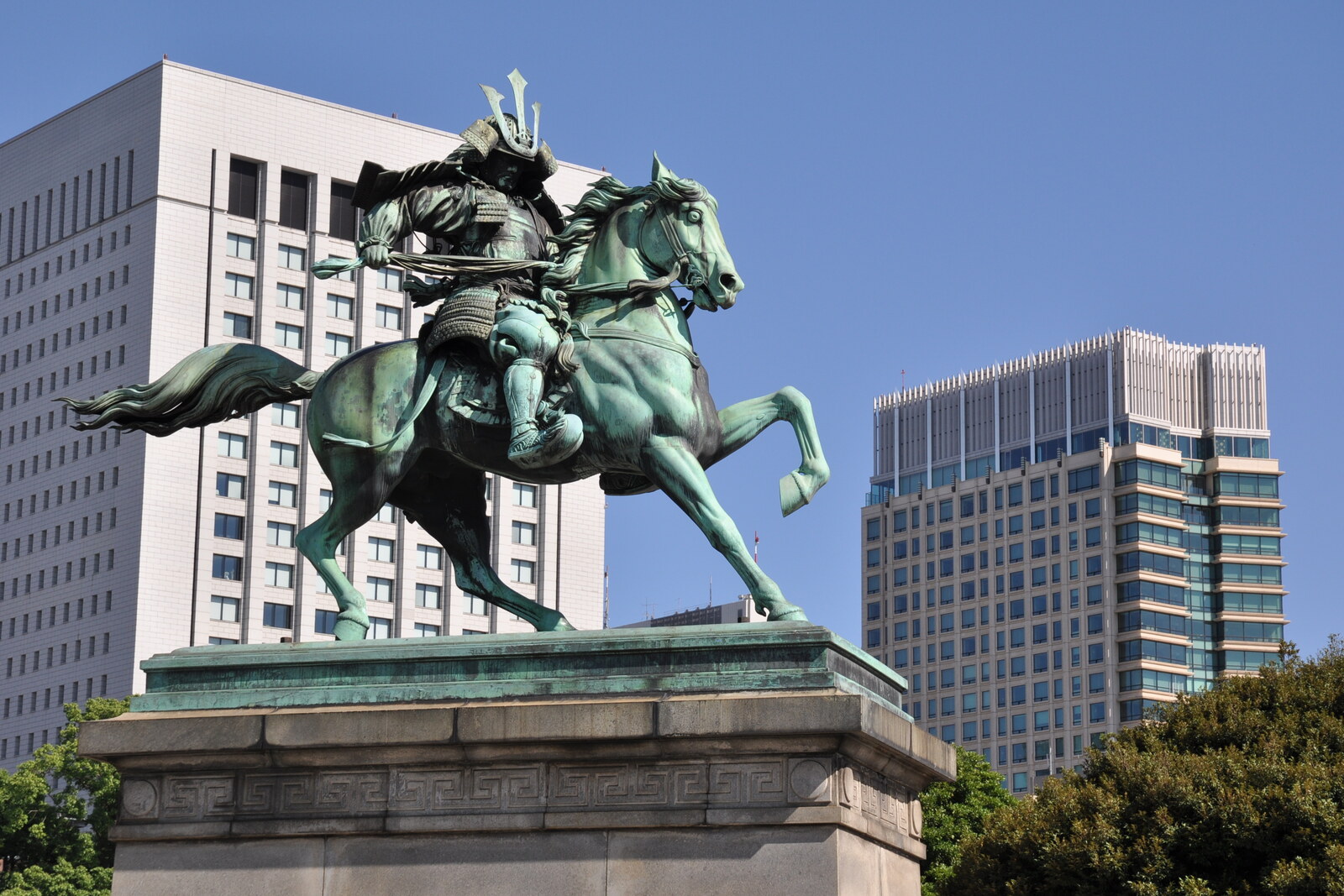
Look around first
What to notice
- Bronze rider
- Granite pedestal
- Seam by the horse's right front leg
- Black pines
The story of the place
Kokyo Gaien National Garden stretches beside Nijubashi, on land where princes' estates once stood near the palace. They were demolished to make room for a broad square with black pines; after the war, it became a national garden open to everyone. Among the pines, a bronze rider stands on a granite pedestal: the statue was presented to the imperial court by the owners of the Besshi copper mine, and its horse was the first in Japan to be assembled from seven separately cast parts. A seam remains by the right front leg, making this construction visible.
The horse beneath Kusunoki Masashige is held back by a taut rein. The warrior is not attacking: the sculptors depicted the meeting of thirteen thirty-three. On the road to Hyogo, Kusunoki greets Emperor Go-Daigo as he returns from exile. The happiest moment of Kusunoki's service faces Nijubashi here.
Go-Daigo sought to overthrow the Kamakura shogunate, the military government that had removed the imperial court from governing the country. The first attempt ended in defeat and the emperor's exile to the Oki Islands. Kusunoki was a landowner from Kawachi Province: he had castles, his own detachment, and people connected to his household. Answering Go-Daigo's call, he put all of these resources, along with his life, at stake in the outcome of the uprising.
In the mountain castles of Akasaka Castle and Chihaya Castle, Kusunoki's small detachment held up the shogunate's far more numerous forces. While troops were being assembled against him, other commanders were joining the emperor's side. The shogunate collapsed, Go-Daigo returned from exile, and Kusunoki met him in Hyogo and accompanied him to the capital. This is the resolution shown by the statue.
Three years later, the alliance fell apart. The commander Ashikaga Takauji rose against Go-Daigo, intending to establish his own military government. He approached Hyogo with superior forces. Kusunoki believed a direct battle was doomed to fail and asked the emperor to change the plan, but received an order to go into battle. At Minatogawa, his detachment was defeated; Kusunoki and his brother killed themselves to avoid capture. Takauji occupied Kyoto and founded a new shogunate, while Go-Daigo fled south to Yoshino. Later generations remembered Kusunoki as a warrior who warned of defeat yet still carried out the order.
Late in eighteen eighty-nine, Hirose Saihei, the manager of Sumitomo's enterprises, and Sumitomo Tomotada, head of the Sumitomo family, decided to mark the two-hundredth anniversary of the Besshi copper mine. They planned to cast Kusunoki from metal mined there and present the statue to the imperial court. The gift was intended for the palace, so a site outside Nijubashi was set aside for it. Tomotada died before the work was completed; his successor, Sumitomo Tomoito, carried the plan through to its presentation to the court.
The commission went to the recently opened Tokyo Fine Arts School. The sculptor Takamura Kōun faced a simple difficulty: no one knew Kusunoki's real face. More than twenty images of him survived, and their features did not match. Kōun refused to pass any one of them off as an authentic portrait and created the commander's face as he imagined it—thin, focused, with an expression of calculation. That is why the rider on the pedestal shows how people in the Meiji era wanted to remember Kusunoki, rather than how he indisputably looked.
Casting the horse proved even more difficult. Japanese craftsmen did not know how to make such an enormous, complex figure in a single casting. Okazaki Sessei, who directed the work, went at his own expense to the World's Columbian Exposition in Chicago to study Western bronze monuments. At first, they seemed to be cast in one piece. One day, oblique light revealed thin seams: the craftsmen cast separate parts and joined them afterward. Okazaki returned to Japan and divided the horse into seven parts—the body, neck, four legs, and tail. This was how the country's first monumental statue assembled by sectional casting came into being.
The work took about ten years. In July nineteen hundred, the horse and rider were installed on a granite pedestal. By then, on the orders of Itō Hirobumi, the former estates of princes in front of the palace had already been demolished, and the cleared land had been turned into a large square with black pines. After the war, the territory passed to the state, and in April nineteen forty-nine it was opened to everyone as Kokyo Gaien National Garden.
The statue remained in its original place. A casting seam is still visible by the horse's right front leg, and the inscription on the pedestal preserves the name of the late Tomotada, who began this ten-year commission and never saw Kusunoki in front of the palace.
Useful on site
The square and park are open around the clock; admission is free. Access may be restricted during state events.
Checked: June 27, 2026. Check the official source before visiting.The square is open and distances here are deceptive; pause by the monument, but save your strength for the walk along the moats and through the garden.