 Guide On Map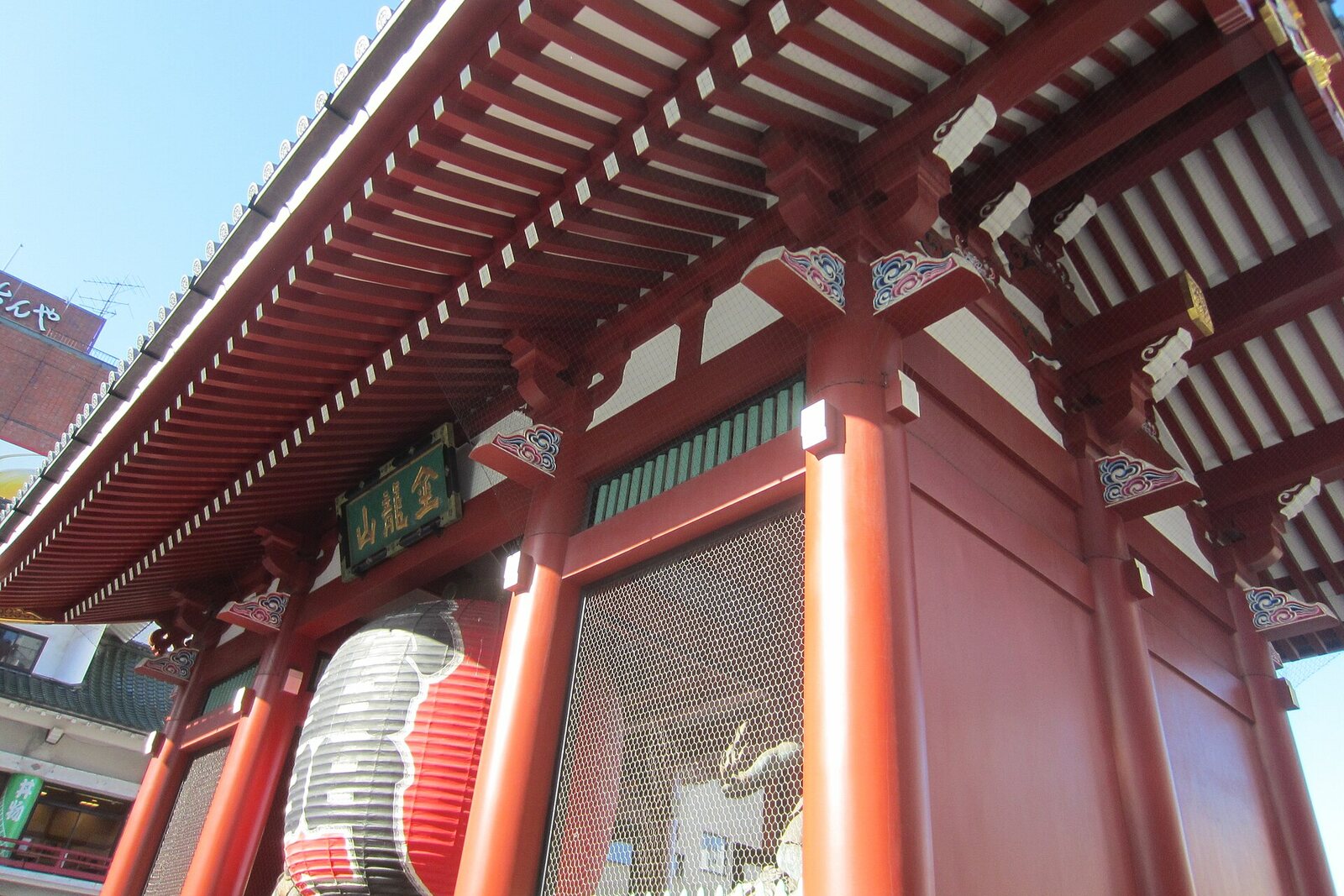
Look around first
What to notice
- Red paper lantern
- Two figures in the side niches
- Metal rim of the lantern
- Inscription on the reverse of the lantern
The story of the place
At Kaminarimon Gate, this story begins in the mid-nineteen fifties. Konosuke Matsushita, the founder and president of Matsushita Electric, a major manufacturer of electrical goods, had almost stopped walking. Japan was experiencing a boom in household appliances, the company was growing quickly, and its leader was working himself to exhaustion. He developed neuralgia of unknown origin; then his legs and lower back failed. Matsushita consulted different doctors and tried Western and Eastern treatments, but he did not get better.
An acquaintance advised him to ask for a prayer at Sensoji Temple. Kyojun Shimizudani, the temple’s abbot, performed a ritual before the main sanctuary, and Matsushita soon recovered. This is how the temple and the entrepreneur’s biographers recount the sequence of events; they offer no medical explanation. In gratitude, Matsushita gave Sensoji Temple a television set.
A few years later, the abbot came to see him again. In December nineteen fifty-eight, he appeared at the company’s Tokyo branch and began talking about the gate at the start of the temple approach. The previous gate had burned down back in eighteen sixty-five: the fire began in the neighboring Tawaramachi district and spread here. For ninety-five years, there had been no permanent building on this site. Temporary arches were sometimes put up for festivals and commemorative dates, but funding for a true reconstruction could not be found.
The abbot warned him at once that construction would require an enormous sum. Matsushita thought for about ten seconds and agreed to pay for it personally. He had one condition: the donation was not to be turned into advertising, and his name was to be mentioned as little as possible. Delighted by the quick decision, the abbot soon revealed the donor himself.
In May nineteen sixty, the present reinforced-concrete gate opened here, repeating the appearance of its Edo-period predecessors. The red lantern appeared with it, but the name Kaminarimon Gate—“Thunder Gate”—does not refer to the lantern. Officially, it is Furaijinmon Gate, the “Gate of the Gods of Wind and Thunder.” In the side niches stand Fujin, the lord of wind, and Raijin, the lord of thunder. They were placed at the main entrance to Sensoji Temple as protectors of the temple buildings against storms and floods; people also appealed to them for timely rains and a harvest. The shortened name Kaminarimon Gate entered everyday speech no later than the beginning of the nineteenth century.
These figures have their own connection to the fire. In eighteen sixty-five, only the heads of both statues could be saved. Nine years later, craftsmen carved new bodies for them, and when the gate was built with Matsushita’s funds, the figures were restored and repainted. That is why the heads of Fujin and Raijin are older than the building in which they stand.
The paper lantern, by contrast, has to be replaced regularly. The current one was made in two thousand twenty; it is already the sixth lantern since the reconstruction. It is nearly four meters high and weighs about seven hundred kilograms. During the Sanja Festival, it is folded upward to clear the passage for people carrying portable shrines. The abbreviated name Kaminarimon Gate is written on the side facing the street, and the full Furaijinmon Gate is on the reverse. And on the metal rim at the bottom remains the name “Matsushita Electric”—the signature of the man who asked for his name to be shown as little as possible.
Useful on site
The gate and its approach are accessible as an open outdoor space; there is nothing to visit inside, and the site can be understood from outside and while passing through. Checked against official Sensoji Temple pages on 2026-06-29.
Checked: June 29, 2026. Check the official source before visiting.First look at the gate from the city side, then walk beneath it and turn around. Do not linger in the middle of the passage: dense streams of people constantly cross here.