 Guide On Map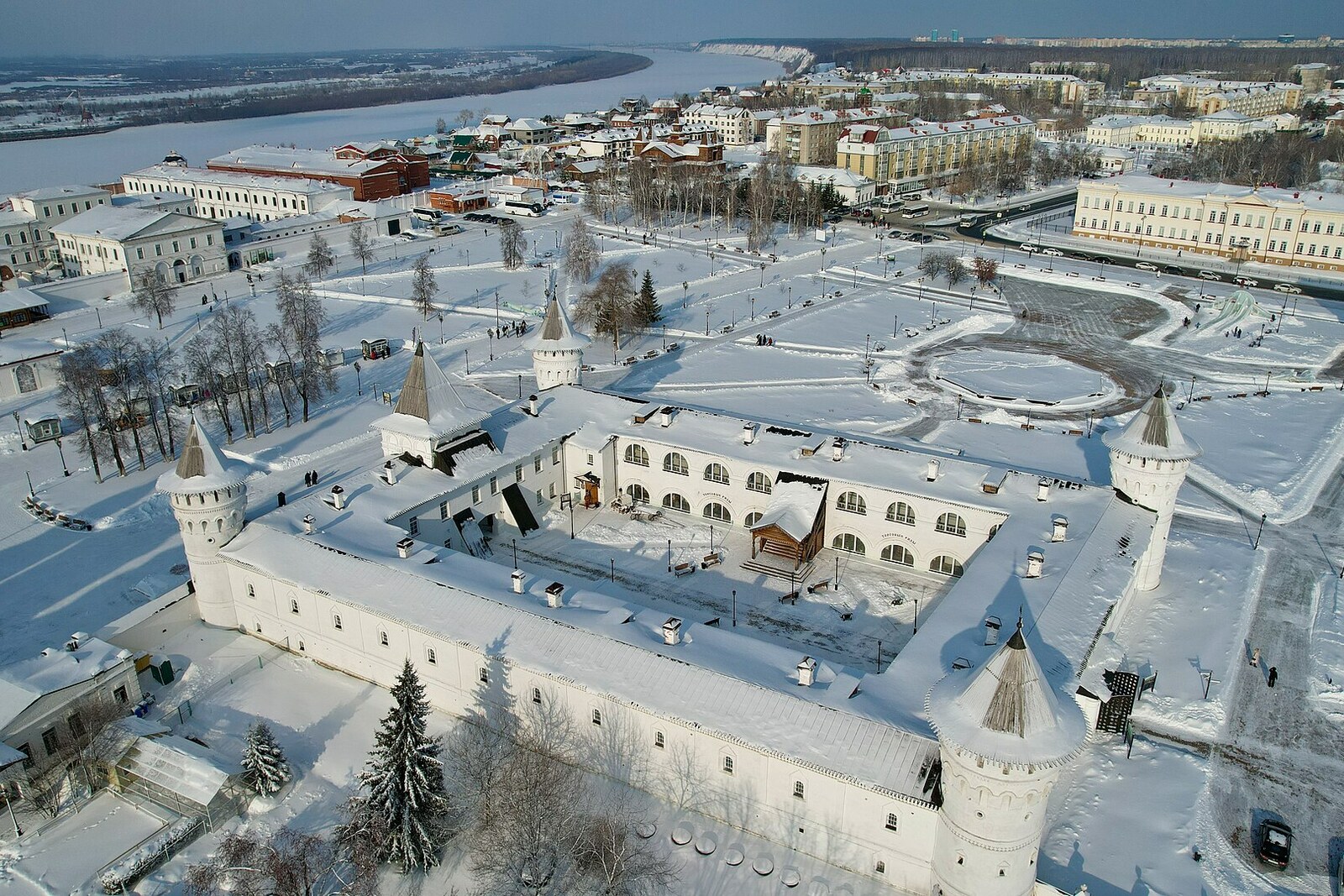
Look around first
What to notice
- Solid outer walls
- Corner towers
- Enclosed inner courtyard
- Former shops facing inward
The story of the place
In seventeen oh one, Tobolsk merchants secured the support of the town's leaders—the voivodes Mikhail Cherkassky and Pyotr Cherkassky—for their petition. The merchants needed a new stone Gostiny Dvor. At that time, “guests” were visiting merchants: in the courtyard, they rented rooms and shops, stored goods, concluded deals, and went through customs.
The merchants asked for it to be built in the lower part of Tobolsk, near the old bazaar and the wharf on the Irtysh River. Cargo vessels arrived there; carrying goods up to the upper town was inconvenient. The Cherkasskys explained to Moscow that trade by the wharf would bring greater turnover and the treasury would receive more customs duties.
At first, the Siberian Prikaz—a Moscow institution that administered the affairs of Siberia—agreed. In August seventeen oh one, Moscow ordered brick shops, market rows, and a weigh house to be built by the Irtysh River, with roofs protected from fire by tile or turf.
A year later, the prikaz reversed its own decision. The documents do not explain why. The courtyard was now required to be built above, near the Kremlin, and in such a way that the building could replace part of the town wall. The merchants' convenience gave way to another calculation: caravan goods were to be locked behind stone and protected from fire.
This order was carried out by the Tobolsk architect Semyon Remezov. He enclosed the courtyard with solid outer walls and built towers at the corners. Sixty-seven shops and twenty-seven cellars opened inward. Customs was above one gate and a chapel above the other. The trading complex came to resemble a separate fortress.
The merchants were right in the main thing. They continued trading in wooden shops in the lower posad, where there was no need to haul goods from the wharf up the high bank. By the middle of the eighteenth century, the courtyard built for them was already falling into disrepair. Governor Fyodor Soymonov found the former shops occupied by a court, an official commission, and fifty prisoners, while the cellars were flooded with water. After repairs, the premises were again rented out to visiting merchants, but by the seventeen sixties the building had definitively lost its role as the main place of trade. It housed offices, a pharmacy, the treasury, and an archive.
Today, the Museum of Siberian Entrepreneurship, souvenir shops, a café, and a small hotel are inside. Yet all the former trading premises still face the enclosed courtyard, while the walls and corner towers face outward. The stone has preserved the Moscow prikaz's decision; the town trade supported by the merchants never did move up here.
Useful on site
The courtyard and exterior viewing are accessible independently of a museum ticket. In summer, the Museum of Siberian Entrepreneurship is open 10:00–19:00; the ticket office closes 30 minutes earlier.
Checked: June 24, 2026. Check the official source before visiting.Walk around the accessible sides of the building: its defensive character is easier to read from the outside, while interior access depends on the opening hours of the spaces located there.