 Guide On Map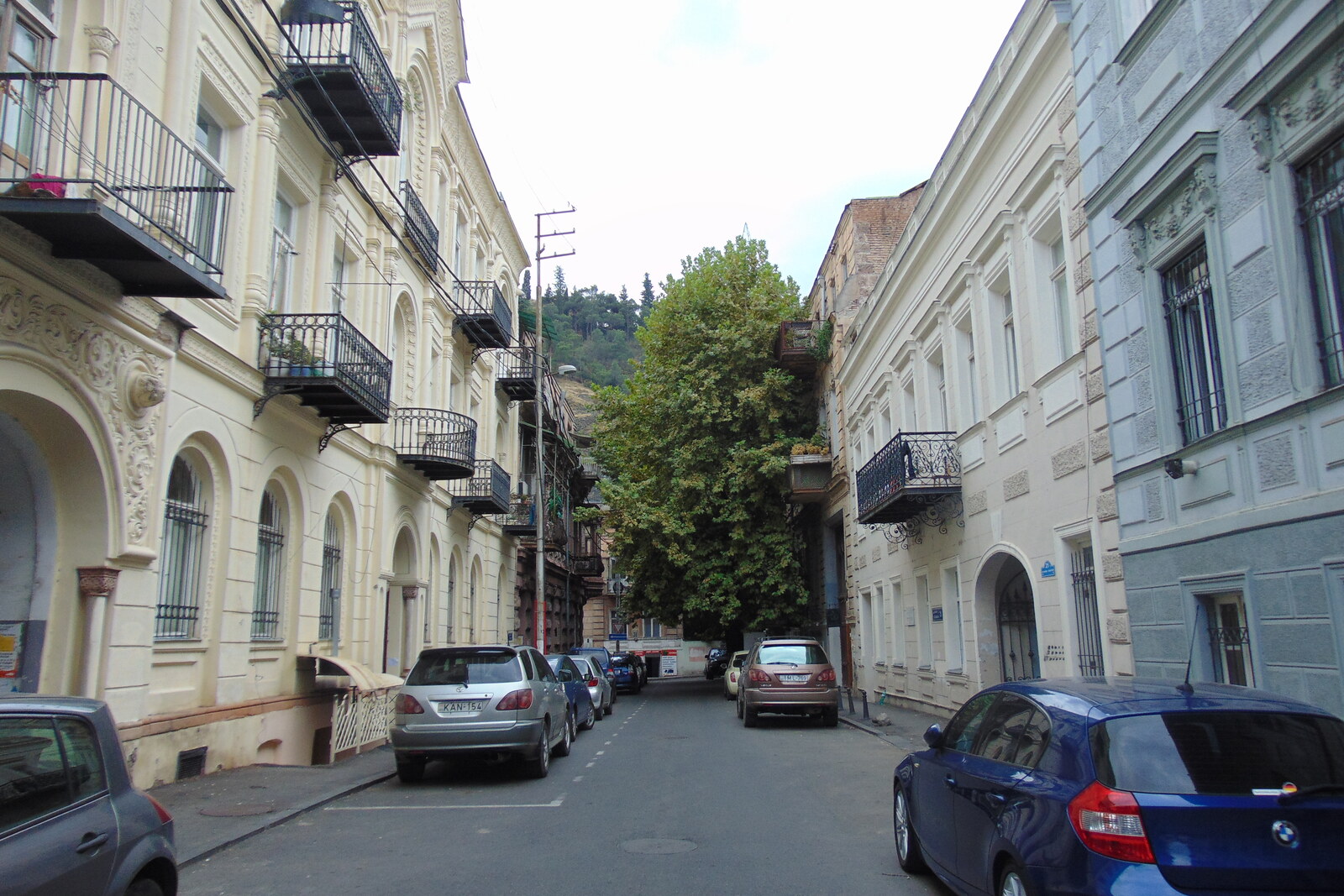
Look around first
What to notice
- A sign with the name Galaktion Tabidze
- The street's straight line
- Corner houses of the blocks
The story of the place
The current name might seem like a clue: as if the poet Galaktion Tabidze had lived in one of these houses. His memorial apartment is in another part of Tbilisi. The poet's name appeared here after the renaming, while the street's first personal name belonged to a man who probably did indeed settle on it.
In the eighteen twenties, city surveyors began dividing the Sololaki gardens into rectangular blocks. In a street list from eighteen forty-one, this line was already recorded as Gan Street. Historians cautiously connect the name with Pavel Gan: it is believed that he lived here, although the exact house has not been identified.
Gan arrived in Tbilisi in June eighteen thirty-seven as chairman of an imperial commission. Nicholas I instructed him to create a final system of government for Transcaucasia. After the wars with Persia and the Ottoman Empire, St. Petersburg wanted to replace local arrangements with institutions modeled on those of the Russian Empire's interior provinces. Gan advocated precisely this rapid unification.
The first draft was criticized for its disregard of local conditions. Gan changed individual provisions but retained the concept. To get it through the Transcaucasian Committee, he assured officials that the population was ready for Russification. A later inspection found this information to be false. Yet in April eighteen forty, the draft became law, and by January of the following year the region's civil administration had already been reorganized under it.
At first, Gan received everything for which he had returned to public service: a salary increase, orders, a seat on the State Council of the Russian Empire, the title of senator, and money to pay off his debts. Then the inhabitants of Guria, Ossetia, and Belokan refused to obey the appointed officials, and unrest began. In eighteen forty-two, imperial inspectors arrived in Tbilisi and reported that the new system was not achieving its stated goal. Nicholas I accused Gan of misleading the government. The senator was expelled from the Transcaucasian Committee, and a few years later he resigned.
The name did not last either. The street was called Damskaya Street, then in nineteen twenty-three it was given the name of the Georgian poet and public figure Akaki Tsereteli. In nineteen fifty-nine, Tsereteli's name was transferred to a new avenue in the developing Didube district. The vacated address went to Galaktion Tabidze.
Galaktion was a poet whose experiments with rhythm and sound changed twentieth-century Georgian lyric poetry. His second collection, published in nineteen nineteen, brought him such renown that his contemporaries called him the king of poets. The street was named after him in the year of his death.
Galaktion's house has survived on Marjanishvili Street. A different connection has survived here: the old Gan line was freed from one poet's name and assigned to another. The senator's name disappeared from the signs along with his reform.
Useful on site
A city route stop; access to private entrances, museums, and courtyards varies, so check the rules on site and do not enter residential spaces without an invitation.
Checked: date not specified. Check the official source before visiting.Listen to the story away from doorways and the roadway: this is a working street, not a separate memorial site.