 Guide On Map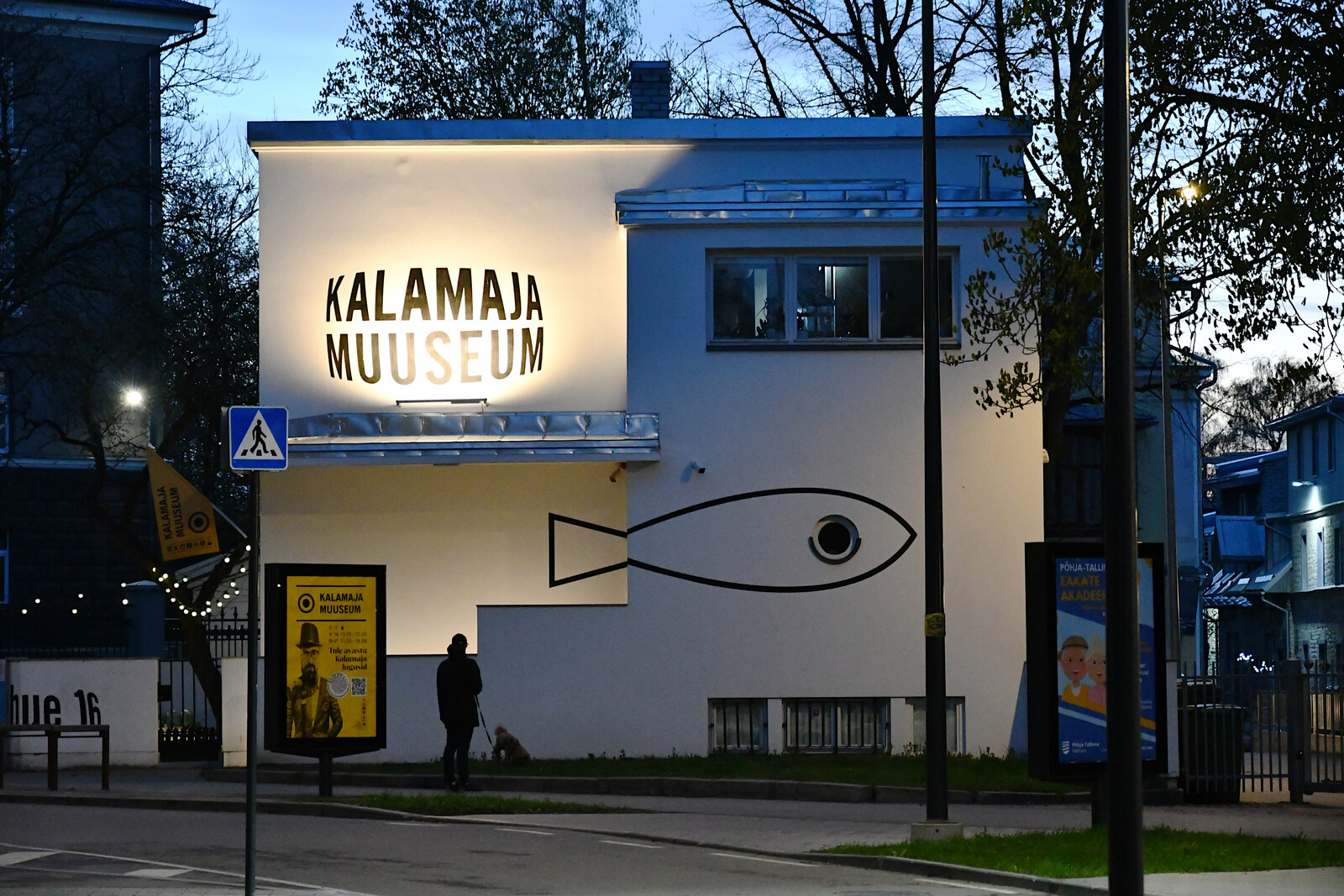
Look around first
What to notice
- White facade of the villa
- Round vent window
- Fish around the window
- Plaster ear casts
The story of the place
The white villa on Kotzebue Street was built in nineteen thirty-four for the professor of mechanics Hans Einberg and his family. After the war, the house was divided into one-room apartments, and since nineteen eighty-five, small museums have succeeded one another here. By two thousand eighteen, the building needed repairs, and Triin Siiner, director of Tallinn City Museum, proposed opening Kalamaja Museum in it.
Siiner worked to ensure that the district's residents determined the content. First, they were asked whether such a museum was needed at all. Questionnaires were distributed at Kalamaja Days and published online. The responses asked for the district's past and present-day life to be told, for a space for meetings to be left, and for it to be made convenient for families. These wishes formed the basis of the future exhibition.
Then the museum staff began collecting memories. They invited long-time residents, new neighbors, young people, and those who had lived here as far back as the thirties and forties. Several elderly participants initially replied, “What is there for me to tell?” They were used to considering their own daily lives too ordinary for a museum. The staff met with them again and explained why information about apartments, courtyards, celebrations, and neighbors was needed. As a result, they recorded more than sixty conversations in Estonian and Russian, and over two years scanned more than three thousand family photographs and documents.
One of the questions was about what residents had heard at home. Helle, born in nineteen forty-seven, recalled the thin walls: neighbors inevitably knew about one another's lives. The exhibition Kalamaja Ears grew out of this response. Before the renovation, the artist Flo Kasearu made plaster casts of the ears of residents aged three to eighty-two. Thirty-eight casts were mounted on the walls of an empty house; recorded memories were played there as well, and visitors wrote directly on the walls about what they had heard through the partitions. After the museum opened, the casts and recordings became part of the permanent exhibition.
The rest of the museum is arranged in the same way: the district's history is told through the things and testimonies of its residents, while the exhibition spaces are called the basement, the corridor, the garage, the living room, and even the toilet—as rooms in a real home. On the white facade, a round vent window became the eye of a painted fish. Five hundred fifty-five participants in an open vote chose this symbol from four options. “Kalamaja” literally means “fish house”; the fish around the window is that very choice by residents with which the museum began.
Useful on site
Wed–Thu 13:00–20:00, Fri–Sun 11:00–18:00, Mon–Tue closed. Tickets: adult 7 euros, concession 5 euros, family 14 euros. The building is not equipped for wheelchair users.
Checked: June 30, 2026. Check the official source before visiting.Exploring the exhibition requires a separate visit inside; if the museum is inaccessible, viewing the exterior still helps reveal its former residential function.