 Guide On Map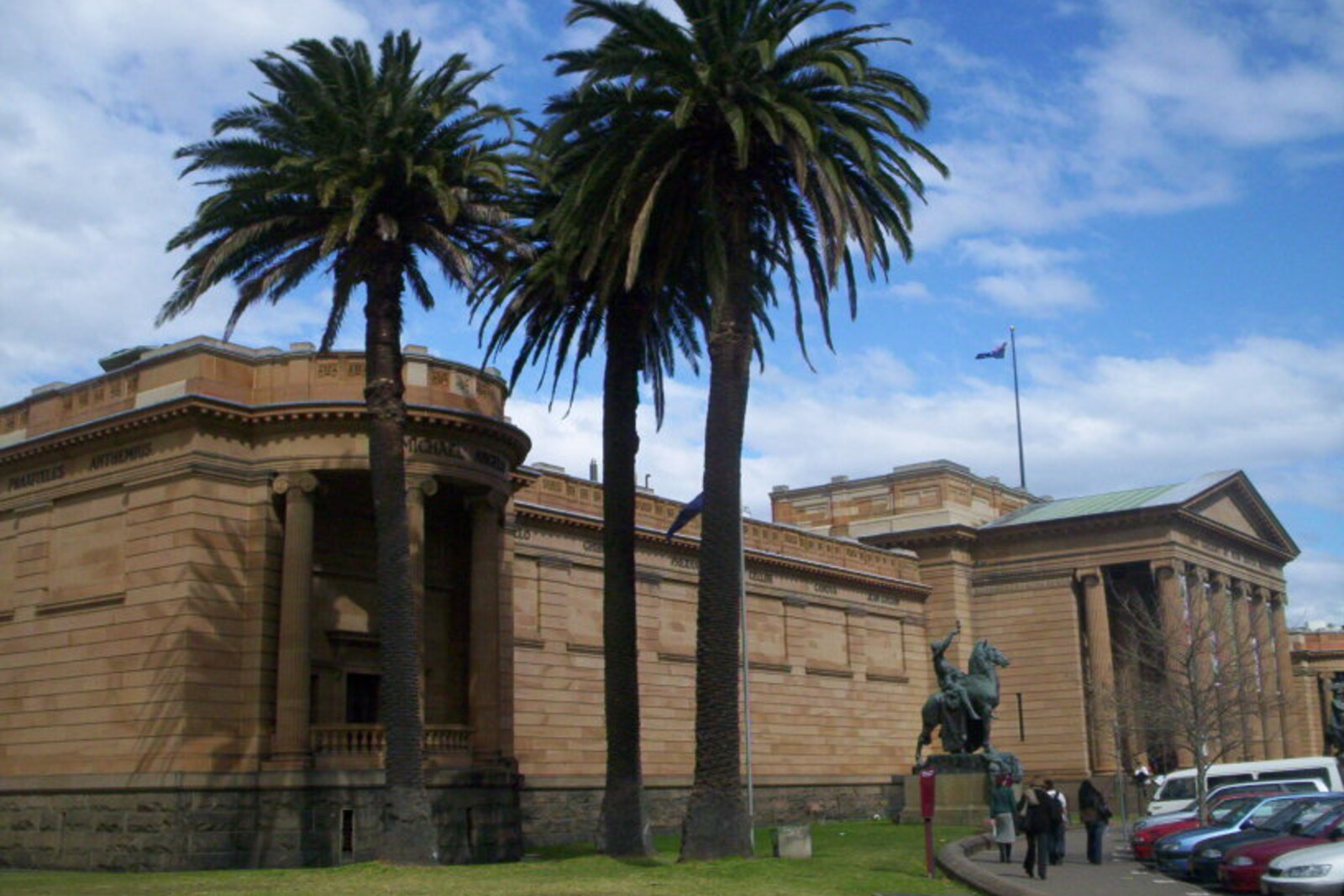
Look around first
What to notice
- Classical portico
- Exhibition halls
The story of the place
Six Ionic columns beneath the pediment mark the entrance to the old building of the Art Gallery of New South Wales. Before the old building was constructed, a temporary six-room structure stood on this site in The Domain: the city's art collection was moved here after a fire destroyed the former exhibition palace. The new building was constructed in sandstone in stages; the first rooms are connected by arches on paired columns, followed by a long picture gallery and two domed halls for sculpture. Construction lasted more than ten years, and the façade was completed after the first exhibitions had already been held within these walls.
Behind the classical portico, the gallery's trustees choose the best painted portrait for the Archibald Prize each year. It was established in his will by Jules François Archibald, editor of the Sydney magazine The Bulletin: he left money for an annual award to an artist who had painted a person distinguished in art, literature, science, or politics.
In January nineteen forty-four, the winner for the previous year was chosen here. William Dobell wanted the five hundred pounds and recognition as a portraitist. During the war, he earned money in a camouflage unit and was then employed as a laborer in the Civil Construction Corps. There he became friends with the artist Joshua Smith, who worked on mobile camouflage for hangars and warehouses.
Both came here as entrants in the same competition. Dobell submitted a portrait of Smith. Smith himself hoped to win the same prize with his portrait of the poet Mary Gilmore. The trustees of the gallery, which was at that time called the National Art Gallery of New South Wales, chose Dobell's work. Smith lost to a painting that depicted Smith himself.
Dobell called the canvas “Portrait of the Artist,” but it was entered in the exhibition catalog as “Mr Joshua Smith.” The artist lengthened his model's arms and neck, showed a narrow face and clasped hands. The next morning, Smith's parents asked for the portrait to be removed from the exhibition, and Smith himself stopped speaking to Dobell.
The trustees' decision divided the public. The management extended both the opening hours and the exhibition itself; by March, more than one hundred forty thousand people had seen the portrait. Two artists who had not received the prize, Mary Edwell-Burke and Joseph Wolinski, secured court proceedings. They wanted the award overturned: in their view, Dobell had painted a caricature, while Archibald's will allowed an award only for a portrait.
Artists, gallery directors, critics, and even doctors were called to court. They examined Smith's face and physique as evidence. Dobell admitted that he had slightly emphasized certain features, but explained that his friend really did have long arms, often clasped his hands, and sat exactly that way when he wanted to insist on his point.
Judge Edward Roper decided that the likeness was sufficient: exaggeration does not turn an image into a caricature. The award remained with Dobell, and a later attempt to appeal the decision also failed.
The victory cost both friends dearly. After a stream of insulting letters, Dobell developed severe dermatitis and suffered a nervous breakdown. He stopped painting and went to stay with his sister in Wangi Wangi; only later was he able to return to work. The following year, Smith himself won the Archibald Prize—with a portrait of parliamentary speaker Sol Rosevear. That victory did not restore their friendship.
Smith's portrait narrowly escaped destruction in a fire in nineteen fifty-eight, but it was restored. Under the terms of the prize, the winner is not required to give the painting to the gallery, so it did not become a permanent exhibit in these halls. The list of prize winners retained two adjacent entries: first Dobell with Smith's portrait, then Smith with a portrait of another person.
Useful on site
The exhibitions and specific works change, so do not make this stop depend on a guaranteed display of a single painting. In the halls, follow the current rules on photography and keep the required distance from the works.