 Guide On Map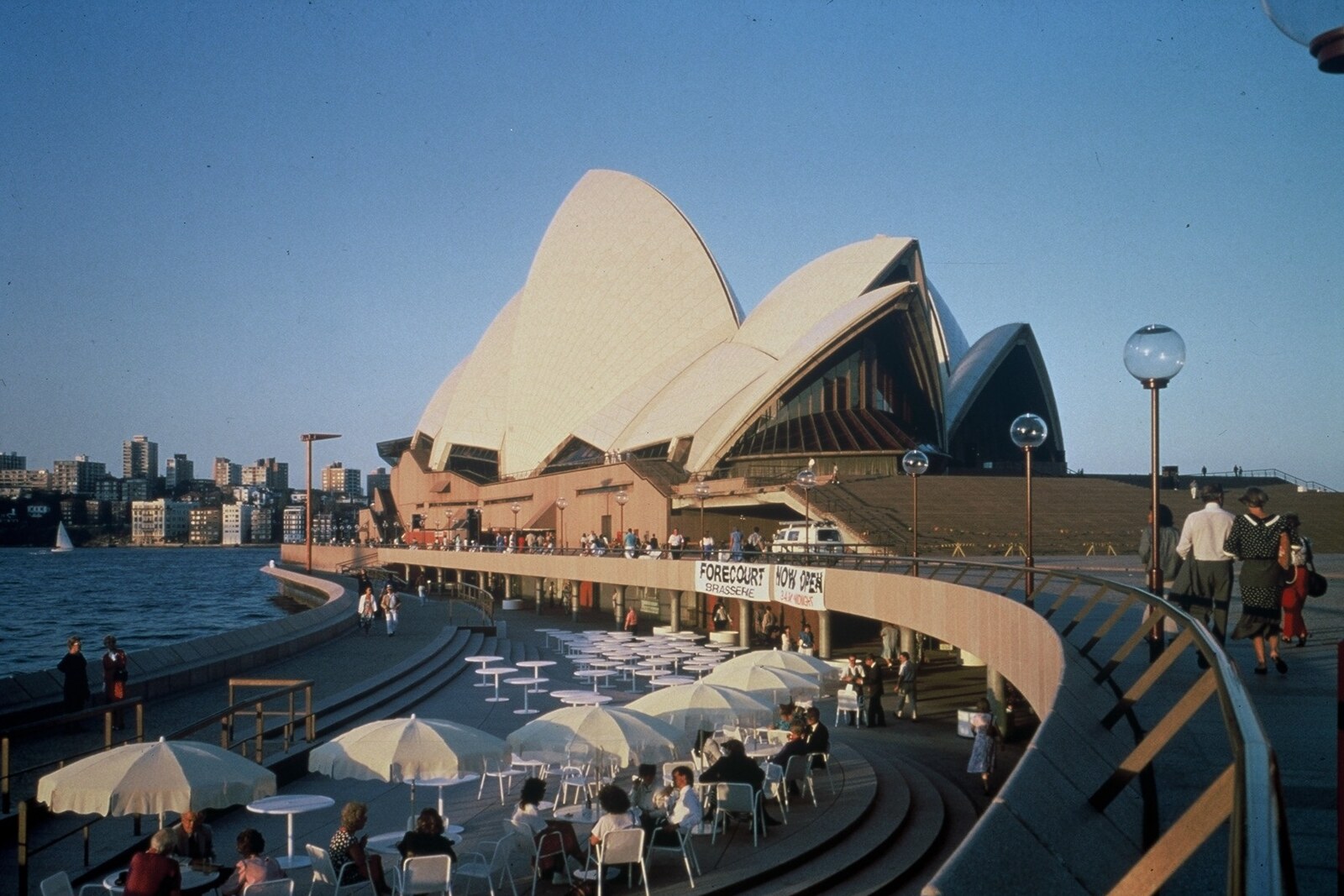
Look around first
What to notice
- Monumental Steps
- Granite forecourt
- The Opera's white shells
The story of the place
Sydney Opera House documents designate this open section as a separate Concert Hall, the most capacious in the entire complex. The broad granite Sydney Opera House Forecourt meets the Monumental Steps and lies beneath the building's white shells; today, up to six thousand people are admitted here for a standing performance. Temporary stages and service structures change, while the steps and stone surface remain a permanent part of this ceremonial approach to the Sydney Opera House.
On November twenty-fourth, nineteen ninety-six, drummer Paul Hester sat down at the drum kit of Crowded House again. Two years earlier, he had left the band in the middle of an American tour. Now he returned for one concert—the last one.
Neil Finn, the band's leader and the writer of most of its songs, had already announced the breakup. Bassist Nick Seymour did not want it. He expected to keep recording and touring for another five years, and after the announcement, in his own words, he had no idea what he would do next. The musicians were ending their work together at the peak of their success, and their manager Grant Thomas suggested saying goodbye where more people could fit than in any of the Sydney Opera House's halls: on the Sydney Opera House Forecourt and the Monumental Steps.
The band members themselves had doubts. Hester felt that a stage beneath the famous white shells was too ceremonial for an ordinary rock band. Thomas persuaded several young Australian groups to perform with them and found corporate sponsors. The million dollars raised was intended for the Australian Cord Blood Bank, where donor cells are stored to treat serious illnesses. The charity fundraiser helped the manager obtain permission for a free concert at the Sydney Opera House.
The performance was scheduled for November twenty-third. Because of a downpour, the organizers declared the open forecourt unsafe and moved everything to the following evening. More than one hundred thousand people then filled the granite space and the Monumental Steps; spectators stood farther along the shore of Sydney Cove. Television crews broadcast the concert live.
Crowded House began with their first single and ended with a song whose title translates as “Don't Dream It's Over.” After the final note, the four musicians embraced in a small temporary dressing room behind the stage. The band then really did break up. Finn turned to solo recordings, Seymour was left without the five years of work together he had expected, and Hester returned to his own musical and television projects.
The band reunited ten years later, after Hester's death. Another decade later, Finn and Seymour returned to give concerts on this same forecourt; another musician occupied the drummer's seat.
In Sydney Opera House documents, the forecourt in front of the steps is listed as a separate open-air Concert Hall—the most capacious in the entire complex. Today, up to six thousand spectators are admitted here for a standing performance. Nothing remains of the stage and temporary structures of nineteen ninety-six; the forecourt and the steps remain, where an audience more than sixteen times the current limit once fit.
Useful on site
Outdoor access to the forecourt depends on events and security; Sydney Opera House tours are listed as daily, but performances, temporary barriers, weather, and crowd management alter visitor movement.
Checked: date not specified. Check the official source before visiting.This story is intended for viewing from outside. Book a tour and visits to the halls separately, and do not block stair passages in a crowd.