 Guide On Map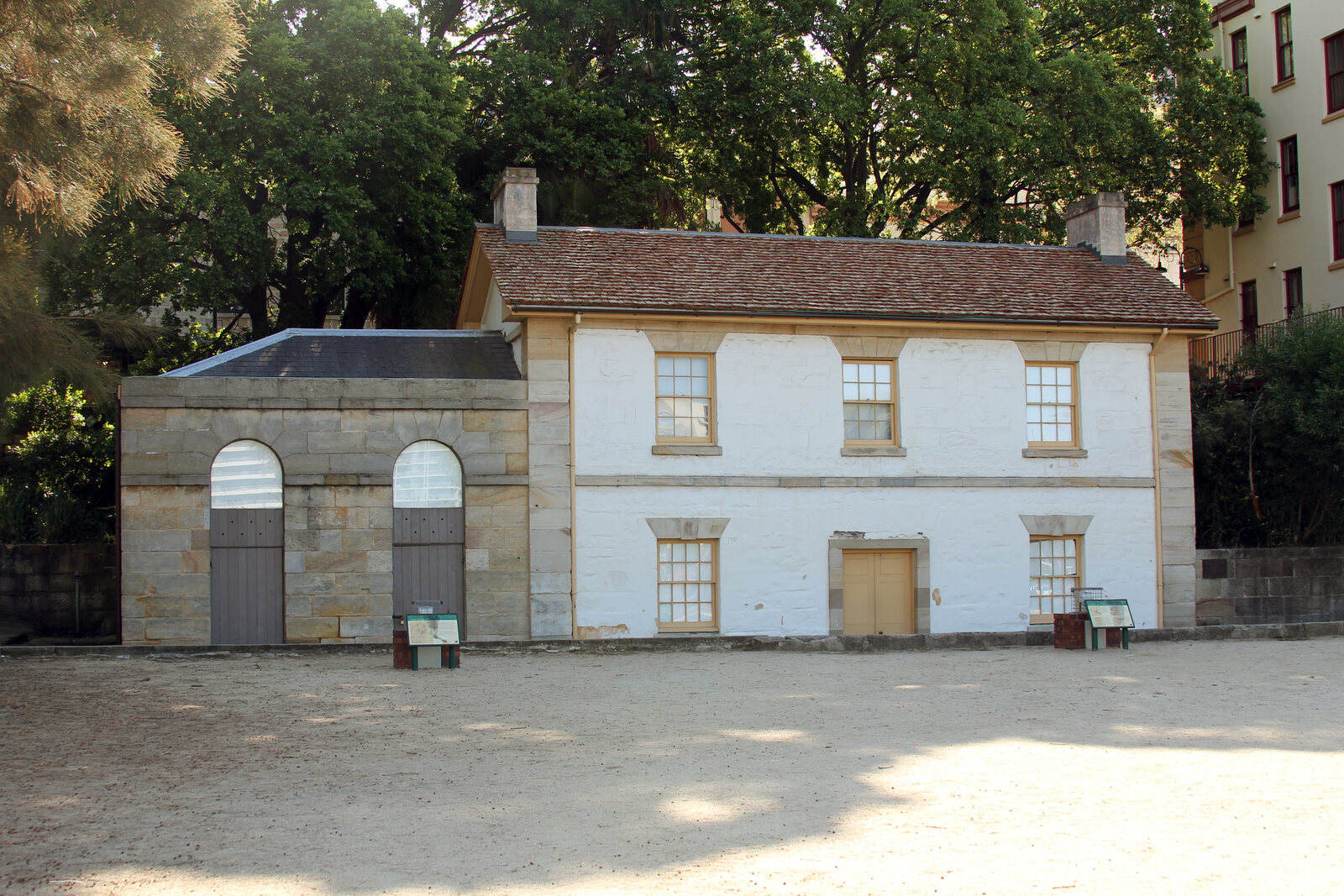
Look around first
What to notice
- Two-story sandstone cottage
- Lawn in front of the house
- Modern waterfront by the water
The story of the place
The two-story sandstone cottage survives from a time when the harbour worked in place of a road network. From the shore beside the house, boat crews set off with timber and supplies, for grass for livestock and shells for lime, and also served the governor's barge. Across the water, they linked the town with settlements and farms along the shore. The lawn in front of the house and the modern waterfront lie where there was once a descent to the water: the harbour has moved about one hundred meters away from here because of reclaimed land.
John Cadman did not build this house and was not its first occupant. In eighteen sixteen, the colonial administration built the Coxswains' Barracks right by the water. The lower floor served as an office, the upper as living quarters. Boats were not brought inside: they were hauled ashore in front of the building or left at anchor nearby. The site was chosen at the edge of the government dockyard so that the superintendent could see the vessels and assign crews from here.
Cadman arrived in Sydney far from being a superintendent. In England, he was sentenced to transportation for life for horse theft. In seventeen ninety-eight, he disembarked from a ship as a convict and began working for the government. Later, Cadman received a full pardon and earned his living in service on the water.
He was entrusted with the government cutter Mars. In eighteen twenty-six, the vessel was wrecked off Port Stephens, and Cadman was removed from his post. The dismissal itself does not prove that he was at fault for the loss of the cutter, but it left him without a regular income. He petitioned for another job at the dockyard.
A year later, the post of superintendent of government boats became vacant. Cadman received it, along with a salary of ninety-one pounds a year and the right to live here. From here, he assigned crews: some carried timber and supplies, others collected grass for livestock and shells that were burned for lime, while a third group served the governor's barge. With a sparse road network, such boats linked Sydney with settlements and farms along the shores of the harbour and rivers.
After marrying, Cadman housed his wife and her two daughters upstairs. The girls grew up in this house and left it when they married. Cadman himself worked here for eighteen years—longer than any other superintendent of the boat service.
In eighteen forty-five, he retired. His post was abolished at the same time, its duties were divided among Customs, the water police, and private carriers, and Cadman received an allowance of one hundred eighty-two pounds—two of his annual salaries. The water police soon occupied the barracks, but the building retained the name of its last and longest-serving superintendent.
One spatial clue remains from the former working setting. Today, about one hundred meters of reclaimed land lie between the cottage and the harbour. In Cadman's time, the water came almost up to the walls, and where the waterfront now runs, his crews launched boats from the shore.
Useful on site
The historic site is listed as open; interior access is not guaranteed, so check current notices and treat this as an exterior stop.
Checked: date not specified. Check the official source before visiting.Do not count on getting inside: the main point is clear from outside if you imagine the harbour almost at the doorstep again.