 Guide On Map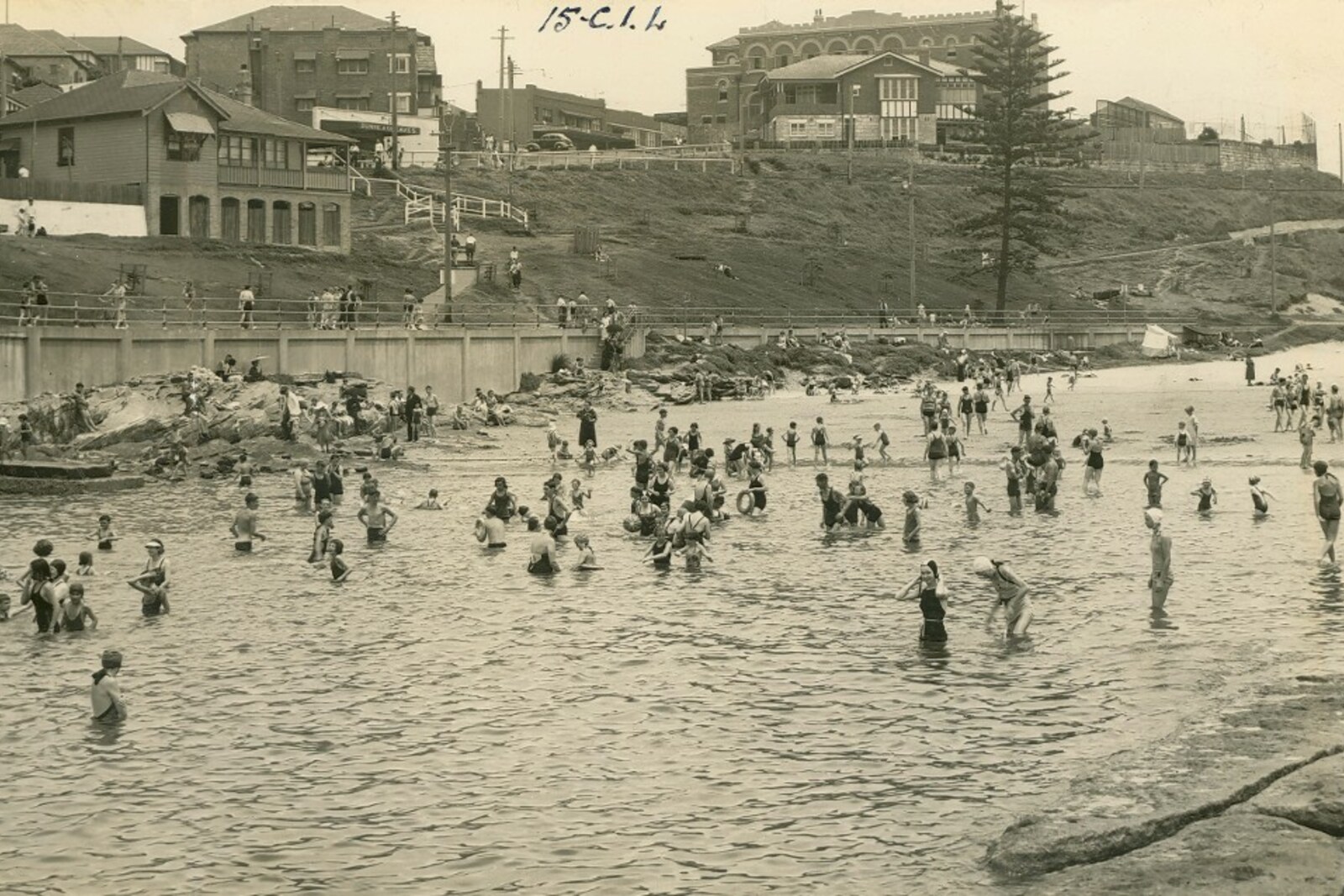
Look around first
What to notice
- The narrow bay of Clovelly, Sydney
- Wooden racks with aluminum boats
- A mural of a blue groper on the pumping station
- The sandy shore of Gordons Bay
The story of the place
Between Clovelly, Sydney, and Gordons Bay, the coast forms two small bays where open water quickly gives way to a calm sandy edge. The Cliffbrook house once stood above one of them; the house has long been gone, but access to the water remains public. On the sand, you can see sloping wooden racks with light aluminum boats: they are used by a local amateur club that heads out to deep reefs farther from shore.
In January two thousand two, a young spearfisher emerged from the water at Clovelly, Sydney. A live eastern blue groper—a large fish from the wrasse family—was still on his spear. Witnesses said the man finished it off with a diving knife. He was breaking a ban: spearfishing for these fish had been prohibited in New South Wales since nineteen sixty-nine.
Gropers are especially vulnerable to spearfishers because of their own curiosity. They swim up to swimmers and inspect them at close range. Local residents called the enormous blue male that regularly appeared at Clovelly, Sydney, Bluey. Even Bob Carr—then Premier of New South Wales and a regular visitor to this coast—swam with it. When news of the killed one-meter groper spread through the area, Carr decided that Bluey was the fish that had died and demanded stronger protection for the coastal waters. The spearfisher's identity was never established.
A week later, two local divers told a newspaper that they had seen and fed Bluey after the incident. They said the spearfisher had taken a smaller female. The difference is visible in their coloring: eastern blue gropers begin life as gray-brown females, and some become bright-blue males as they age. Bluey's death could not be proved; later encounters with a large blue groper also do not establish whether it was the same fish.
After the scandal, Carr announced the creation of five protected waters near Sydney. In March two thousand two, the state authorities, together with the municipalities of Randwick and Waverley, established the Bronte-Coogee Aquatic Reserve. It covered a four-kilometer stretch of coast, including Clovelly, Sydney, and neighboring Gordons Bay. Taking blue gropers by any means was prohibited in these two bays.
Later, biologists tested whether such a small reserve suited fish that could freely leave for the ocean. From two thousand nine to two thousand eleven, they tracked gropers with acoustic tags. Most tagged fish were recorded here for an average of ninety-seven percent of the time. Not one groper tagged inside the reserve was recorded beyond its boundaries.
The map of these waters preserves names that arose from different human decisions. Clovelly, Sydney, was formerly called Little Coogee. When the tram was extended here in nineteen thirteen, the two similar destinations began to be confused. Fred Howe, chairman of the local improvement society that organized a competition for a new name, proposed “Clovelly,” after a fishing village in Devon, England. His proposal won; municipal historians do not know why it appealed more than the others. “Eastbourne” came second, and that name remains on Eastbourne Avenue above the bay.
The name Gordons Bay appeared earlier. In eighteen forty, the government surveyor Lewis Gordon received a plot here that included the shore of the bay. Later, John Thompson, the future mayor of Randwick, bought the estate and built the Cliffbrook house above the water. Some residents called the bay after its first owner—Gordons Bay—while others called it after the next one—Thompsons Bay. The government fisheries map still prints both names side by side.
In nineteen thirteen, the next owner of Cliffbrook, Denison Miller, the first governor of the Commonwealth Bank of Australia, sold the shore to the municipality for three thousand pounds. The house was later demolished, but public access to the water remained. The sloping wooden racks on the sand belong to another group of people: in nineteen sixty-four, Bill Elton and several local fishers agreed with the municipality to occupy an abandoned boatshed and founded the Gordons Bay Amateur Fishing Club. They keep light aluminum boats on the racks and go fishing at deeper reefs beyond the bay.
At the northern edge of Gordons Bay, Bluey is now painted on the wall of a pumping station. Neither the portrait nor new encounters with blue gropers confirm that the famous fish survived that spearfisher. Below the painting continues the same protected water that the official map calls, all at once, Clovelly, Sydney, Gordons Bay, and Thompsons Bay.
Useful on site
Stay on the maintained paths and do not go out onto the outer rocks when there is swell. Underwater activities require suitable conditions and separate training; clear water does not eliminate currents.