 Guide On Map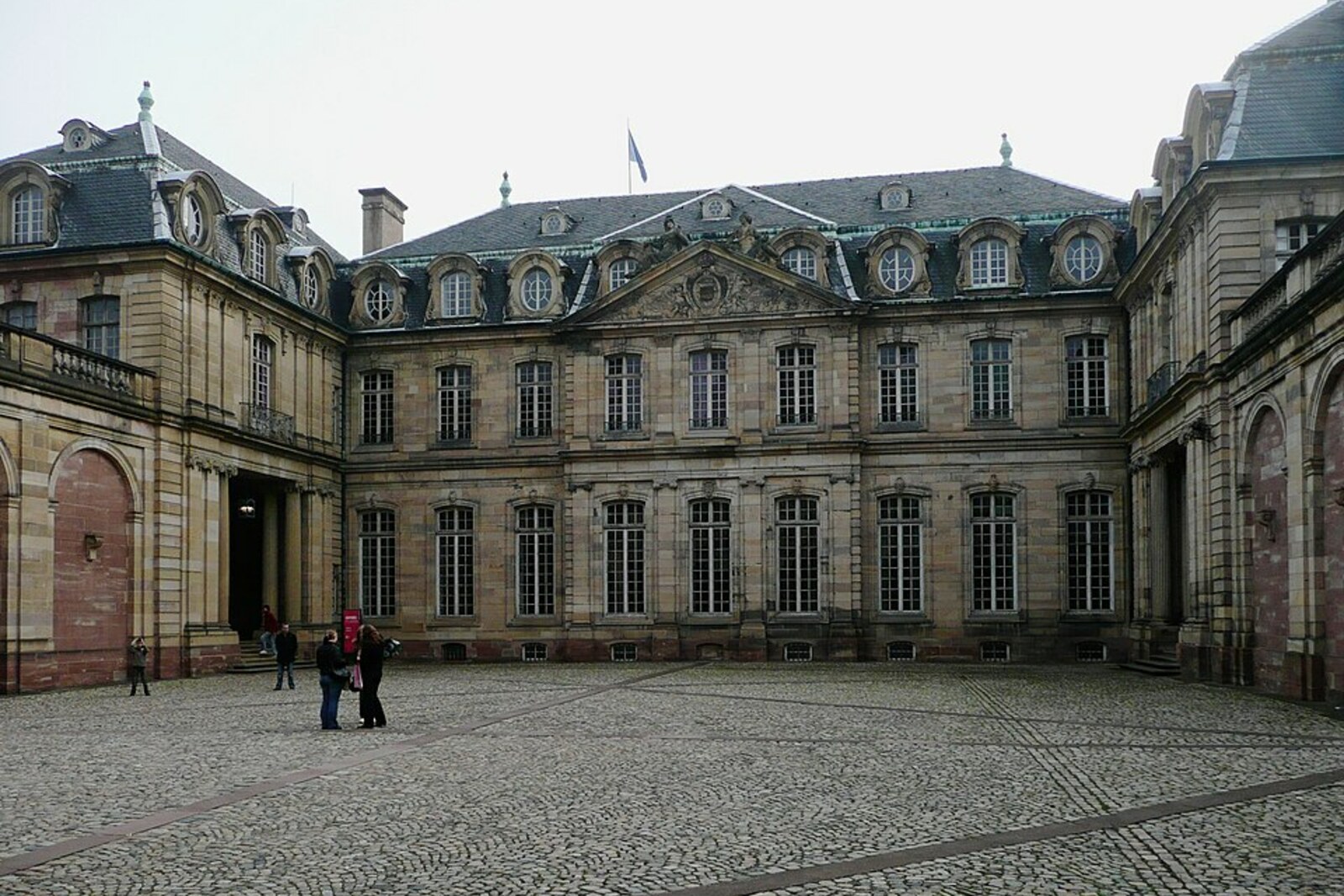
Look around first
What to notice
- The palace's river façade
- The cardinal's stone coat of arms
- The terrace above the Ill
- The windows of the ceremonial apartments
The story of the place
The stone coat of arms on the river façade belonged to Cardinal Armand-Gaston de Rohan-Soubise. As prince-bishop, he led the Diocese of Strasbourg and was at the same time a secular prince of the Holy Roman Empire. For such an owner, the palace placed his own rooms beside ceremonial apartments for the king and ruling families; the windows above the terrace open from those very rooms. After him, three more Rohan cardinals governed the diocese, which is why the palace bears the name of the whole family; three museums are now housed here, and some of the former ceremonial rooms have been restored for the Museum of Decorative Arts.
In late January seventeen forty-seven, fifteen-year-old Maria Josepha of Saxony stayed in this palace. She was being taken to Versailles to seventeen-year-old Louis, Dauphin of France, the only son and heir of King Louis XV. Louis's first wife had died the previous summer. He continued to mourn her, but his father ordered him to marry again: the king needed grandsons capable of inheriting the throne.
In Strasbourg, Maria Josepha was already received as the dauphine—the title given to the wife of the heir to the French Crown—although the wedding had not yet taken place. From the window of the apartments above the terrace, she watched the city militia pass in front of the palace. After a public dinner, local coopers brought her the city's wines. A public dinner meant a spectacle in the literal sense: the princess ate while people admitted to the hall watched her. The future dauphine was expected to live in public view even before arriving at court.
On the morning of January twenty-ninth, she came to Mass in the palace chapel. The host of the residence, Cardinal Armand-Gaston de Rohan-Soubise, had been ill and confined to bed, but came down from his rooms to say farewell. The cardinal tried to kiss the hem of his guest's dress. Maria Josepha lifted the old man up and embraced him. Then the Polish courtiers, ladies, and servants who had accompanied her said goodbye. The princess wept with them, then left for France without her former court around her.
The ill cardinal's family name remained on the building. Palais Rohan means “the palace of the Rohans.” Armand-Gaston was a prince-bishop: he headed the Diocese of Strasbourg and at the same time held the title of secular prince of the Holy Roman Empire. He commissioned a residence in which his own rooms stood alongside ceremonial apartments for the king and members of ruling families. After him, three more Rohan cardinals held the Strasbourg see. That is why the palace took the name of the whole family rather than of a single owner.
On February ninth, Maria Josepha was married to Louis at Versailles. Her husband never became king: he died before his father. Maria Josepha outlived him by fifteen months. Yet three of their sons later occupied the French throne in turn—Louis XVI, Louis XVIII, and Charles X.
Three museums now operate in the palace. The cardinal's coat of arms is set on the façade facing the River Ill, and behind it are the restored ceremonial rooms of the Museum of Decorative Arts—the very apartments where fifteen-year-old Maria Josepha ate before spectators and said goodbye to her entourage.
Useful on site
Museums are usually open daily except Tuesday: Monday–Friday 10:00–13:00 and 14:00–18:00, Saturday–Sunday 10:00–18:00. The exterior can be viewed without a ticket.
Checked: June 24, 2026. Check the official source before visiting.The courtyard and an exterior walk around the building are enough for this account. The museum collections inside are a separate visit that will require additional time.