 Guide On Map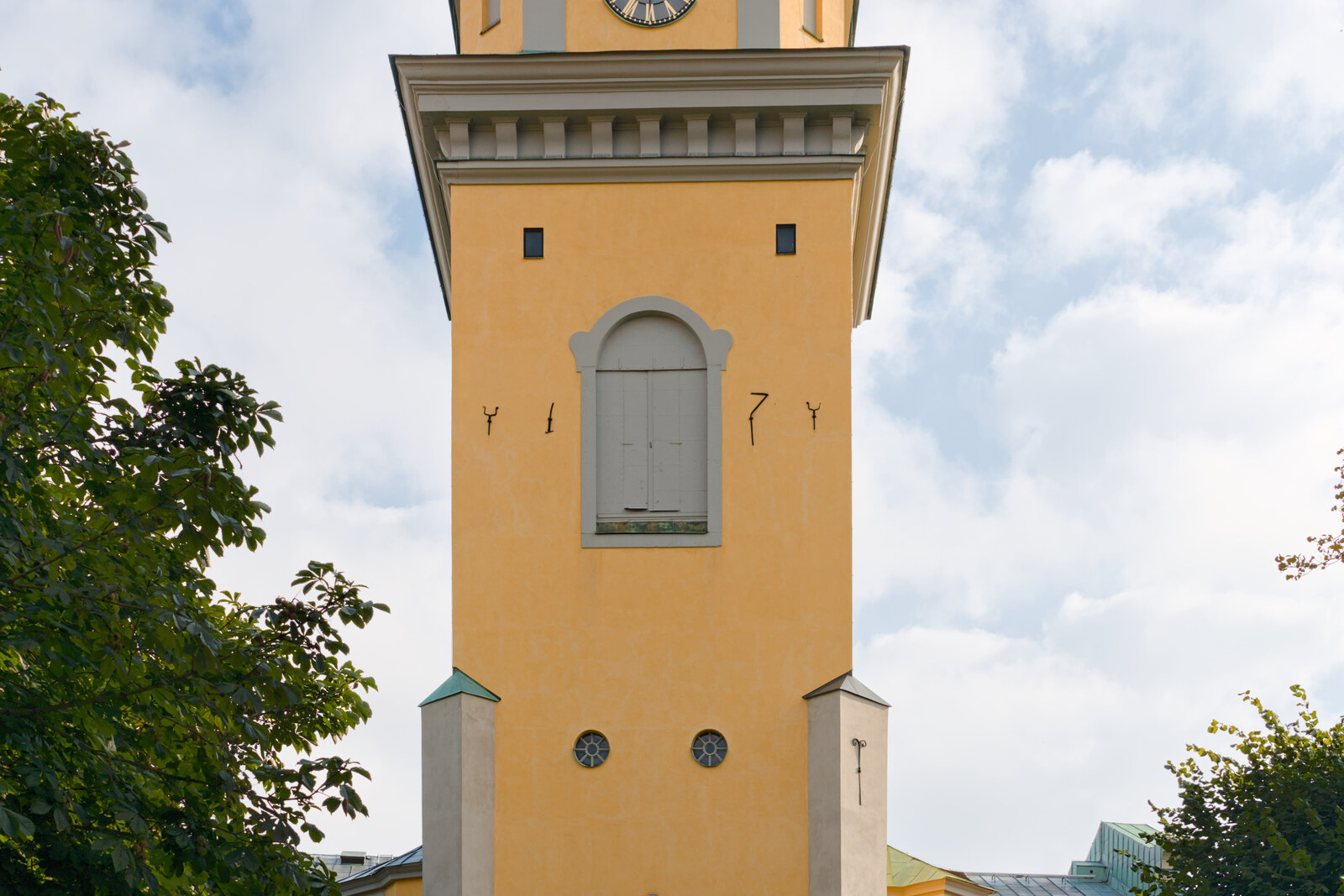
Look around first
What to notice
- Yellow facade
- Cemetery
- Medieval tower
- Western wall
The story of the place
The yellow church stands in the middle of a cemetery because the cemetery was here first. Around thirteen fifty, King Magnus Eriksson ordered a burial chapel for the city’s poor to be established outside the Stockholm of that time. It was dedicated to Maria Magdalena, from the Galilean town of Magdala—a follower of Jesus who, according to the Gospels, was the first to see him after the Resurrection and told the disciples about it. The Swedish form of her name, Maria Magdalena, passed from the chapel to the church and the entire Maria Magdalena Parish.
By the beginning of the sixteenth century, the chapel had been enlarged. Together with the neighboring houses enclosed by a wall, it resembled a small fortification on the southern approach to the city. In the autumn of fifteen twenty-two, this arrangement proved useful to Peder Fredag.
Fredag was a Stockholm townsman and, during the war, became a captain in the army of Gustav Eriksson—the future King Gustav Vasa. The Swedes were trying to leave the union ruled by the Danish King Kristian II, but Stockholm was still held by a garrison loyal to him. Gustav was besieging the city from land, and Fredag commanded one of his detachments.
When the garrison prepared a sortie against the Swedish camp on Södermalm, Fredag hid five hundred soldiers in the church. The warriors who came out of the city passed the fortified chapel, after which Fredag’s men struck them from the rear and repelled the attack. The siege continued, and the following summer Gustav entered Stockholm. Fredag remained a military commander and was killed in the assault on Kalmar Castle in fifteen twenty-five.
The battle by the chapel showed how dangerous a stone building outside the city walls could become if occupied by the enemy. In fifteen twenty-seven, Gustav Vasa ordered most of the church dismantled for military-strategic reasons.
A few decades later, his son, King Johan III, faced the opposite task. Södermalm’s population was growing, and its residents had no parish church of their own. In fifteen eighty-eight, Johan ordered a new church built beside the surviving medieval tower. He died four years later, construction stopped, and services could begin only in sixteen twenty-five.
Services and concerts now take place here, people come for private prayer, and the cemetery retains the site’s original purpose. Most of the visible building appeared later, but fragments of a fifteenth-century structure remain in the present tower. The western wall does not align with the nave’s axis: the new church was attached to the stone masonry of the very chapel where Peder Fredag hid his soldiers.
Useful on site
A city route stop; access to the lift, church, museum, and theater changes, so check the current rules on official pages or on site.
Checked: date not specified. Check the official source before visiting.Walk quietly through the cemetery and do not disturb services or private ceremonies. The baptismal font is inside; check access to the church separately.