 Guide On Map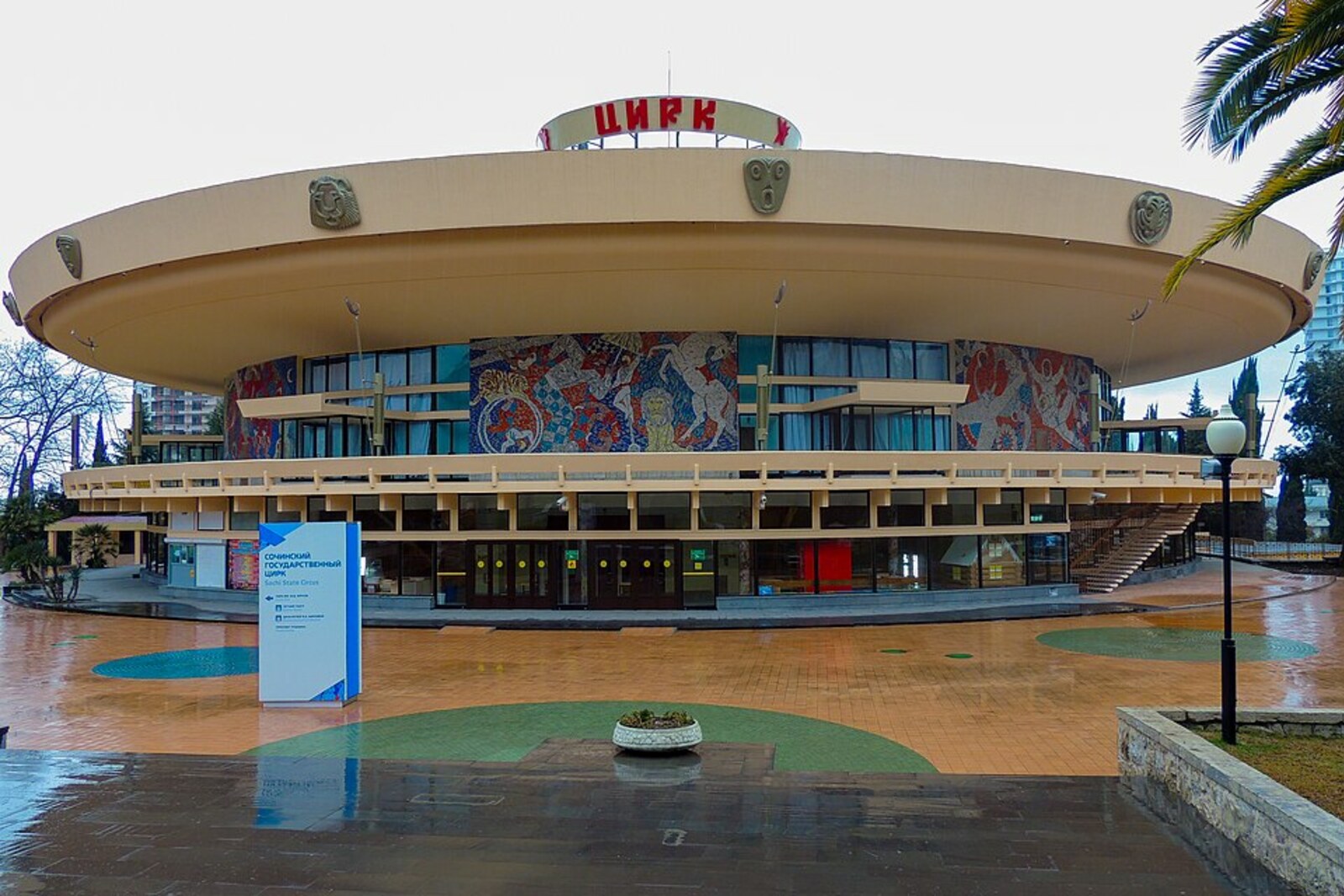
Look around first
What to notice
- Glass cylinder
- Ceremonial facade
- Round volume of the arena
- Sign bearing Mstislav Zapashny’s name
The story of the place
In the fall of nineteen fifty-five, another Sochi circus stood on this site: a summer building with one thousand two hundred seats. The current glass cylinder was built beside it later, and the old ring was dismantled after the new one opened. It was in that vanished circus that the animal trainer Irina Bugrimova twice, within several weeks, found herself locked in with five attacking lions.
Bugrimova was the first woman in the Soviet Union to work professionally with predators. Her touring act had supported her for nine years already. In Sochi, the lion Araks was supposed to stand on a large wooden ball and roll it with his paws, but he refused. Bugrimova brought a metal trident—a trainer’s working tool—up to his muzzle and made him perform the trick. Araks then attacked Bugrimova’s favorite, the lion Caesar. The other animals joined the fight, and two lions blocked the way to the cage door.
The assistants tried to drive them back with pitchforks through the barrier. At Bugrimova’s command, the ring workers turned on the fire hoses. Jets of water dispersed the animals, and the lions were driven into their cages. Several weeks were spent treating the wounds, after which the act was returned to the program.
At the very first performance, Araks again lunged at another lion. The workers no longer waited for a command and turned on the water, but it did not help. Bugrimova’s husband, the circus performer Konstantin Parmakyan, went through the barrier with a trident. Together, the spouses retreated toward the exit and got out of the ring.
A new mistake happened backstage: three worked-up lions were put into one cage. The impact of their bodies knocked the latch off the door, and Araks and Dick tumbled into the inner courtyard. Parmakyan fired into the air. Dick hid in an empty horse stall, while Araks went after Parmakyan. Bugrimova grabbed a length of pipe and ran to help her husband. A city street began just beyond the low wooden fence; the spouses and two assistants kept the lion away from the fence until they drove him back inside.
After the Sochi tour, Bugrimova parted with her entire group except Caesar. She gathered young lions, fed them herself, and selected tricks according to each animal’s behavior. In May nineteen fifty-eight, the trainer returned to Sochi with a new group. And on May twenty-first, nineteen seventy-one, Bugrimova and her lions took part in the first performance under the roof of the current circus.
In this building, the part of circus work invisible to the audience was set down the slope, one floor below the main entrance. The ring, rooms for performers and animals, and two inner courtyards are all on one level. The public enters at the middle of the amphitheater, while props and participants in the program move below without crossing the audience foyer. The circular arena receives successive touring troupes; there is no permanent show here.
Since May two thousand twenty-six, the building’s official name has been Sochi State Circus named after Mstislav Mikhailovich Zapashny. Zapashny was an animal trainer and director, and from nineteen ninety-two to two thousand three he ran this circus. He assembled his own large programs in the Sochi ring: for the building’s twenty-fifth anniversary, he staged “I Love You, Russia” and “Stars of the World Circus.” They ran here for two seasons, then the performers took them to other cities.
After Zapashny’s death, a museum opened in the building with his costumes, awards, and working documents. Now his name is displayed on the facade of the very circus where he turned individual acts into programs capable of leaving the Sochi ring on tour.
Useful on site
The facade is accessible from outside; the auditorium and foyer require a ticket to a performance. The circus operates during the 2026 season.
Checked: June 24, 2026. Check the official source before visiting.The building’s overall layout is clearly visible from outside; the amphitheater and internal routes are open only to performance visitors. A separate ticket is required.