 Guide On Map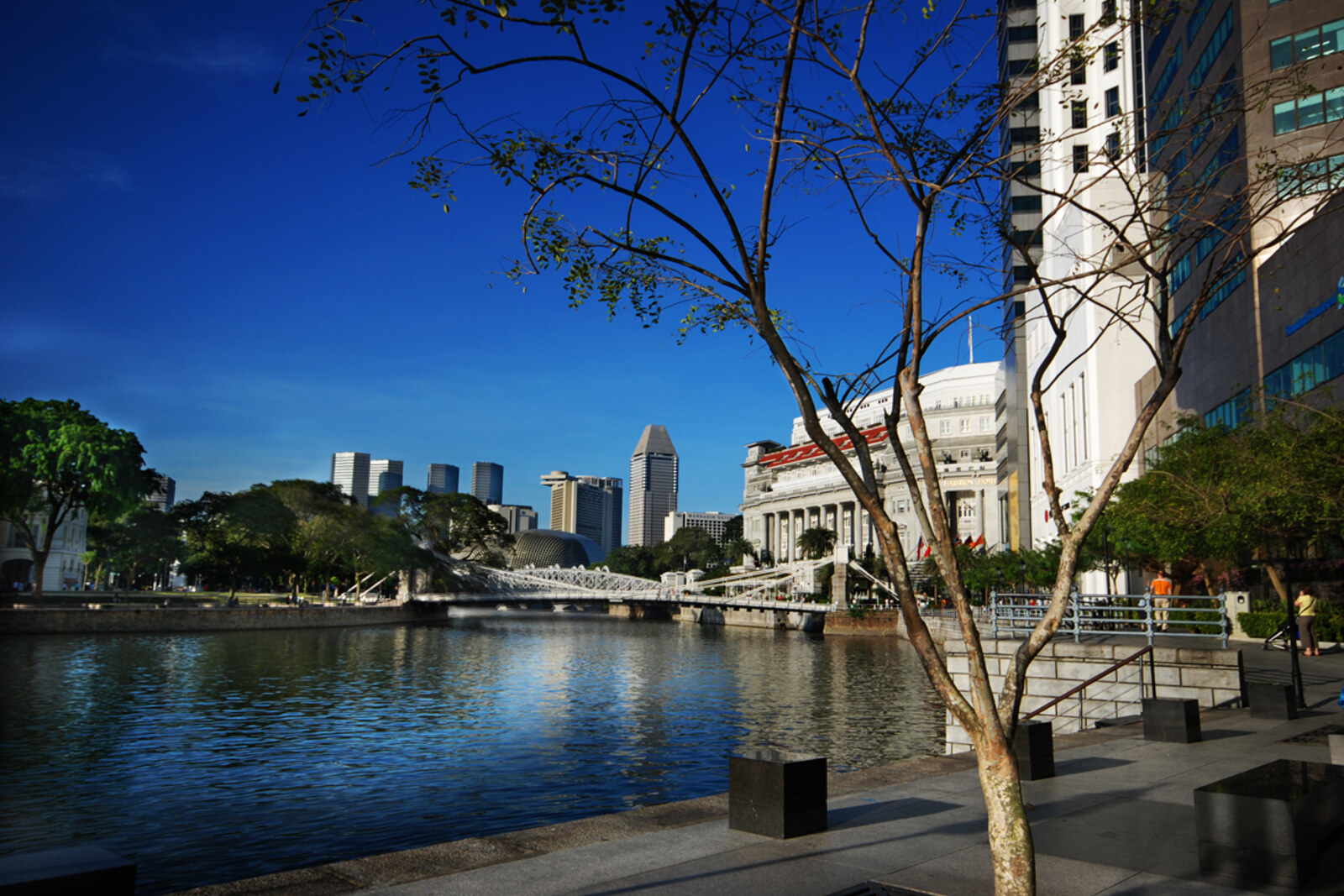
Look around first
What to notice
- The bridge's iron gates
- Police prohibition signs
- Coats of arms above the entrances
- The façade of Fullerton Building
The story of the place
For a long time, the mouth of the Singapore River divided two working banks, with government offices on the northern one and the offices of trading houses on the southern one. To get between them, people paid boatmen or paid to pass through the turnstile of a temporary crossing. The permanent iron span was assembled from parts brought from Glasgow, and Indian convicts worked on its construction, though the records did not preserve their names. Coats of arms remain by the iron gates, and the southern end leads to Fullerton, where a fort built to protect the harbor was replaced by the General Post Office.
At both ends of the bridge, an order from the chief of police survives: livestock and horses must not be brought onto it, and a loaded carriage must not weigh more than three English hundredweights—roughly one hundred fifty-two kilograms. An adult bull would already exceed that limit. The signs remain from a twist in history in which the new bridge very quickly proved too weak for the city that had called for it.
Until the eighteen sixties, there was no permanent crossing at the very mouth of the Singapore River. Government offices stood on the northern bank, while Commercial Square—today's Raffles Place—with the offices of trading houses stood on the southern bank. The river lay between civil servants and merchants: they had to pay a boatman or walk across a temporary pedestrian bridge with a turnstile and a toll. Complaints about this crossing continued for decades.
In eighteen sixty-seven, the colonial administration commissioned an iron bridge. A Glasgow firm made its parts and, before shipping them, loaded them with a weight four times greater than that of the structure itself. In Singapore, Indian convicts assembled the sections. Once installation was complete, Madras sepoys—Indian soldiers in the colonial army—were marched across the deck several times: their formation served as a test load.
For the convicts, the assembly was part of their punishment. The British transported convicts from India to Singapore and assigned them to categories: some worked in chains, others went on to public works after a probationary period, and the most trusted could receive a ticket of leave. The bridge became one of the last major works of this system. The transport of new convicts stopped when Singapore was removed from the jurisdiction of British India in eighteen sixty-seven. Convict labor brigades continued to work for another six years; then the last convicts were sent to India and the Andaman Islands, while holders of the highest-class tickets were allowed to remain as free people. The names of those who assembled the bridge were not preserved in the records.
Cavenagh's name did not appear at once either. Governor Harry St George Ord, under whom construction was being completed, wanted to call the crossing Edinburgh Bridge, in honor of the Duke of Edinburgh, who was visiting the colony. Members of the Legislative Council persuaded him to choose the name of his predecessor, William Orfeur Cavenagh. Cavenagh governed the Straits Settlements—the united British possessions of Singapore, Penang, and Malacca—from eighteen fifty-nine to eighteen sixty-seven, and he became the last governor appointed through British India. Cavenagh's coat of arms was fixed above the bridge entrances; it was thanks to a departing administrator, not a memorial to his work on the crossing itself.
Pedestrians, rickshaws, carts, and even a tram used the bridge. It was built so low that large boats had to wait for the water to fall at high tide. By the beginning of the twentieth century, traffic on its deck had grown as well. In nineteen ten, the stronger Anderson Bridge opened nearby, heavy transport was redirected there, and Cavenagh Bridge was left to pedestrians. The police signs banning horses, livestock, and heavy carriages still stand by the iron gates.
The southern end of the bridge leads directly to Fullerton. Robert Fullerton was the first governor of the Straits Settlements, but the present building appeared almost a century after his service. His name came here through a vanished structure: Fort Fullerton stood at the river mouth, named after the governor and intended to protect the harbor and trading ships.
Merchants whose warehouses crowded along the river saw another danger in the fort. In an attack, its artillery position could turn neighboring warehouses into targets. After their appeals, the colonial administration decided to remove the fortification. By eighteen seventy-three, the fort had been demolished, and the General Post Office was built in its place—now useful to the merchants, since letters and documents no longer had to be transported from the other bank.
Governor Hugh Clifford opened the present building in nineteen twenty-eight. He named it Fullerton Building in memory of the demolished fort and Robert Fullerton. The General Post Office operated on the lower floor; bags from ships were delivered through an underground tunnel from the pier, bypassing the busy waterfront. There is now a hotel inside. The postal hall and the fort are no longer here, but their shared name remains on the river promontory—Fullerton.
Useful on site
The bridge and waterfront are usually accessible as open pedestrian infrastructure. Restrictions are possible during major city events, rehearsals, and closures by the bay.
Checked: July 1, 2026. Check the official source before visiting.It is best to look at the bridge first from the side, then walk across it without holding up the flow of people for a photograph. Fullerton is used differently today, so this account does not assume free access to its historic service rooms.