 Guide On Map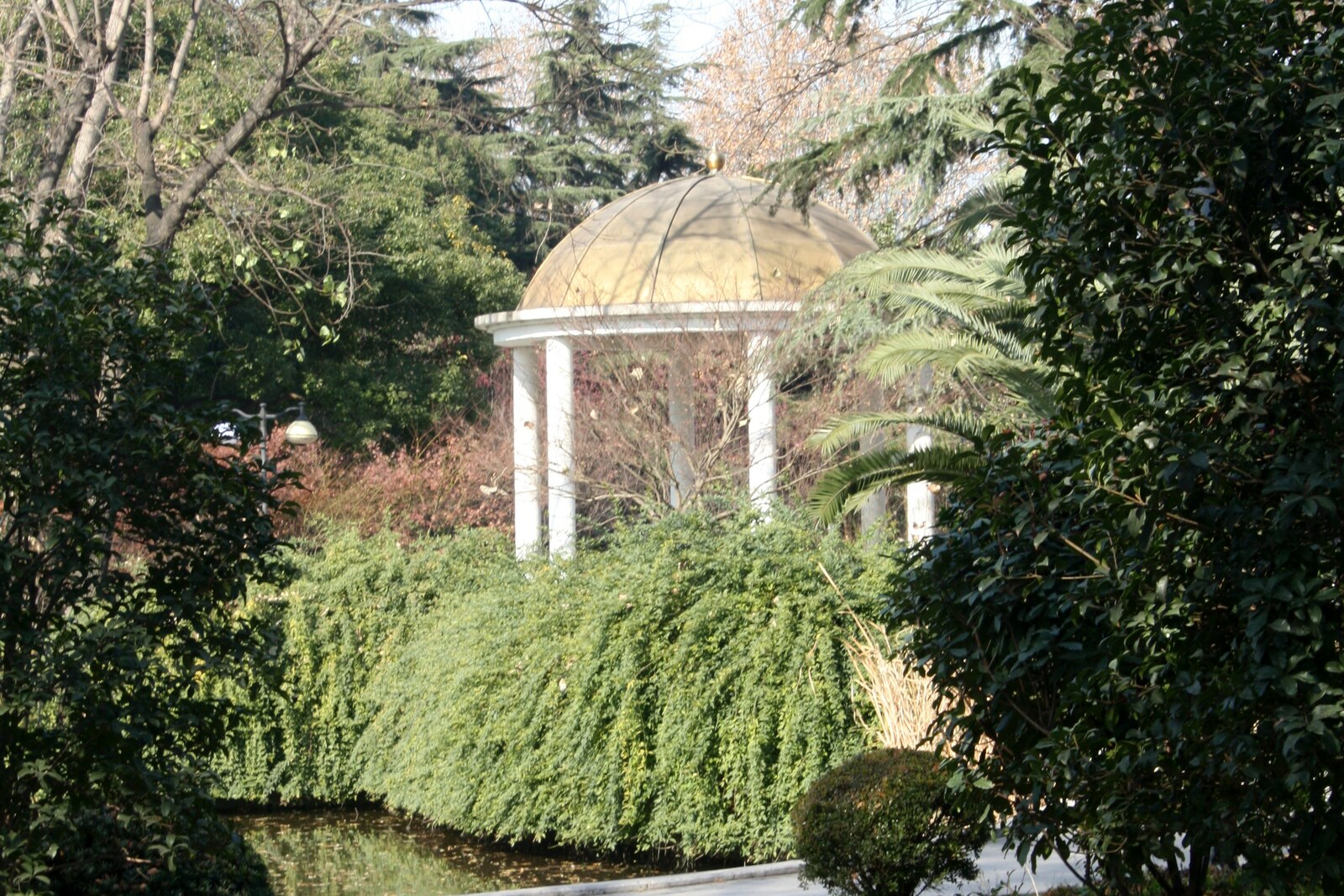
Look around first
What to notice
- Large lawn
- Plane-tree avenues
- Rose garden
- Pond and pavilions
The story of the place
Regular morning visitors divide Fuxing Park into small clubs: some practice tai chi, while others dance, sing in a choir, play instruments, or paint characters with a brush. A large lawn, two broad plane-tree avenues, a rose garden, a pond, and pavilions give each group its own space. The French Municipal Council created this geometric layout beginning in nineteen oh nine. At the time, the park was called Gujiazhai, after the Gu family village.
In the fall of nineteen thirty-seven, workers began building iron cages and a large aviary in its northeastern part, closer to what is now Chongqing South Road. They were built for animals that Shen Xiangrui, director of the city zoo, was trying to evacuate through war-torn Shanghai.
Shen's zoo stood near the Confucius Temple, in the Chinese part of the city. He created it as a hands-on school of natural science, and more than one million people visited it in its first year. Eighteen employees cared for the animals, though only eight held permanent positions. When fighting for Shanghai began in August, Shen and several colleagues closed the gates, moved into the zoo itself, and continued feeding the animals. Soon, an antiaircraft shell punched through the roof of the service building.
Shen feared two outcomes. If the cages were destroyed, lions, tigers, bears, and leopards would end up among residential neighborhoods. If city funding ceased, more than one hundred species of animals would die of hunger. He arranged a temporary site in another park, but six iron sections were priced at three thousand nine hundred yuan, and he was not given the money. Shen still expected to bring the animals home after the war, so at first he asked only for temporary accommodation.
On November ninth, Japanese troops entered the Chinese districts. Shen and the workers lured the predators into cramped portable cages and moved them to the international refugee zone. Funding for food and upkeep stopped for good. The director then abandoned his earlier plan and offered the animals to the French Municipal Council as a gift for Gujiazhai Park. Once they had been handed over, he could no longer demand them back.
By then, passageways between the Chinese and French parts of the city had been blocked with iron gates. Two crossings remained, where people were allowed through with documents. Shen and his staff obtained permits and took lions, tigers, leopards, bears, and wolves through them, followed by kangaroos, macaques, deer, cranes, peacocks, and pelicans. The two crossings were then closed. The second group remained in the old zoo and died along with the destroyed cages.
The French Municipal Council allocated about four thousand square meters in the park's northeastern corner to the rescued animals. By the following summer, a zoo with a separate admission ticket had opened here. But the shelter proved temporary. During the occupation, the animals were moved to another park; food arrived irregularly, and there was a shortage of specialists and medicines. A python froze to death, while the lions, tigers, and a black leopard died of disease. Of the group Shen had moved, mainly macaques, civets, crocodiles, and several other small species survived. Shen himself refused to serve the occupation administration, left his post, changed his name, and went into hiding.
In January nineteen forty-six, the park received its current name, Fuxing—“Revival.” A few years later, the zoo was restored, new animals and an aquarium were added. In nineteen sixty-three, it was closed for good, and its inhabitants were moved to Western Suburb Park, now Shanghai Zoo.
In the eastern part of Fuxing Park, there are no longer any iron cages, large aviary, or aquarium. In their place, there have been a circular area with electric horses, a swimming pool, and a dance hall. All that remains of the rescue zoo is its exact site by Chongqing South Road, among the avenues where people now exercise.
Useful on site
The official city listing describes the park as open year-round and all day; check individual areas and events on site.
Checked: June 28, 2026. Check the official source before visiting.Do not treat the regular visitors' activities as a street show: observe unobtrusively and ask permission before taking close-up photographs of people.