 Guide On Map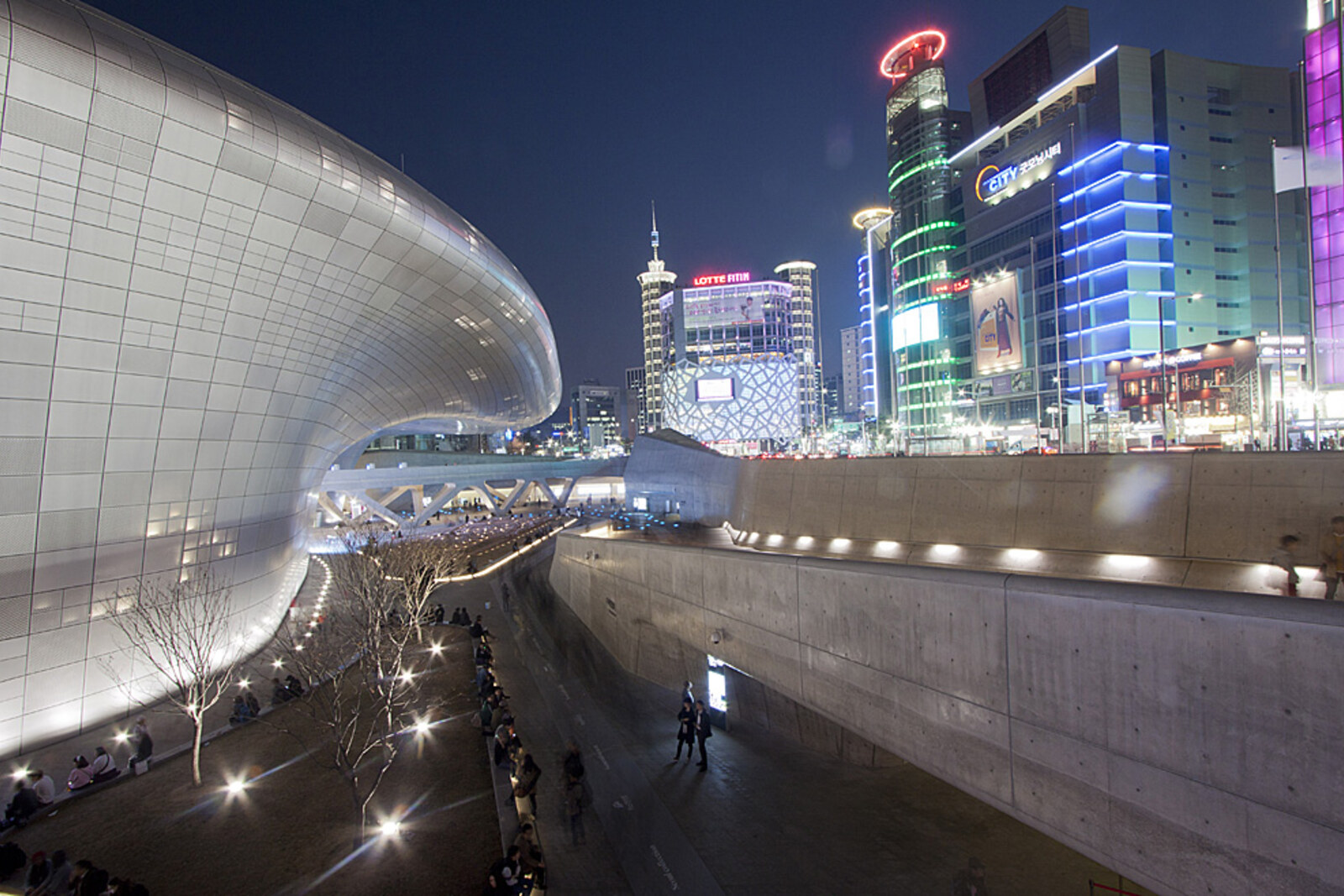
Look around first
What to notice
- Silver aluminum shell
- Two arches of Igansumun
- Line of the city wall
- Stone foundations of Hadogam
The story of the place
The silver shell of Dongdaemun Design Plaza consists of forty-five thousand one hundred thirty-three aluminum panels, differing in shape. Inside, there are exhibitions, conferences, and fashion shows, while beside the wholesale clothing markets there is a lab where local brands meet with overseas buyers. Beneath this smooth surface, on the second underground level of Oullim Square, the stone foundations of Hadogam, the lower camp of the Military Training Command, have been preserved. Farther east, the two arches of Igansumun and the raised line of the city wall leave the old city’s trace on the surface.
In January two thousand eight, Kim Byeong-hui, a senior archaeologist at the Jungwon Cultural Heritage Institute, was comparing old plans with the site where Dongdaemun Stadium was already being dismantled. The Seoul Metropolitan Government had assigned his group to find the remains of the city wall before new construction began. This was a commissioned rescue survey, with a deadline in April: whether the lost wall would make it into the report before the site was handed over to builders depended on the lines Kim chose for the test trenches.
The stadium opened in nineteen twenty-five under the name Gyeongseong—the name the colonial administration used for Seoul. Part of the fortifications and military buildings was demolished for the sports complex, and the site was covered with earth. The stadium was later renamed first Seoul Stadium, then Dongdaemun Stadium. By the time it closed, almost nothing of the earlier development was thought to remain.
From old maps, Kim determined that the wall should cross the football field diagonally and that the baseball ground lay on the inner side of the fortifications. Archaeologists laid out trenches along this line and found beneath the stadium a one-hundred-twenty-three-meter section of wall, a defensive projection, and Igansumun—a water gate with two stone arches. Nearby they found a wooden barrier, the foundations of about ten buildings, wells, water reservoirs, and one thousand one hundred thirty objects: roof tiles, ceramics, coins, and iron fittings.
The finds belonged to Hadogam, the lower camp of the capital's Military Training Command. Its soldiers guarded the vulnerable eastern part of Hanyang, trained here, and made weapons and gunpowder. Igansumun let the city's water out through the wall. The stadium's builders destroyed the upper parts of the structures, but the earth fill covered what remained in the ground.
By then, Zaha Hadid's project had already won the architectural competition. The British-Iraqi architect joined exhibition halls, underground passageways, and a park into one continuous surface; on the eastern side, she had planned a design street. After the excavations, the Seoul Metropolitan Government changed this part of the program. The street was replaced by a historical and cultural park, six excavated foundations were moved and restored, and part of Hadogam's stone masonry was preserved where archaeologists had uncovered it. Igansumun and the line of the wall also remained beside the new building.
Dongdaemun Design Plaza (DDP) opened on March twenty-first, two thousand fourteen. Inside, it hosts exhibitions, conferences, and Seoul Fashion Week shows; in the design lab, brands meet with overseas buyers. Such a center appeared here because of the neighboring wholesale clothing markets and sewing districts. Its silver shell was assembled from forty-five thousand one hundred thirty-three aluminum panels of different shapes.
On the second underground level of Oullim Square beneath this shell lie the stone foundations of Hadogam. Farther east, on the site of the planned design street, stand the two arches of Igansumun, and the line of the city wall raised by archaeologists continues.
Useful on site
Usually 10:00‑20:00; individual spaces and events operate flexibly according to the program. Check holiday closures and exhibition tickets on the official website.
Checked: June 28, 2026. Check the official source before visiting.Walk around the complex from the outside and go down to the open archaeological sites: there is no single main facade here. Exhibitions and special spaces require a separate check of the program and visiting conditions.