 Guide On Map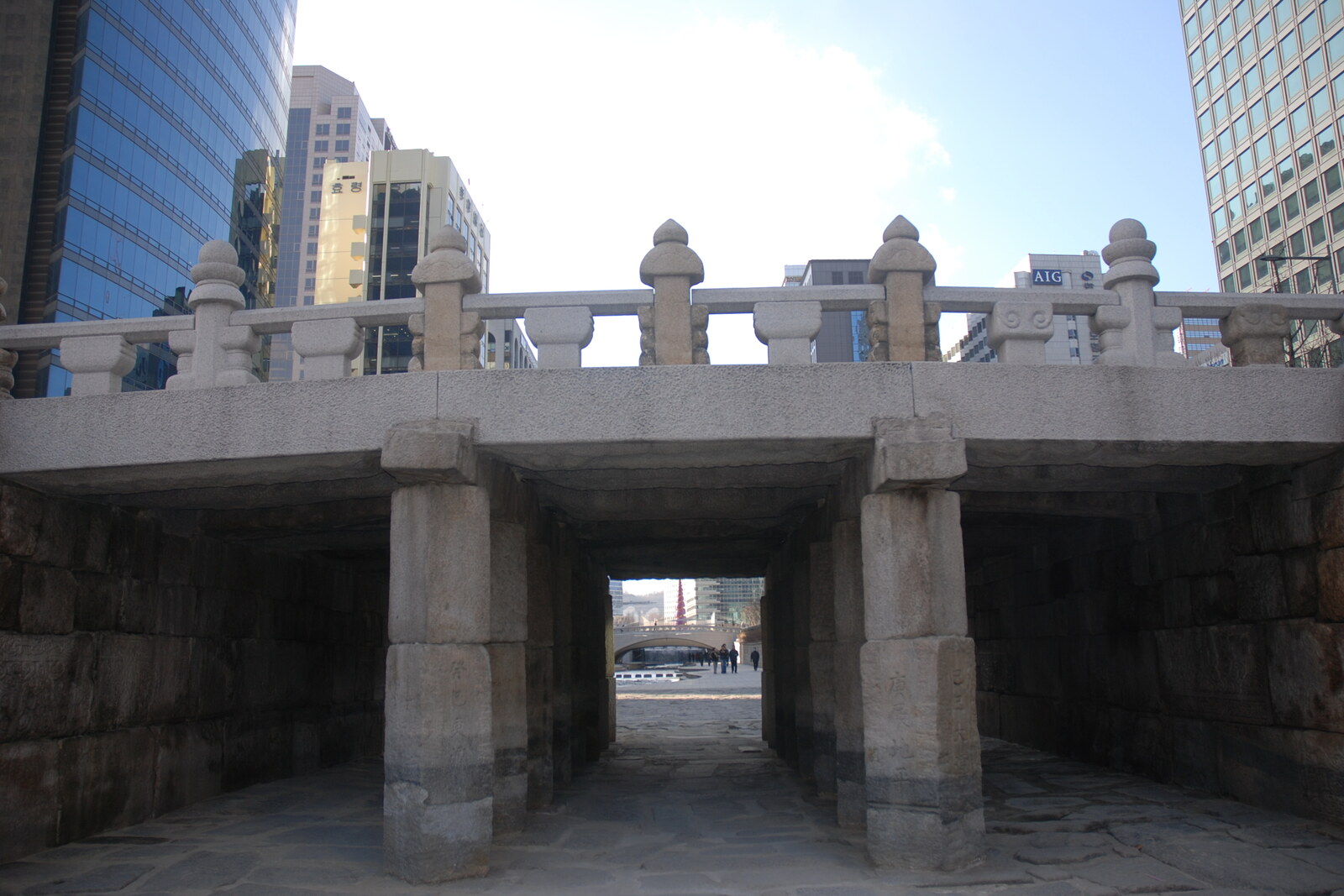
Look around first
What to notice
- Carved stone slabs
- An upside-down figure of a guard
- Stone abutments
The story of the place
Gwangtonggyo Bridge spans Cheonggyecheon Stream as a short stone crossing with heavy abutments right by the water. Its name preserves that of the Gwangtongbang quarter, and the road across the bridge connected the palace district, commercial Jongno, and the capital's southern gate. An earthen crossing once stood here, and the stream had already washed it away before. During the restoration of Cheonggyecheon Stream, the bridge was assembled one hundred fifty-five meters upstream from its former location, with the old blocks returned to the abutments.
In the abutments of Gwangtonggyo Bridge, you can see slabs with clouds, plant motifs, and figures of guards. Some images are upside down. These stones were carved for a royal tomb, and they ended up in the bridge after a struggle over succession to the newly established Joseon throne.
Queen Sindeok was the second wife of the dynasty's founder, King Taejo, and she sought to secure the throne for her children. In thirteen ninety-two, King Taejo named their younger son, Yi Bang-seok, as heir. The king's adult sons by his first wife were left aside. Among them was Yi Bang-won, a prince who had helped his father seize the throne and expected to receive his share in the new state.
Bang-won had his own armed detachment. The king's chief adviser, Jeong Do-jeon, pressed for the princely retinues to be disbanded: after that, the prince passed over in the succession would have no force capable of defending his claims. Queen Sindeok died in thirteen ninety-six. Two years later, Bang-won led his men against the palace. They killed Jeong Do-jeon, the heir Yi Bang-seok, and his elder brother. King Taejo abdicated, and after one more clash between the brothers, Bang-won became Joseon's third ruler under the name King Taejong.
King Taejo buried Queen Sindeok inside the city walls, near the palace, so that he could visit her. The tomb was named Jeongneung Royal Tomb and entrusted to the finest stonemasons: carved slabs surrounded the burial mound, while stone warriors and animals guarded it. After his father's death, King Taejong agreed to officials' proposal to move Jeongneung Royal Tomb beyond the capital. The queen's remains were transferred, the burial pavilion was dismantled, and the heavy decorated blocks were left in their original place.
In the summer of fourteen ten, a downpour flooded the city stream. People drowned, and the earthen Gwangtonggyo Bridge was destroyed again. The State Council proposed building a stone bridge from slabs from the old Jeongneung Royal Tomb. King Taejong agreed. The finished tomb blocks were laid into the foundations and abutments of the city's busiest crossing.
The upside-down images gave rise to a story that King Taejong ordered the stones laid so that passersby would tread on the memory of his stepmother. No such order appears in the chronicle: it records the flood, the council's proposal, and the king's consent. Researchers allow for a more ordinary reason for the disorderly masonry: the bridge was urgently needed, and ready-made slabs saved the stonemasons' work. Another thing is indisputable: it was under King Taejong that the royal tomb lost its former status, after which its decoration was permitted for use in construction.
The name Gwangtonggyo Bridge comes from Gwangtongbang, the name of this city quarter. The main road between the palace district, commercial Jongno, and the capital's southern gate crossed the bridge, so the earthen crossing could not be left destroyed.
When Cheonggyecheon Stream was restored in two thousand five, the bridge was assembled one hundred fifty-five meters upstream from the original crossing. The old carved blocks were returned to the abutments. A stone guard that ended up upside down has remained here since fourteen ten: it is a detail from the queen's tomb, whose son Yi Bang-won killed, whose tomb King Taejong ordered moved out of the city, and whose slabs he permitted to reinforce Gwangtonggyo Bridge.
Useful on site
Usually accessible around the clock as part of the Cheonggyecheon Stream embankment; during rain and evacuation announcements, the lower paths and areas beneath bridges may be closed.
Checked: June 28, 2026. Check the official source before visiting.The reliefs are set low, and not all of them can be seen from one point. Examine the masonry from the path along the channel, without climbing onto the stones.