 Guide On Map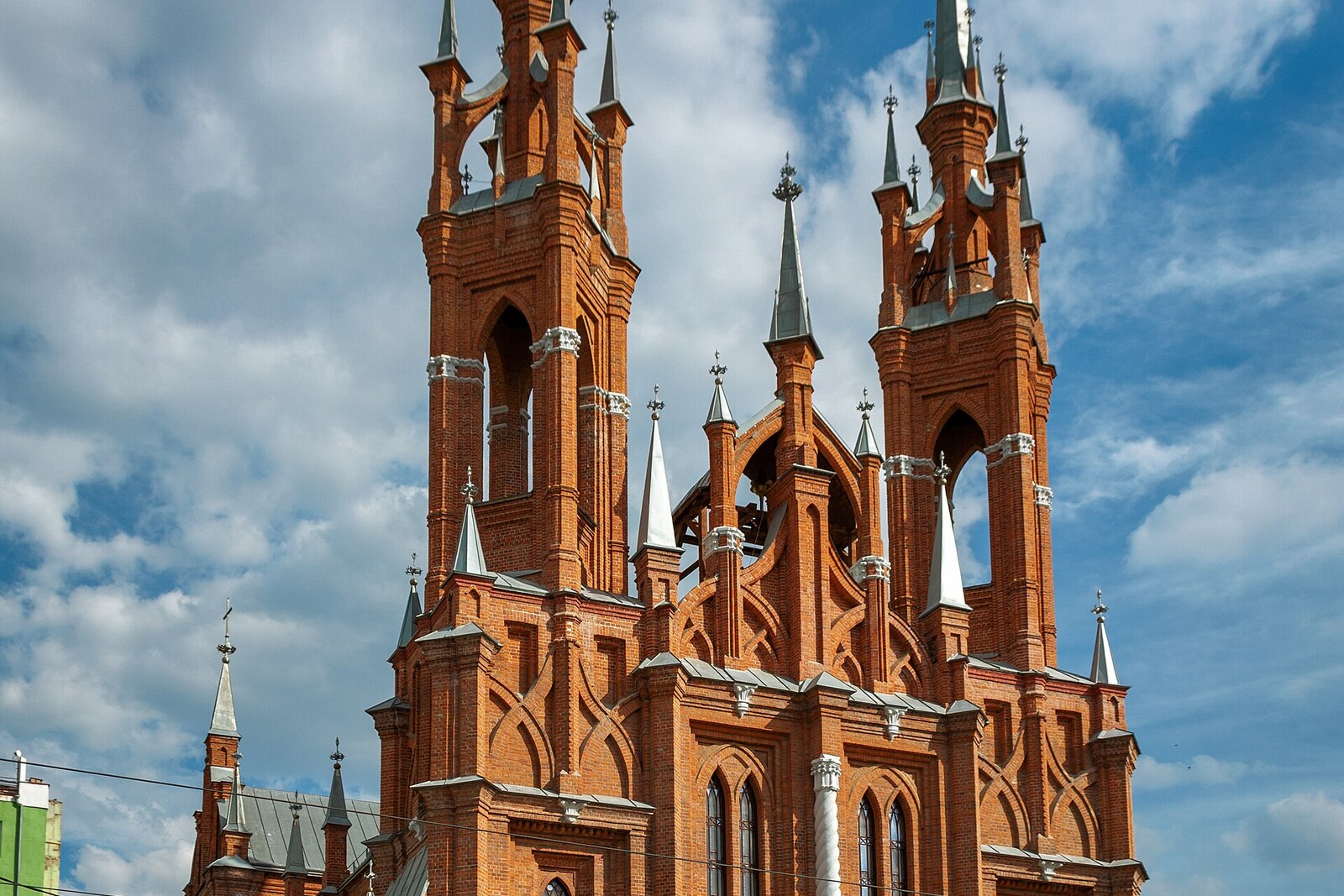
Look around first
What to notice
- Red-brick façade
- Two spired towers
- Two-story wooden house behind the church
- Pointed-arch windows
The story of the place
Two spired towers and pointed-arch windows rise above the red brick of the Catholic Church of the Sacred Heart of Jesus. Parishioners collected funds for the stone church for several years, after the former chapel could no longer hold the community; the new walls rose in front of the wooden house on the same site. The name is connected with Catholic veneration of Christ’s heart as a sign of human and divine love, revealed in compassion and the sacrifice of the cross. The church was nicknamed the Polish kościół because Poles made up about three quarters of Samara’s Catholics.
Behind the red-brick church, a two-story wooden house has survived. The history of this site began with that house—and with the actions of the merchant Iosif Yegorovich Dochar, the elected overseer of the Samara Catholic prayer house. He sought permanent premises for the community, where a priest could live and celebrate Mass.
Samara’s Catholics petitioned for their own church for several decades. Their first church was almost completed elsewhere, but after the Polish uprising of eighteen sixty-three, the building was transferred to the Lutherans. New petitions were filed from eighteen eighty-one onward. The Ministry of Internal Affairs finally allowed a prayer house to open, but the question of free land continued to make its way through official channels.
Then the building committee asked Dochar to act in his own name. The merchant bought a plot on Saratovskaya Street—the former name of what is now Frunze Street—and built a wooden house at his own expense. The priest and church staff were housed downstairs, while the prayer hall was upstairs. The land, the building, and the expenses were still on Dochar’s account; the community rented the house from a man willing to answer with his merchant’s property for its first permanent address. On November first, eighteen eighty-eight, the chapel was consecrated.
Two years later, the Samara Roman Catholic Parish received official recognition. Two years after that, it was allowed to buy the plot, together with the house, from Dochar. The private transaction by a merchant achieved what petitions had failed to achieve: the land became parish property, and Catholics could no longer be sent to hold services in other people’s premises.
The wooden chapel soon became too cramped. For several years, parishioners collected donations and by nineteen hundred had raised more than seventy thousand rubles. A stone church was built in front of the old house and, on February twelfth, nineteen oh six, was consecrated in honor of the Sacred Heart of Jesus. In Catholic tradition, Christ’s heart signifies his human and divine love, revealed in compassion and the sacrifice of the cross. The name therefore refers to Jesus himself, not to a relic kept here.
The church was nicknamed the Polish kościół because of its parishioners: in the late nineteenth century, Poles made up about three quarters of Samara’s Catholics, and the Polish word kościół meant a Catholic church. Masses are held here again today. The stone church occupies the front part of the site, while behind it stands the house that, after the church opened, went on to serve as a school, a shelter, and a parish hotel. The upper floor, where the first chapel began, has survived behind the two forty-seven-meter towers.
Useful on site
According to Visit Samara, open for visits and tours Tue–Fri 10:00–18:00; services, concerts, and parish events may affect access.
Checked: June 24, 2026. Check the official source before visiting.This is an active church, not merely an architectural attraction. Enter only when it is open, keep quiet, and do not photograph people without permission.