 Guide On Map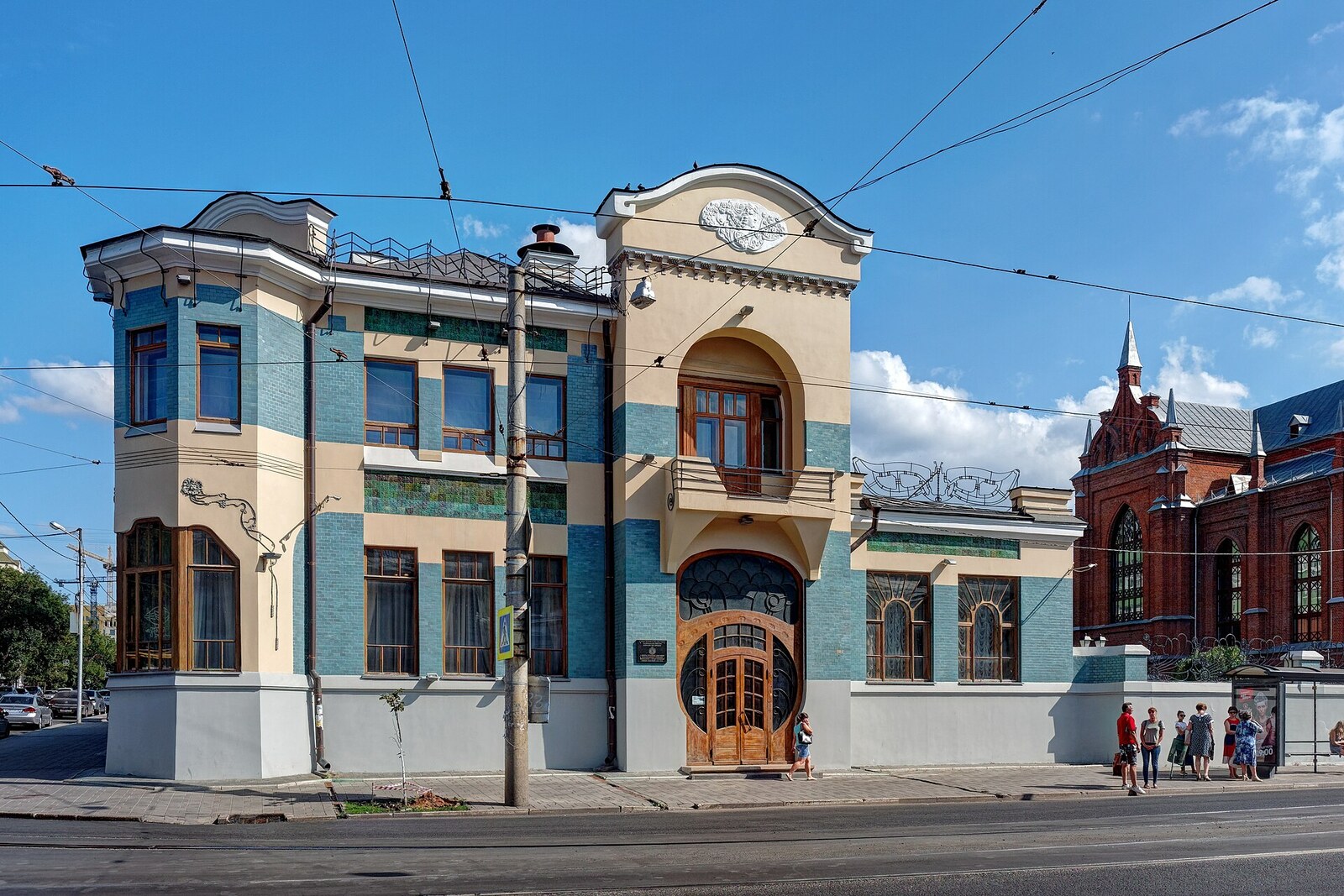
Look around first
What to notice
- Female head above the entrance
- Floating nymph on the boudoir ceiling
- Heating grilles
- Rock-crystal seal
The story of the place
The Museum of Art Nouveau is housed in a city estate where the rooms themselves, rather than a separate display case, remain the main exhibit. From the central hall, the office, boudoir, dining room, and reception halls branch out: each had its own purpose and interior, but the parquet floors, fireplaces, door glass, stucco, and hot-air heating grilles united the house into a whole. Warm air rose from the basement through passages hidden in the walls; some of these passages and the ventilation chamber have survived. A female head remains above the entrance, and a flying nymph is on the boudoir ceiling; their likeness to the lady of the house is considered a city legend, not confirmed by documents.
In the summer of nineteen oh three, the grain merchant Aleksandr Georgievich Kurlin was seeking to have his new house connected to electricity. The equipment had already been purchased, but the manager of the city power station refused: no spare capacity remained. A friend of Kurlin's proposed transferring to him part of the limit allotted to his own house—twenty-five of the eighty lamps. It did not help. Kurlin filed another petition and promised that no more than twenty-five lamps would be lit at the same time. He received permission only in November. Seven years later, the mansion already had ninety-two light bulbs.
Kurlin could afford such persistence thanks to his grain trade. In Zasamarskaya Sloboda, across the Samara River, he had an office and grain warehouses. Construction of the mansion cost nearly fourteen thousand rubles—more than twice as much as an ordinary wealthy house of that time. The architect Aleksandr Zelenko designed a house for Kurlin and his wife, Aleksandra Pavlovna Kurlina, with running water, sewerage, a telephone, and hot-air heating. The air traveled from the basement through channels inside the walls; some of these channels and the ventilation chamber have survived.
The Museum of Art Nouveau was opened here because the mansion itself serves as the main exhibit. Around the central hall, Zelenko arranged the rooms according to their purpose: an office for business conversations, a boudoir for private conversations, a dining room, and reception halls. Each had its own interior, but the door glass, parquet floors, stucco, fireplaces, and heating grilles formed a unified decor. Today, the office, boudoir, and dining room have been recreated on the first floor, while temporary exhibitions are held upstairs and in the basement.
Five years after the housewarming, the family's arrangements had to change. In nineteen oh eight, Aleksandra Pavlovna Kurlina sought to preserve her husband's affairs and property: Aleksandr Georgievich Kurlin was declared legally incapacitated because of mental illness, and his wife was appointed his guardian. The medical papers have not survived, but a court file with household receipts has. Almost all of them were already made out to Aleksandra Pavlovna Kurlina: electricity, telephone, groceries, parquet polishing. She managed the trading affairs, maintained the house, and continued paying for the education of four students at a commercial school.
Aleksandr Georgievich Kurlin died in nineteen fourteen. His widow became the official owner of the estate, and the feminine name became established in local speech—Kurlina Mansion. The female head above the entrance and the floating nymph on the boudoir ceiling are considered images of Aleksandra Pavlovna Kurlina, but this is a city legend: researchers found no documents confirming the likeness.
After the events of nineteen eighteen, Aleksandra Pavlovna Kurlina's property was confiscated. She left for Moscow and lived there for more than half a century in a communal apartment. From her former life, the widow kept her husband's rock-crystal seal, engraved with the initials “A. G. Kurlin.” Before her death, she gave it to a neighbor and asked her to send it to Samara. In nineteen ninety, the seal was transferred to the local history museum, whose exhibition was already housed in this mansion. It returned to the very office from which Aleksandra Pavlovna Kurlina had once begun managing the affairs of her ailing husband.
Useful on site
Mon closed; Tue–Wed 10:00–18:00; Thu–Fri 13:00–21:00; Sat–Sun 10:00–18:00. The ticket office closes 30 minutes earlier. A regular ticket to the main exhibition in 2026 is 500 rubles; check the museum website for concessions and guided tours.
Checked: June 24, 2026. Check the official source before visiting.The interiors are accessible only during museum hours, but the exterior remains meaningful in its own right. Do not limit yourself to the main entrance—view the facade from different points.