 Guide On Map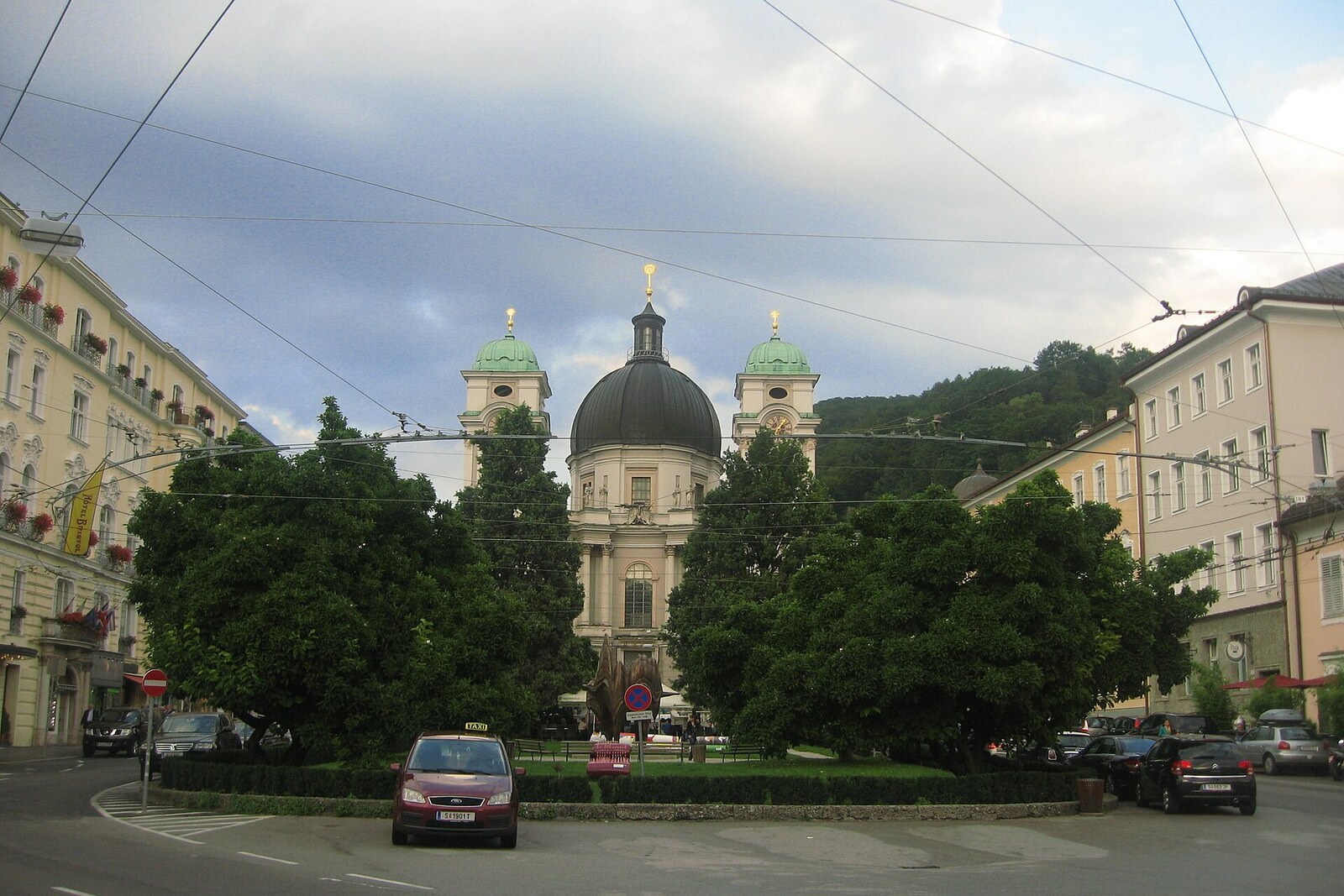
Look around first
What to notice
- Central dome
- Two towers with flat finishes
- Right wing of the complex
- Painting of Mary's coronation
The story of the place
At the end of the seventeenth century, a complex for the Salzburg seminary was built with a church between two residential and teaching wings. The large dome brought the building together as a unified whole; beneath it, future priests took part in worship. Johann Michael Rottmayr's painting depicts Mary's coronation by the Father, the Son, and the Holy Spirit in the form of a dove; the church received the name Holy Trinity Church from this scene. Two towers with flat finishes stand on either side of the façade, and the entrance to the archiepiscopal seminary is again in the right wing.
On April thirtieth, eighteen eighteen, twenty-year-old Elisabeth Trepka was preparing lunch in the right wing of this building. She was the wife of a patrol commander and lived with her husband in the barracks. The military occupied part of a complex built for an entirely different purpose.
At the end of the seventeenth century, Prince-Archbishop Johann Ernst von Thun conceived of giving the Salzburg seminary a permanent home. The church was built between two residential and teaching wings. The dome served as the center of the whole composition, and beneath it future priests took part in worship. After Salzburg came under the administration of the Austrian Empire, one of the buildings was handed over to a Jäger battalion. Thus, the seminary kitchen became a soldiers' kitchen.
The military were assigned to fight fires then, so their wives were allowed to cook only when the barracks were at full strength. That day, the garrison had left for a parade in honor of the arrival of a distinguished guest. Trepka decided to prepare lunch anyway and placed a pan of rendered fat over the fire. Water was boiling nearby.
No one saw the exact moment. Investigators found burnt fat in the chimney, and Trepka herself, after lengthy interrogations, admitted that she had been cooking. According to their reconstruction, water entered the red-hot pan. The burning fat was thrown through the chimney onto the dry wooden roof.
There were no soldiers on duty nearby. A cannon signal for the fire was given from the fortress, but people were awaiting the distinguished guest's arrival and at first mistook the shot for a salute. By the time the military broke formation and ran to the barracks, the roof was already burning. The wind carried the fire along the wooden shingles of neighboring houses. The fire lasted several days: twelve people died, nearly three hundred families lost their homes, and more than eighty buildings were destroyed or severely damaged.
Elisabeth Trepka was arrested and tried in Linz. No intention to start a fire was found; the time she had spent under arrest was counted as punishment, and she was released. The consequences lasted longer for the battalion: the military lost their buildings on the right bank, were refused permission to build new barracks, and had to withdraw some units from Salzburg.
The church towers were scorched, and some altar figures were lost. The oval hall beneath the large dome suffered much less. On October twenty-fifth of the same year, the church reopened; inside, mainly cleaning was needed. The flat finishes of the two towers, now visible on either side of the façade, were installed only after the fire.
Under the central dome, Johann Michael Rottmayr's painting remained. The artist depicted Mary's coronation by the Holy Trinity—the Father, the Son, and the Holy Spirit in the form of a dove. The church received its name from this scene.
The entrance to the archiepiscopal seminary is again in the right wing. A bookstore now operates in the corner section of the complex where the fire began. Above the former barracks kitchen, the dome with Rottmayr's painting still rises.
Useful on site
Salzburg.info publishes Mass times; tourist entry depends on open doors, services, and events.
Checked: June 26, 2026. Check the official source before visiting.During a service, stay by the entrance or return later; if the doors are closed, the building's composition can still be clearly read from outside.