 Guide On Map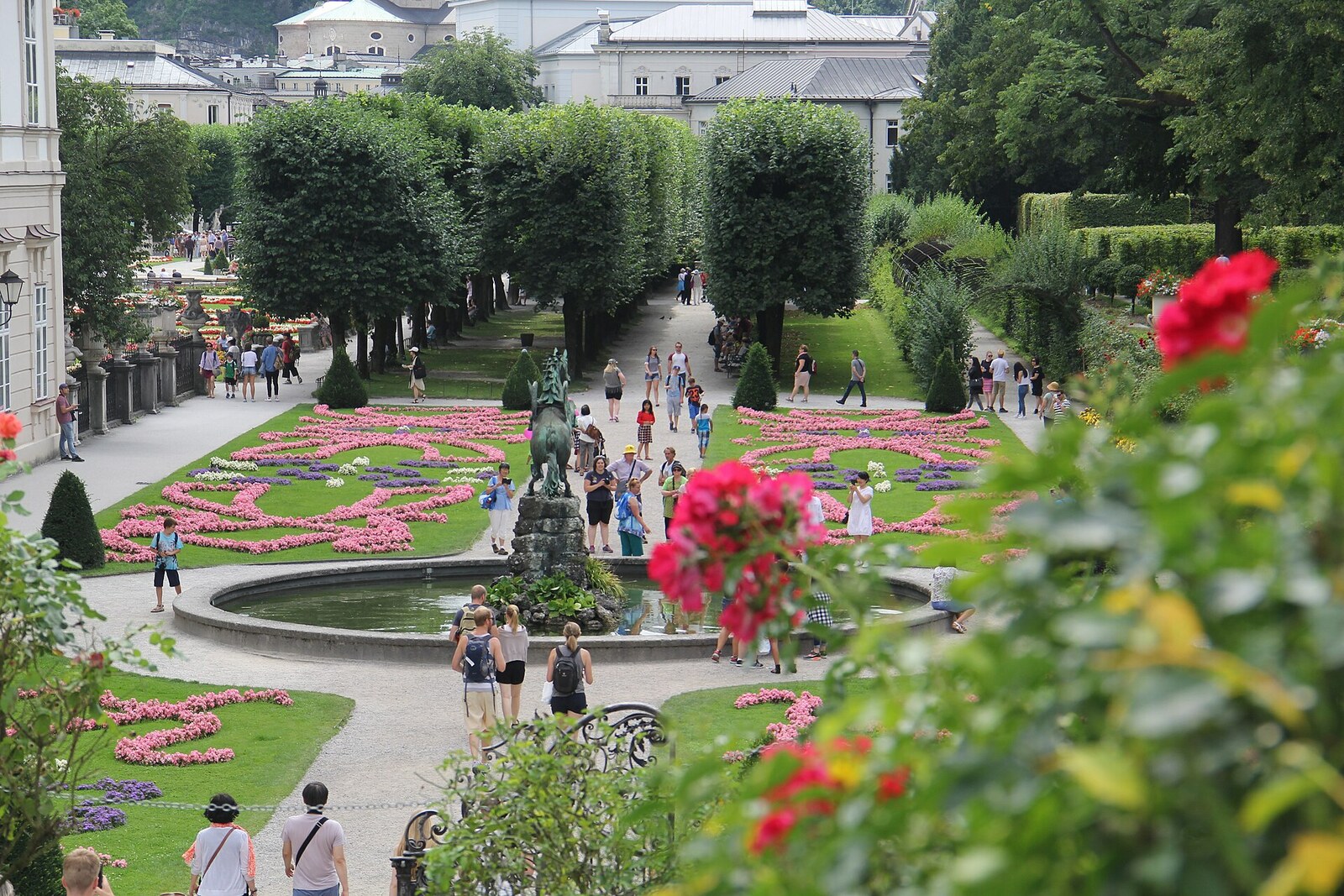
Look around first
What to notice
- Octagonal basin
- Four marble groups
- Shell and anchor on the bases
- Flames and birds on the bases
The story of the place
Eight marble figures around the large octagonal basin are arranged in four groups. Earth is represented by Hades, ruler of the underworld, and Persephone, whom he abducted. Water is represented by the Trojan prince Paris, taking Helen, the wife of the Spartan king, away by sea. Fire is represented by the Trojan warrior Aeneas with his elderly father Anchises on his shoulders: he carries him out of the burning city. Air is represented by Hercules and the giant Antaeus. Antaeus drew strength as long as he touched the ground; Hercules lifted him and strangled him. These are ancient myths, and the elements are additionally indicated on the stone bases by plants, a shell, a fish, an anchor, flames, and birds.
The groups were created by Ottavio Mosto of Padua. He made his living from stucco decoration and was only moving into monumental sculpture when Prince-Archbishop Johann Ernst von Thun, the ruler of Salzburg at the time, turned his attention to the garden of his summer residence. In January sixteen ninety, the court office commissioned Mosto to make four statues of the seasons, at two hundred guilders for each. The contract included a condition: if the first two did not please the client, the rest did not have to be made. For the master, this meant losing half the work and half the earnings.
The next contract suggests that he passed the test. As early as July fourteenth, Mosto was entrusted with much more expensive work for the center of the garden: four multi-figure compositions, at five hundred guilders each. The client provided iron tools and two assistants for fourteen days for each group. Thus, the former stucco decorator received a commission worth two thousand guilders and carved four scenes in which one person carries, abducts, saves, or kills another. They still stand in their original places around the basin.
More than two centuries later, city residents found a new use for this circle of figures. Electric lighting for the fountain was conceived as early as nineteen oh eight, but it was installed only in nineteen thirty, on the initiative of the Salzburg Beautification Society. The society enlisted a local electrical company and held evening concerts by the illuminated basin. Twenty-two thousand people attended six performances; one evening drew four thousand. The influx of visitors made it possible to fully recoup the installation cost in the same year.
Now, from the beginning of May to the end of August, the city once again holds concerts here. On Wednesdays, orchestras play opposite the Four Elements, while electric light highlights the jets, the basin, and those same groups by Mosto. Admission is free; in bad weather, the performance is canceled.
Useful on site
Open part of Mirabellgarten; access during daylight hours, with possible partial closures in winter and seasonal shutdowns of the fountains.
Checked: June 26, 2026. Check the official source before visiting.Walk around the basin: details of the elements are distributed among four separate groups.