 Guide On Map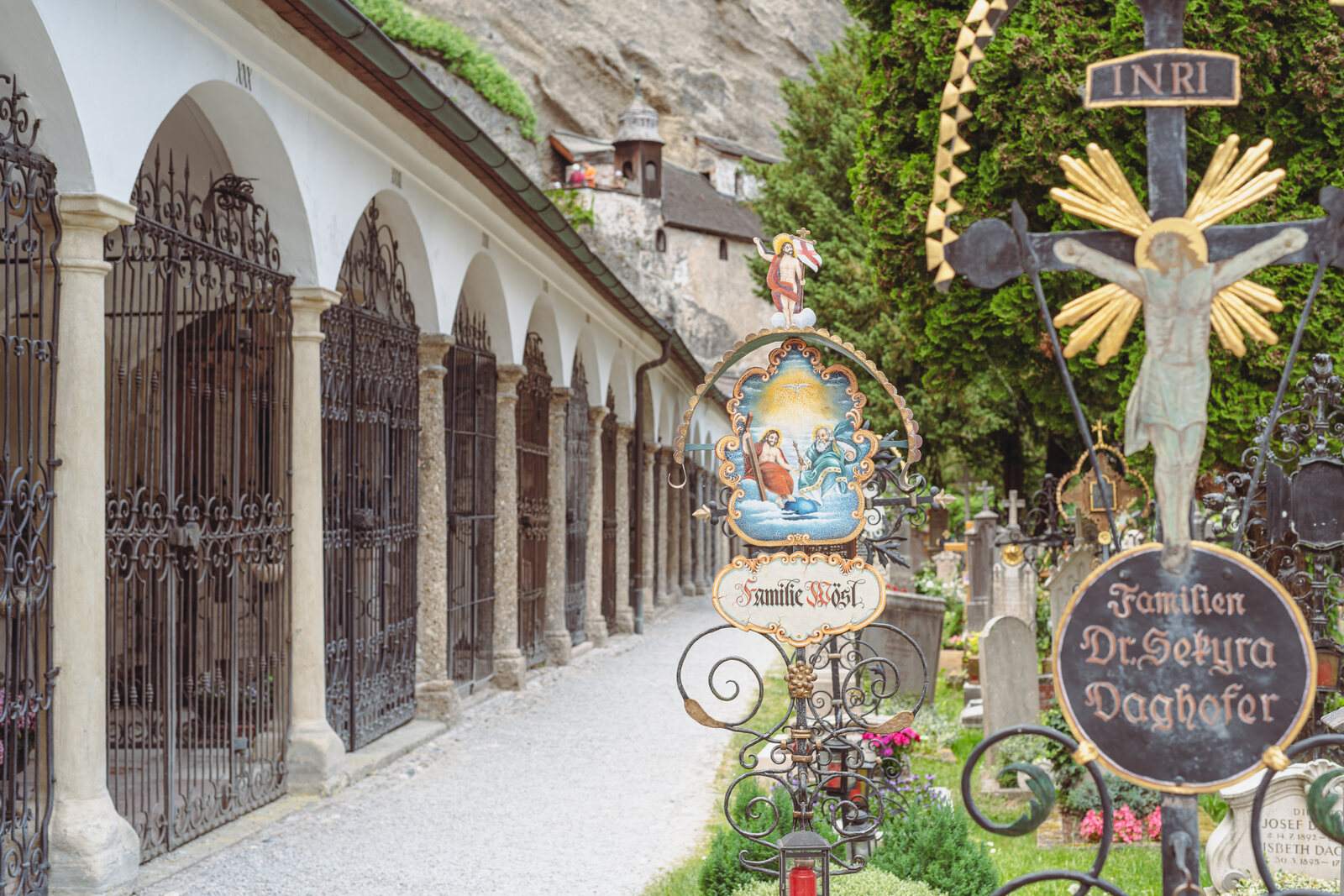
Look around first
What to notice
- St Peter's Church
- Ordinary graves
- Family vaults
- Cave chapels in the rock
The story of the place
At the foot of the rock, beside St Peter's Church, lies a cemetery that arose here as early as late antiquity. Between ordinary graves and family vaults rest the abbey's monks and townspeople. In the rock above the gravestones are cave chapels, later called catacombs, although an underground city of the dead never existed here. The monastic community still lives at the abbey.
On September tenth, nineteen thirty, the Benedictine Valentin Schmid was buried in monastic grave number four hundred five. An ordinary entry in the book of the dead marked the end of a ban that had lasted almost fifty-two years.
In eighteen seventy-eight, the city opened a new general cemetery and decided to hold all funerals only there. New burials were banned at St Peter's Cemetery. The old graves remained, but without new funerals the cemetery gradually fell into decline. The monks and the owners of family vaults maintained it at their own expense. Around nineteen hundred, a proposal appeared to give part of the land over to a passenger railway to Festungsberg. The Benedictines refused to surrender the plot, and no rails were laid among the graves.
Franz Martin helped restore the cemetery's purpose. He earned his living through archival work, directed the Salzburg State Archives, and studied the history of the city's monuments. In February nineteen twenty-eight, Martin gave a public lecture on the fate of St Peter's Cemetery and took the question of resuming burials beyond the abbey walls. After two years of negotiations, the city administration recognized that the monks had preserved the cemetery at their own expense and, on March twenty-fourth, nineteen thirty, allowed burials here again. At first, the right to bury was restored to the monastic community; then the graves of laypeople appeared here again.
By then, this place was already more than a thousand years old. The cemetery arose as early as late antiquity. In sixteen ninety-six, Bishop Rupert founded a missionary monastery nearby. Its church was dedicated to the apostle Saint Peter—a disciple of Jesus Christ whom Catholic tradition considers the first Bishop of Rome. From the church, the name passed to the abbey and the cemetery: Petersfriedhof means St Peter's Cemetery.
The openings in the rock above the graves were called catacombs only in the seventeenth century. That is an inaccurate name: the mountain contained cave chapels and hermits' shelters, not an underground city of the dead like the Roman one. The monks still live at the abbey, and since the decision of nineteen thirty, the cemetery has continued to receive the dead.
Franz Martin achieved this for others. In nineteen fifty, he too was buried. Among the ordinary graves of St Peter's Cemetery remains the name of the archivist who first returned the dead here and, twenty years later, followed them.
Useful on site
Abbey church daily 08:00-20:00, no tourist visits during services; cemetery April-September 06:30-20:00 and October-March 06:30-18:00; the catacombs operate on a separate seasonal schedule.
Checked: June 27, 2026. Check the official source before visiting.Keep quiet in the cemetery and do not go beyond the barriers. The ascent to the rock chambers requires separate steps and access; it is not a through-route to the next stop.