 Guide On Map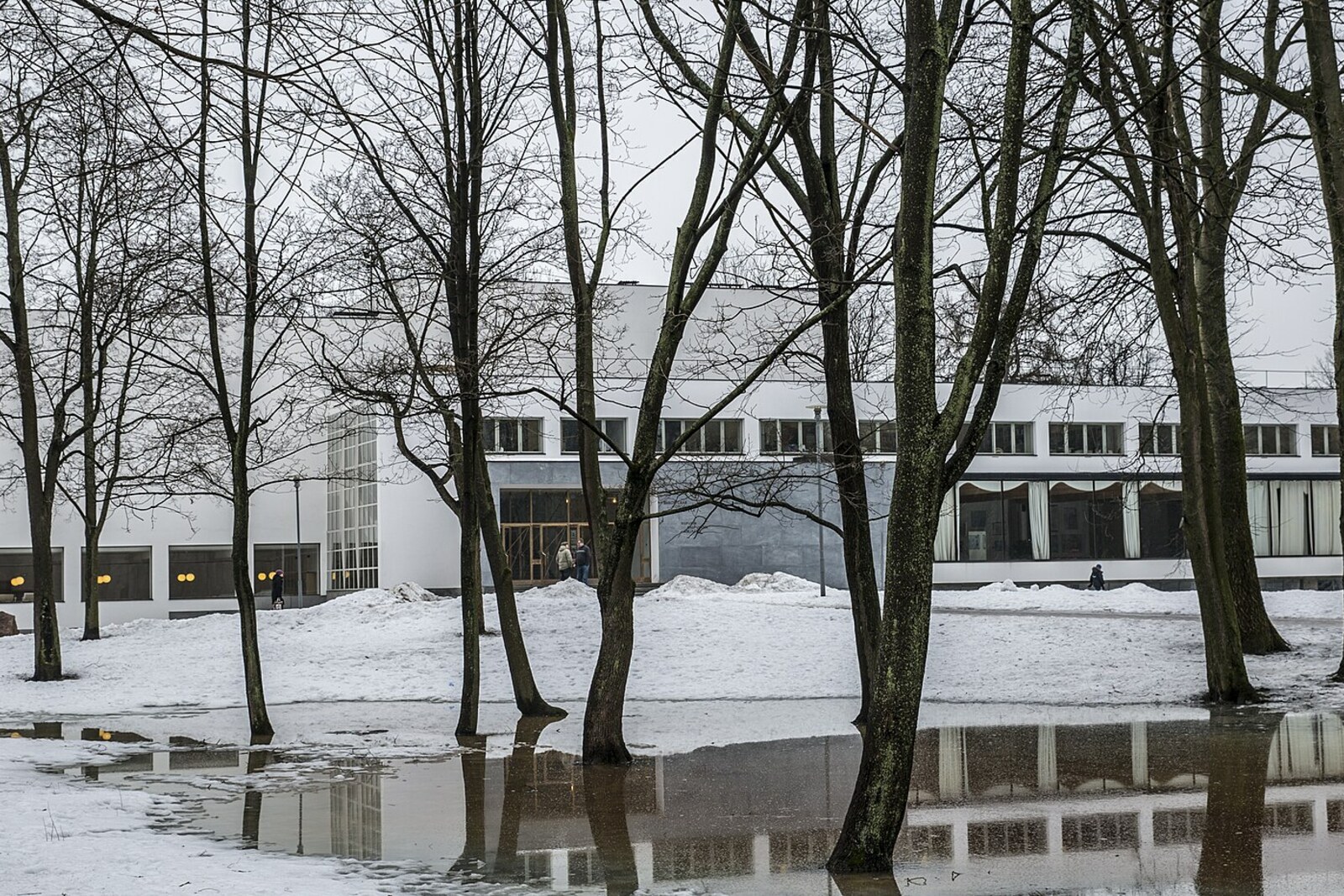
Look around first
What to notice
- Aalto’s surname above the entrance
- Fifty-seven circular skylights in the roof
- The undulating wooden ceiling of the lecture hall
The story of the place
Alvar Aalto’s surname entered this library’s official name only in nineteen ninety-four. Before that, Vyborg Central City Library had borne the name of Nadezhda Krupskaya since nineteen sixty-four. Alvar Aalto was not a writer or a collector of books. He was the Finnish architect who designed the building in front of which we are standing.
By the beginning of the nineteen nineties, the library’s director, Svetlana Semyonova, was responsible at once for readers, book collections, and a building that needed serious repairs. Outside Vyborg, it was studied as one of the leading monuments of twentieth-century architecture, while in the city itself the architect’s name meant little to most people. Even after the renaming, a library survey showed that nine out of ten Vyborg residents surveyed did not associate the surname Aalto with this building.
In nineteen ninety-one, the city asked the Aalto architectural bureau for help. The work was begun by Elissa Aalto—an architect, Alvar’s widow and colleague, who sought to restore his original vision. In nineteen ninety-three, Elissa Aalto and Svetlana Semyonova laid a commemorative stone at the entrance. At the same time, the library staff unanimously decided to include the architect’s surname in the institution’s name. The name helped identify precisely what they were saving: ordinary repairs to the building were no longer enough; the architect’s original architecture had to be restored.
Aalto received this commission at the age of twenty-nine. In nineteen twenty-seven, he won an anonymous competition with a project bearing the motto “three double vees.” The money for construction was left by Maria Lallukka, the widow of the Vyborg entrepreneur Juho Lallukka: she bequeathed half of her estate to the city for a new library.
The economic crisis delayed construction, and the city moved it to the present site in the park. Over five years of waiting, Aalto almost completely reworked the original design. The classical facades with friezes disappeared. The final drawings included a sunken reading room, a separate entrance to the children’s department, rooms for clubs and lectures, and fifty-seven circular skylights in the roof. Through them, diffused light reflects off the walls and reaches the books without direct rays. Aalto designed the undulating wooden ceiling of the lecture hall so that speech could be heard not only from the lectern: the hall was intended for a shared conversation in which people from the floor could take part. Opened in nineteen thirty-five, the Vyborg library brought the young architect worldwide fame.
Elissa Aalto died in nineteen ninety-four and did not live to see the completion of the work she had begun. Finnish and Russian architects continued to measure the building, search for old drawings, and restore lost details. Because of a lack of money, the restoration stretched out for almost twenty years. In November two thousand thirteen, the library reopened after the main work was completed.
Today, books are lent here, the children’s department is open, and meetings and exhibitions are held in the lecture hall. Its undulating ceiling has been reassembled above it, and fifty-seven skylights have been restored above the reading rooms. The institution’s full name does not contain the words “named after Alvar Aalto.” The surname above the entrance identifies the architect of these particular halls, staircases, windows, and ceiling—as the library staff decided at their meeting in nineteen ninety-three.
Useful on site
Service departments are usually open Mon–Fri 11:00–19:00, Sat 12:00–19:00; building tours follow a separate schedule, so check the library’s website before your trip.
Checked: June 24, 2026. Check the official source before visiting.Aalto’s main design decisions are inside, so check access separately. Outside, notice the absence of ceremonial decoration.