 Guide On Map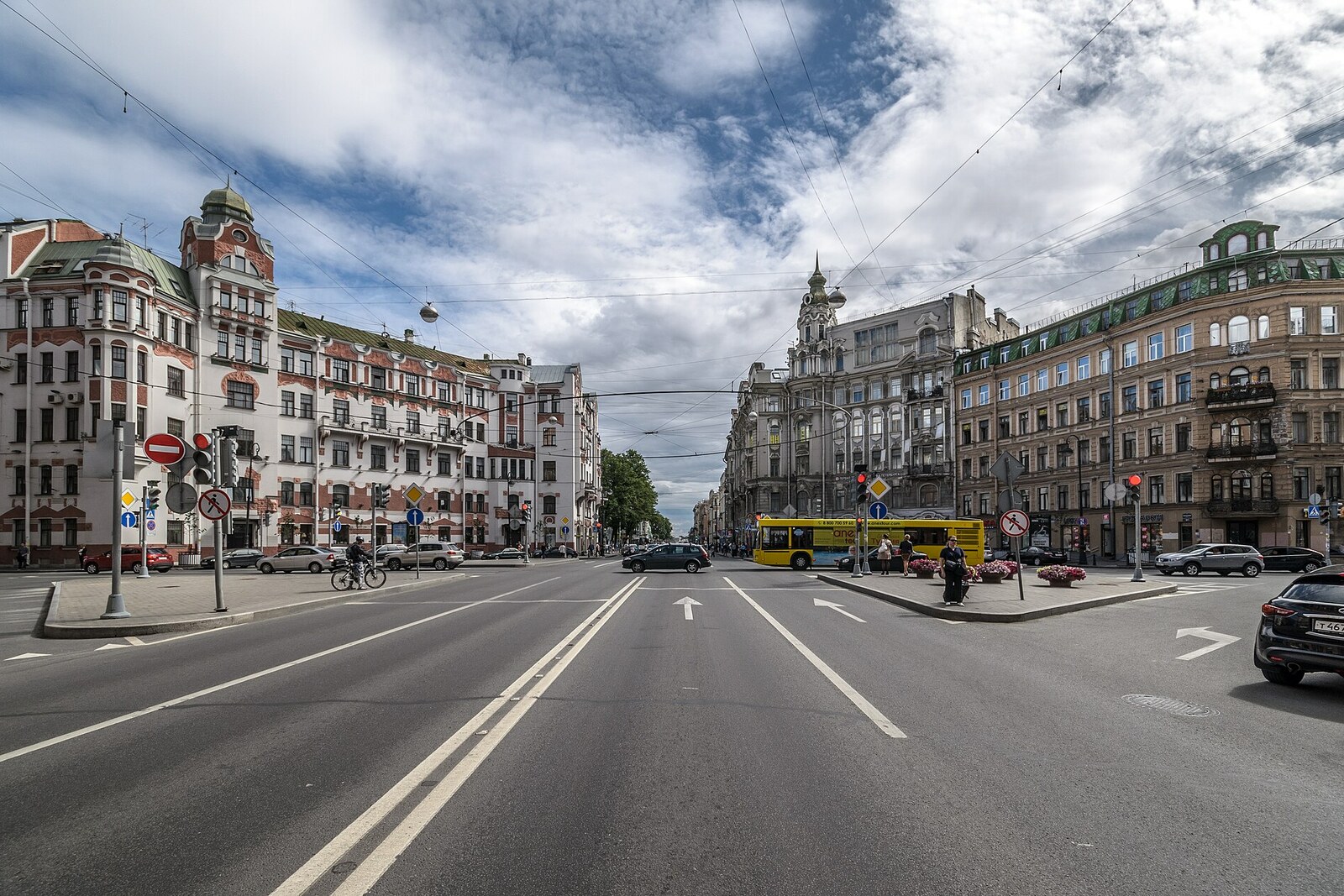
Look around first
What to notice
- Semicircular tower
- Dome and spire
- Round windows of the upper studio
The story of the place
Austrian Square is laid out as an octagonal intersection. There is almost no open space here: its boundaries are marked by the facades of five buildings. One of them, with a semicircular tower, a dome, and a spire, was built for himself by Ernst Lipgart—an artist who earned money from commissioned portraits and wanted to combine a home, a studio, and apartments to let.
Lipgart bought this plot in eighteen ninety-eight. First, a studio appeared deep in the courtyard; then he commissioned the architect Vasily Schaub to build a six-story income-producing apartment house facing the prospekt. Lipgart needed large workrooms and overhead light, while the tenants were meant to provide the owner with a steady income. Schaub raised a tower with round windows above the corner and placed the studio on the upper levels. The client received a house where he could paint portraits, receive models, and live on income from real estate.
In the year the house was completed, Lipgart became keeper of the Hermitage Picture Gallery—a specialist responsible for attributing paintings and shaping the museum’s collection. He now left here for duty at the Hermitage and returned to his own studio. This well-ordered life did not last long. In nineteen twenty-one, Lipgart lost the building he had commissioned for work and income. First, he had to move into the House of Arts—a dormitory for writers and artists on Nevsky Prospekt—then relocate to someone else’s apartment near the Field of Mars. He continued working on the Hermitage catalogues without his own studio.
Its rooms have survived: a columned hall, an oval study, a belvedere, and a tower with round windows. From the square, you can see the upper windows of the house from which its owner was removed, but which is still called by his name.
There was no Austria here in Lipgart’s time, and the intersection itself remained unnamed. Only in nineteen ninety-two did the city’s toponymists decide that Schaub’s facades resembled Viennese architecture and name the square Austrian. They planned to open Austrian shops and service businesses around it. This “Austrian corner” never appeared. What remained of the plan was the square’s name and the houses built by a St Petersburg architect for St Petersburg owners.
Useful on site
Exterior viewing from public sidewalks, with no schedule.
Checked: June 24, 2026. Check the official source before visiting.View the square from several sides: a single building does not reveal the composition as a whole. Cross the roadway only at permitted places.