 Guide On Map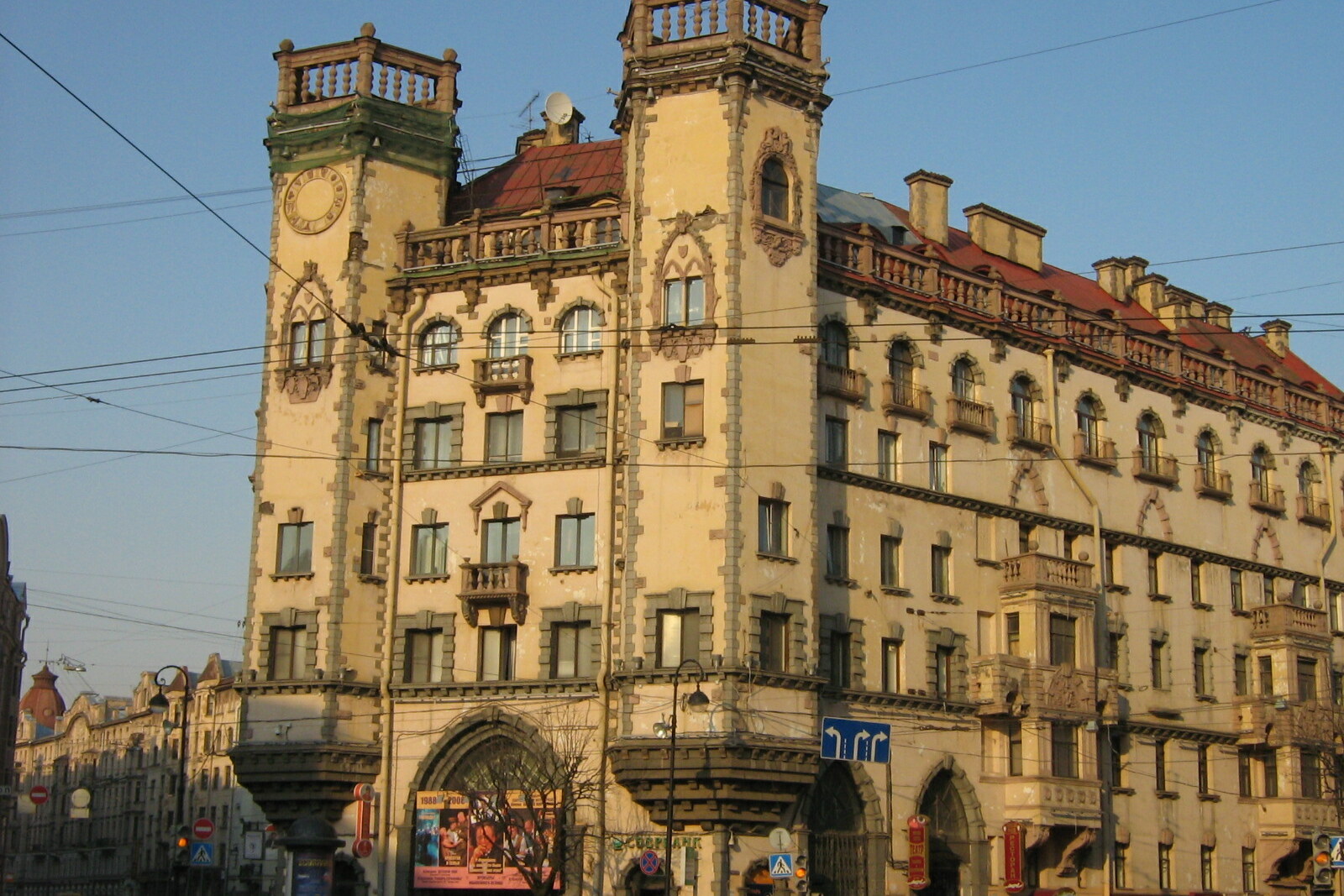
Look around first
What to notice
- Two hexagonal towers
- A circle with zodiac signs
- The theatre entrance
The story of the place
The six sides of the corner towers and the zodiac circle on one of them reveal the architect’s idea: the house was meant to stand out among the square’s new development. The engineer Konstantin Rosenstein built it as an expensive income-producing apartment house, with apartments rented out to tenants. The lower floor had a separate history: films were shown here for decades, and then the auditorium was adapted for performances. So behind the theatre entrance remains an entire city house, to which the towers gave its familiar name.
For eight seasons, Rudolf Furmanov had a theatre without its own auditorium. The Leningrad actor and tour organizer made a living by arranging access to stages and taking famous artists on tour around the country. For his own theatre, he chose the contract principle: actors were invited for specific productions, while the organizer himself was responsible for box-office receipts and subsequent premieres. Hence the word “entreprise” on the sign—an old term for a private theatrical enterprise.
Andrei Mironov was an actor with whom Furmanov spent more than twenty years preparing concert programs and going on tour. In August nineteen eighty-seven, Mironov lost consciousness during a performance of The Marriage of Figaro in Riga and died two days later. He was forty-six years old. A year later, with the consent of the artist’s mother, the actress Maria Mironova, Furmanov created a concert studio named after Andrei Mironov. In nineteen ninety-one, the studio became a theatre, but its productions still had to be performed at other venues.
A permanent stage appeared after the closure of Experiment Theatre, which occupied the lower floor of the House with Towers. Its artistic director, Viktor Kharitonov, who was losing the theatre he had created, asked for the premises, part of the company, and part of the repertoire to be transferred to Furmanov’s group. The request was granted in nineteen ninety-five.
Furmanov received an auditorium that needed to be put in order. Sixteen enterprises helped with materials and work: they refurbished two hundred seats, set up dressing rooms, and repaired the foyer. On October seventeenth, nineteen ninety-six, Maria Mironova cut a blue ribbon at the entrance. Her son’s theatre, which had managed with other people’s stages for eight seasons, began performing here.
The auditorium had been in the building long before Furmanov. Since nineteen twenty-one, cinemas had succeeded one another on the first floor; Ars Cinema operated longer than the others and closed in nineteen seventy-two. After a television studio, the former cinema auditorium was converted for performances, and a theatre stage appeared here in nineteen seventy-eight.
Around this auditorium still stands an income-producing apartment house—a building with apartments constructed to be rented out. The owner of the plot, the engineer Konstantin Rosenstein, began designing it and entrusted the facades to the architect Andrei Belogrud, who was to make the expensive house stand out among the square’s new development. Belogrud turned the corner bay windows into two hexagonal towers and placed a circle with zodiac signs on one of them. These towers gave the house its common name.
Andrei Mironov never performed on the stage of the Russian Entreprise Theatre named after Andrei Mironov: Furmanov opened it nine years after Mironov’s death, in the former cinema auditorium beneath the two towers.
Useful on site
The facades can be viewed from outside from Lev Tolstoy Square without a schedule.
Checked: June 24, 2026. Check the official source before visiting.The overall silhouette is best seen from across the avenue, while the clock and the texture of the stone are best seen up close. Do not enter private residential spaces.