 Guide On Map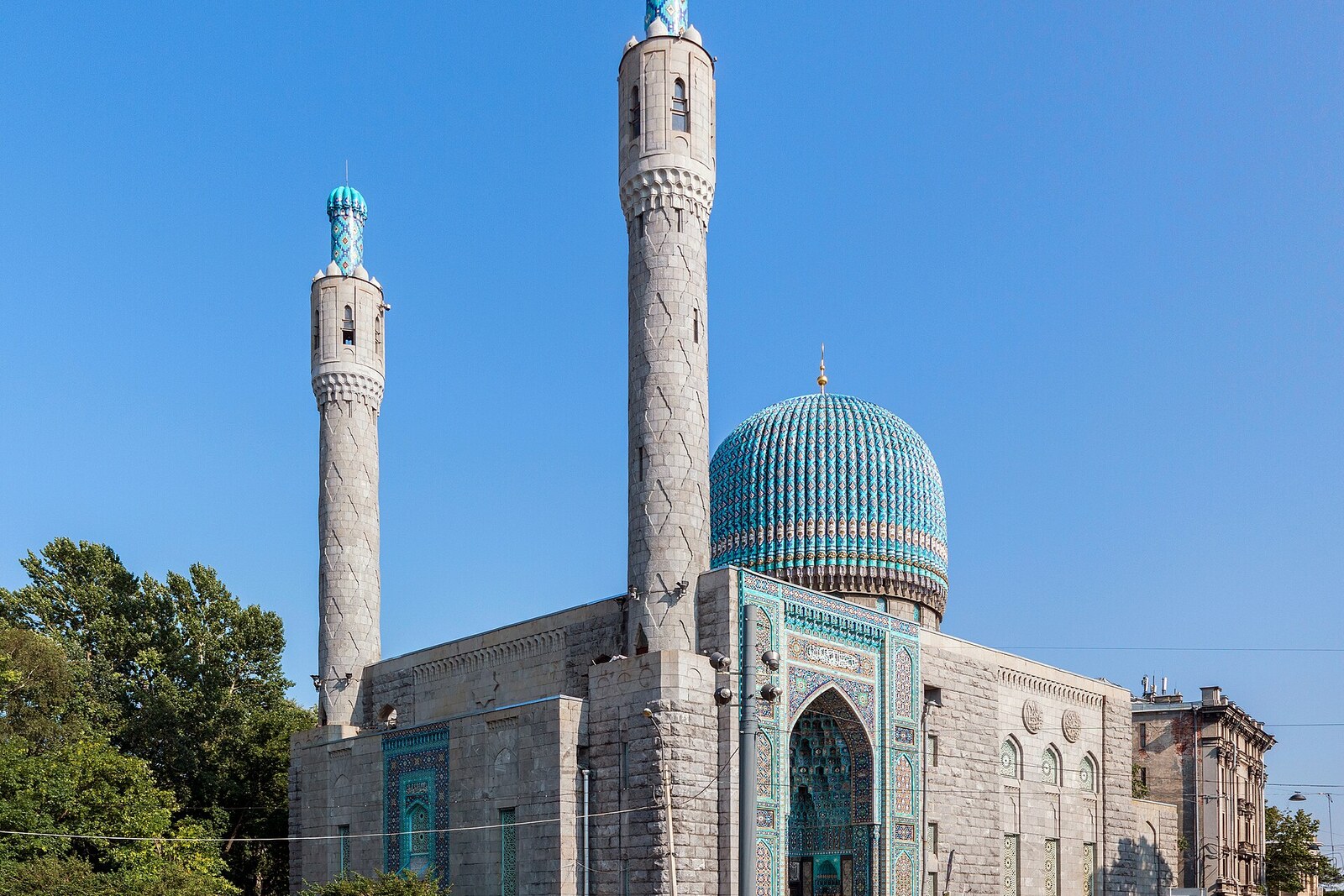
Look around first
What to notice
- Turquoise dome
- Two minarets
- Façade facing Kronverksky Prospekt
The story of the place
The turquoise dome and two minarets above Kronverksky Prospekt mark the city’s main mosque. The word “cathedral” describes its purpose: this is where the community gathers primarily for communal Friday prayer. The plot by Peter and Paul Fortress was visible from several Christian holy sites, and this openness once prompted objections. On Fridays and holidays, Muslims from across St Petersburg still come here.
Before this mosque appeared, Ataulla Bayazitov’s apartment on Moika Embankment served both as the residence of the head cleric and as the city’s prayer room. Bayazitov was an akhun—a senior Muslim cleric in St Petersburg—and he sought a separate building for communal prayer. Besides serving the parish, he taught Turkic languages and Muslim law. Worshippers came to pray in the same place where he lived.
By the beginning of the twentieth century, St Petersburg had around seven thousand Muslims. The word “cathedral” in the name means the city’s main communal mosque, intended primarily for Friday prayer. Bayazitov first requested permission to build it together with representatives of the community as early as eighteen eighty-one. The petition was rejected. Fundraising and correspondence with officials stretched on for decades.
The decisive ally was Seid Abdul-Ahad Khan, Emir of Bukhara: the ruler of a state dependent on the Russian Empire, who wanted to secure a permanent mosque for the capital’s Muslims. In nineteen oh four, he raised the matter at a meeting with Nicholas the Second and obtained permission to purchase land. The emir’s donation enabled the committee to acquire plots on Kronverksky Prospekt.
The location nearly caused another refusal. Members of the Imperial Academy of Arts and the technical committee objected: a large mosque on an open plot would be in view of Peter and Paul Cathedral, Trinity Church, and Peter the Great’s Cabin. The emir replied that proximity to Christian holy sites did not hinder a Muslim place of worship. In the summer of nineteen oh nine, Bayazitov led a delegation to Pyotr Stolypin, chairman of the Council of Ministers, on whom the fate of the project depended. Stolypin refused to revoke the permission already granted by the emperor.
In February nineteen ten, the seriously ill Bayazitov took part in the laying of the mosque’s foundation and recited a prayer. He did not live to see the first service: he died in the spring of the following year. Abdul-Ahad Khan did not see the opening either—he died even earlier, in December nineteen ten.
The first ceremonial prayer in the unfinished building was held in February nineteen thirteen. It was led by Muhammat-Safa Bayazitov, the son of the late akhun. Among those present was Mir-Alim Khan, the son of the late emir. The fathers secured the plot and the start of construction; the sons met here for the first prayer.
The turquoise dome and two minarets rise on the very plot that officials considered too conspicuous beside Peter and Paul Fortress. Today, for Friday and holiday prayers, Muslims from St Petersburg gather here rather than in the head cleric’s apartment on Moika Embankment.
Useful on site
There are no general tourist visiting hours for free admission; tours are conducted with prior written permission.
Checked: June 24, 2026. Check the official source before visiting.View the mosque primarily from outside. It is an active place of worship, so do not enter it as you would an ordinary museum, and observe the community’s rules.