 Guide On Map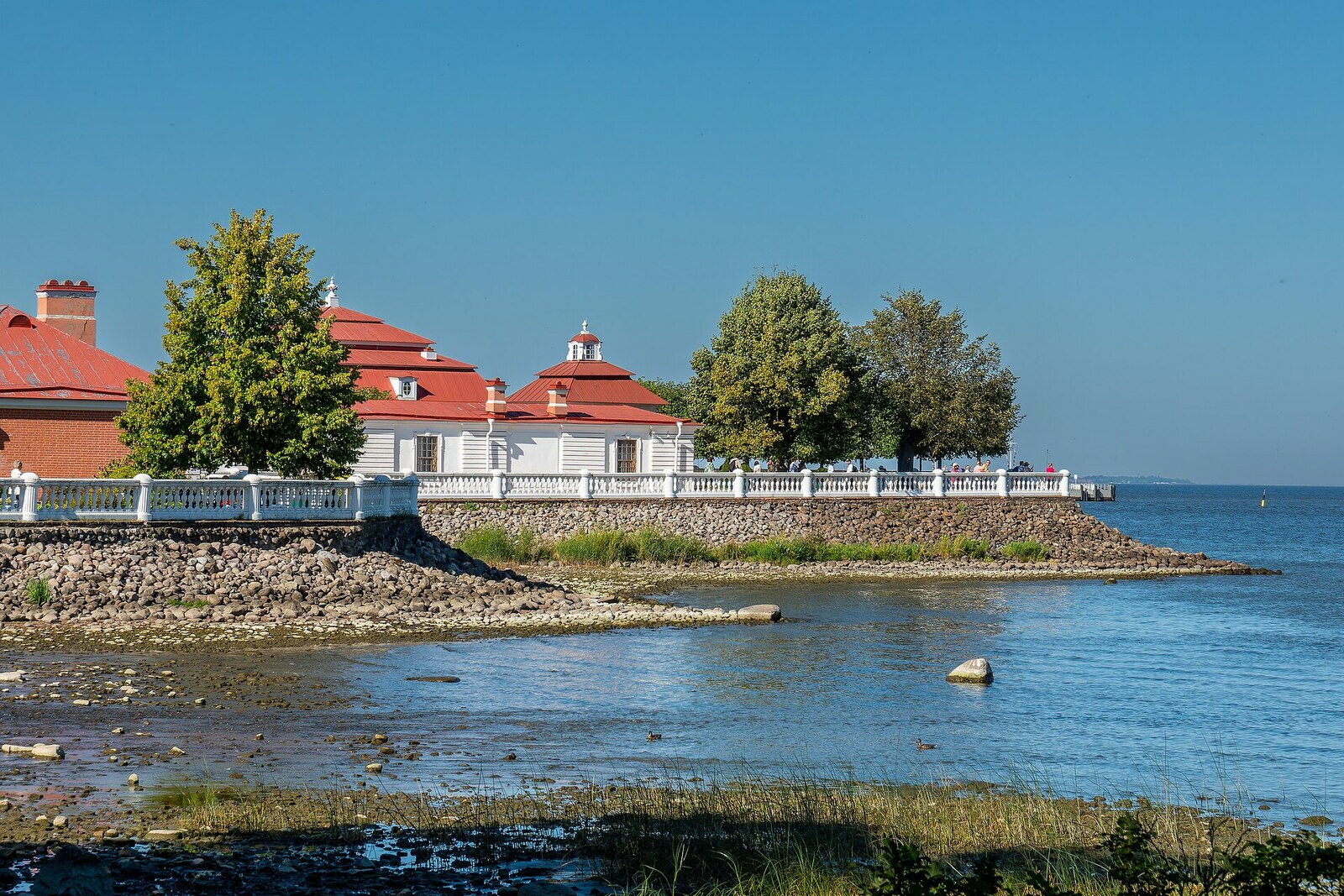
Look around first
What to notice
- Patterned brick paving
- White balustrade
- Stone reinforcement of the artificial embankment
- Strip of the Gulf of Finland
The story of the place
In front of Monplaisir's northern facade lies an artificial embankment reinforced with boulders and brick. Pyotr himself chose this site at the edge of the Gulf of Finland: the small palace could be approached from the water, and from the Sea Study he could watch vessels traveling between St. Petersburg and Kronstadt. By the early seventeen twenties, the builders had laid out the terrace in a pattern of multicolored Dutch clinker—especially durable fired brick. It was not only the view here that was maritime, but also the entrance to the residence.
In January nineteen forty-four, thirty-three-year-old Marina Tikhomirova, a curator at the Peterhof museums, returned here. During the blockade, she had been responsible for evacuated museum valuables stored in the basements of St. Isaac's Cathedral. Now she had to determine what remained in its original place and what could still be saved.
She did not recognize the terrace at once. German soldiers holding this stretch of coast used its open position for defense from the Gulf side. They installed a heavy machine gun here in a concrete emplacement, positioned artillery guns to the west, breached the balustrade, and turned the central part of the palace into a permanent firing point. Trenches and dugouts extended as far as Monplaisir Garden. A white sign bearing a German warning about mines hung on the barbed wire around it.
Before retreating, the soldiers mined Monplaisir with delayed-action charges. Red Army sappers found them inside the palace and defused them. If they had been late, all that would have remained of the building behind the terrace would have been walls fit no longer for restoration, but for clearing as rubble.
Tikhomirova began documenting the damage almost immediately after her return. On February first, she sent Leningrad a list of urgent work needed in Peterhof; in a letter to her mother, she admitted that she worked eighteen to twenty hours a day, although there was not a single building fit for habitation in the liberated city. The inventories compiled by the curators, prewar measurements, and surviving fragments became the basis for restoring Monplaisir. The palace opened to visitors on May fourteenth, nineteen sixty-one.
The concrete machine-gun emplacement is no longer on the terrace. Restorers reassembled the white balustrade in nineteen fifty-six, and restored the patterned paving fourteen years later from preserved clinker samples. Beneath today's geometric pattern, the former military position is gone; its place is marked by restored bricks and the strip of the Gulf, open once more.
Useful on site
Open during Lower Park hours 09:00–20:00; park entry until 19:45.
Checked: June 24, 2026. Check the official source before visiting.It is worth lingering here and letting your eyes adjust to the empty horizon after the crowded cascades. The terrace can be windy; stay in permitted areas and do not climb onto the balustrade.