 Guide On Map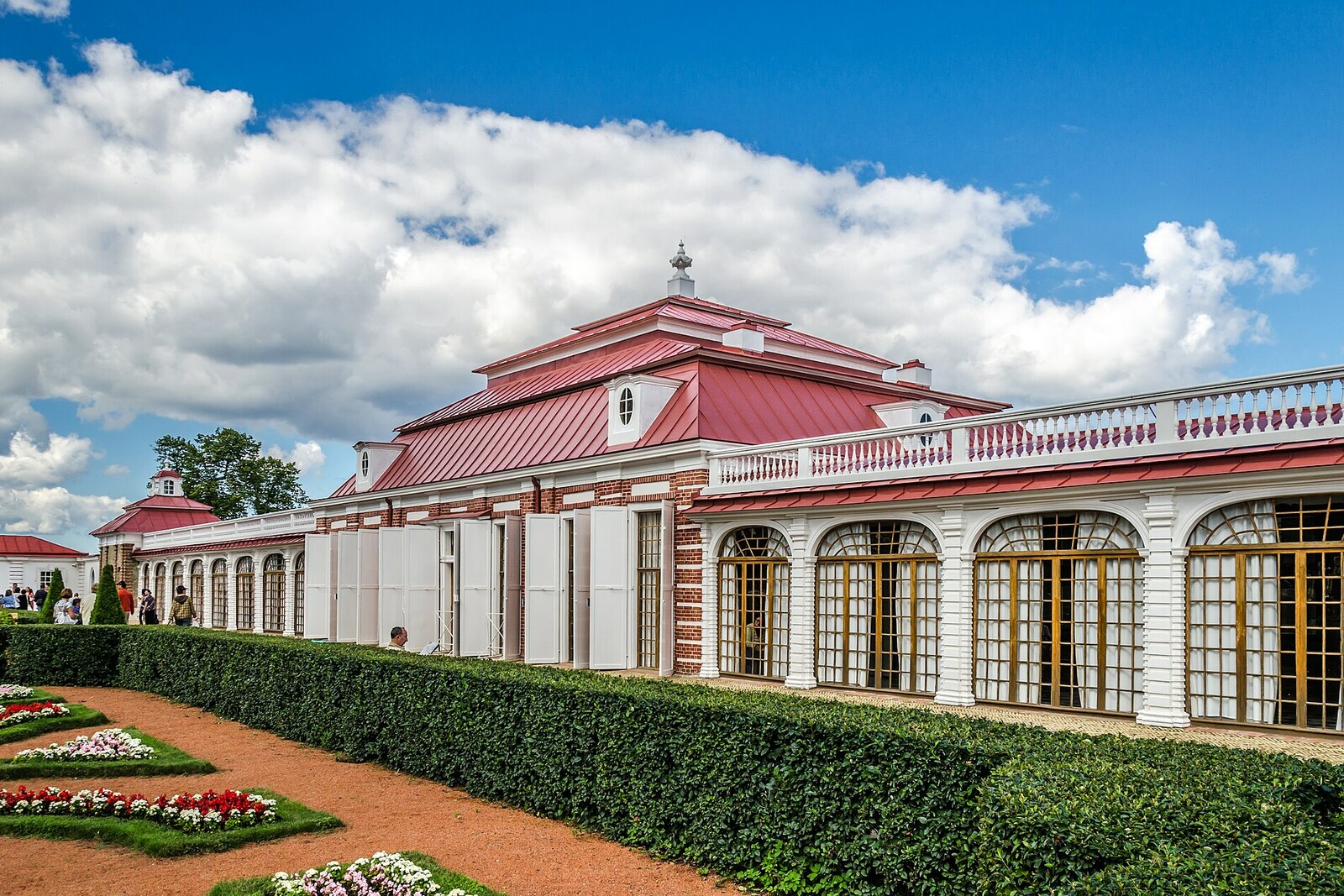
Look around first
What to notice
- Low central block
- Long glazed galleries
- Western wing
- Garden façade
The story of the place
The name “Monplaisir” translates from French as “my pleasure”; Pyotr I came up with it. He himself chose the site and set the plan for the small palace, where he would retreat from the spacious Upper Chambers during his visits to Peterhof. The low central block is connected to elongated glass galleries. A separate ceremonial block later appeared at the western wing.
At dawn on June twenty-eighth, seventeen sixty-two, Guards officer Aleksei Orlov entered Yekaterina II's rooms in Monplaisir's western wing. Orlov was involved in a conspiracy against her husband and had come for her, because waiting was dangerous: one of the conspirators had been arrested the day before, and under interrogation he might name the others.
Yekaterina's husband, Emperor Pyotr III, was the grandson of Pyotr I and ruled for only half a year. The spouses lived apart. Their open hostility had already led to an order for Yekaterina II's arrest, canceled only after the intervention of one of the courtiers. Yekaterina hoped to get ahead of her husband and take the throne with the support of the Guards. At Peterhof, she was staying in the far part of the palace complex, while Pyotr remained in Oranienbaum. A festive luncheon in honor of the emperor's name day had been scheduled at Monplaisir for that day. He intended to come here with the entire court.
Yekaterina went out to the carriage Orlov had prepared. The horses could not withstand the frantic ride; part of the journey had to continue in a chance peasant cart, and then she had to transfer to another carriage. By seven in the morning, she reached the barracks of the Izmailovsky Regiment. The soldiers swore allegiance to her, and the Semyonovsky and Preobrazhensky Regiments followed them. Within a few hours, Yekaterina II was proclaimed empress.
Pyotr III still knew nothing of any of this. At about two in the afternoon, he arrived at Monplaisir for luncheon and found the palace empty. The people sent to St. Petersburg returned with the news: the Guards had gone over to his wife. Field Marshal Münnich urged the emperor to sail to the army at once and continue the struggle, but Pyotr headed for Kronstadt. The fortress commandant refused to admit him and declared that he recognized Yekaterina as sovereign. Pyotr returned, signed his abdication, and was sent under guard to Ropsha. He soon died there; the circumstances of his death remain disputed. Yekaterina ruled for thirty-four years.
Pyotr I chose the name “Monplaisir”: in French, it means “my pleasure.” He himself selected the site and outlined the plan for the small palace, which he preferred to the spacious Upper Chambers during his visits to Peterhof. The low central block with its long glazed galleries is Pyotr I's house. A separate ceremonial block was later added to its western wing. It is now called the Catherine Block—in memory of that morning when Yekaterina left here for the Guards barracks, while Pyotr III arrived at Monplaisir as emperor a few hours later and set off to seek a fortress that had already recognized his wife.
Useful on site
The garden and exterior façades are accessible during Lower Park hours; the palace interiors are closed for restoration.
Checked: June 24, 2026. Check the official source before visiting.The account is designed for viewing the façade and the house's position between the garden and the shore. Check separately whether the rooms can be visited; the point of the stop remains without the interior.