 Guide On Map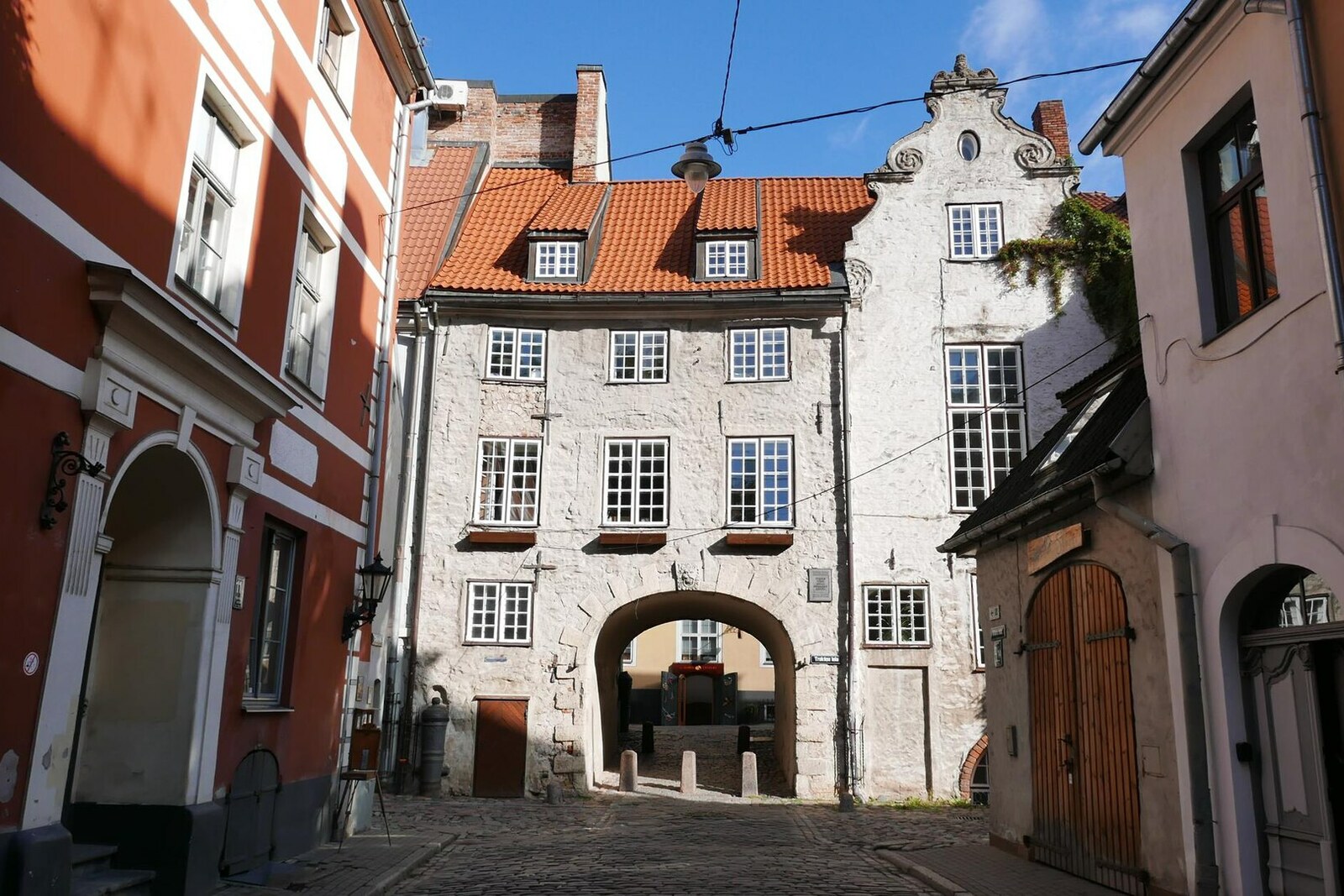
Look around first
What to notice
- The vaulted arch in a residential house
- Lion heads on the keystones
- The long yellow barracks block
The story of the place
Of Riga’s former eight city gates, only this passage has survived. It is called Swedish in memory of the garrison of the Swedish Crown, quartered by the outer line of fortifications. The arch vault passes beneath residential rooms, and lion heads remain on its stone voussoirs. Opposite stretches the yellow block of eighteenth-century barracks, while the streets on either side of the arch were once divided by the medieval city wall.
In sixteen ninety-seven, the owners of houses on Torņa Street demanded that their short route to the center of Riga be restored. They lived in a narrow strip between two fortifications. On one side stood the medieval stone wall; on the other, newer earthen ramparts and bastions. Small-scale craftsmen with workshops attached to their homes settled here, and the garrison was stationed here. To deliver an item to a customer or get from a post to the inner city, people had to go around the old wall through other gates.
Cutting an opening in the masonry was no longer enough. Over the seventeenth century, buildings had gone up on both sides of the wall, and at the necessary point the way was blocked by the residential house of Gerd Heideman. The passage was to occupy its ground floor. The owner allowed the rebuilding, and Erik Dahlbergh, Governor-General of Livonia and the military engineer responsible for Riga’s fortifications, ordered the work to begin.
In March sixteen ninety-eight, builders entered Heideman’s house. By November, they had cut a vaulted passage along the extension of present-day Aldaru Street—then called Great Brewers' Street. The arch was faced with dressed stone, lion heads and the year of construction were carved on the keystones. A private house became a city entrance: residential rooms remained above passersby, while a road appeared beneath them.
The passage shortened the route, but did not eliminate control. The heavy doors were opened at dawn and locked after sunset. The keys were kept at the town hall, and patrols stood at the gate. Residents were asked where they were going and whom they were going to see. Heideman gave up part of his house, townspeople gained a direct exit onto Torņa Street, and soldiers gained a road between the barracks and inner Riga.
The Swedes in the name were soldiers of the Swedish Crown, whose garrison stood in Riga after the city was taken in sixteen twenty-one. Their barracks stood outside the medieval wall, near the new ramparts. The gate was made under Swedish rule and to connect with the garrison quarter, so the name Swedish became attached to it.
The long yellow block opposite appeared later: these are stone barracks from the eighteenth century, which replaced the earlier military buildings. The spatial relationship remains the same. Trokšņu Street, the Noisy Street, lies on the inner side of the former wall, Torņa Street on the outer side, and between them the arch cut through Gerd Heideman’s house still passes. Of Riga’s eight city gates, only this one has survived.
Useful on site
The gate can be viewed from the street and remains an active pedestrian passage. It is more convenient to listen nearby, without stopping directly beneath the arch or obstructing traffic.