 Guide On Map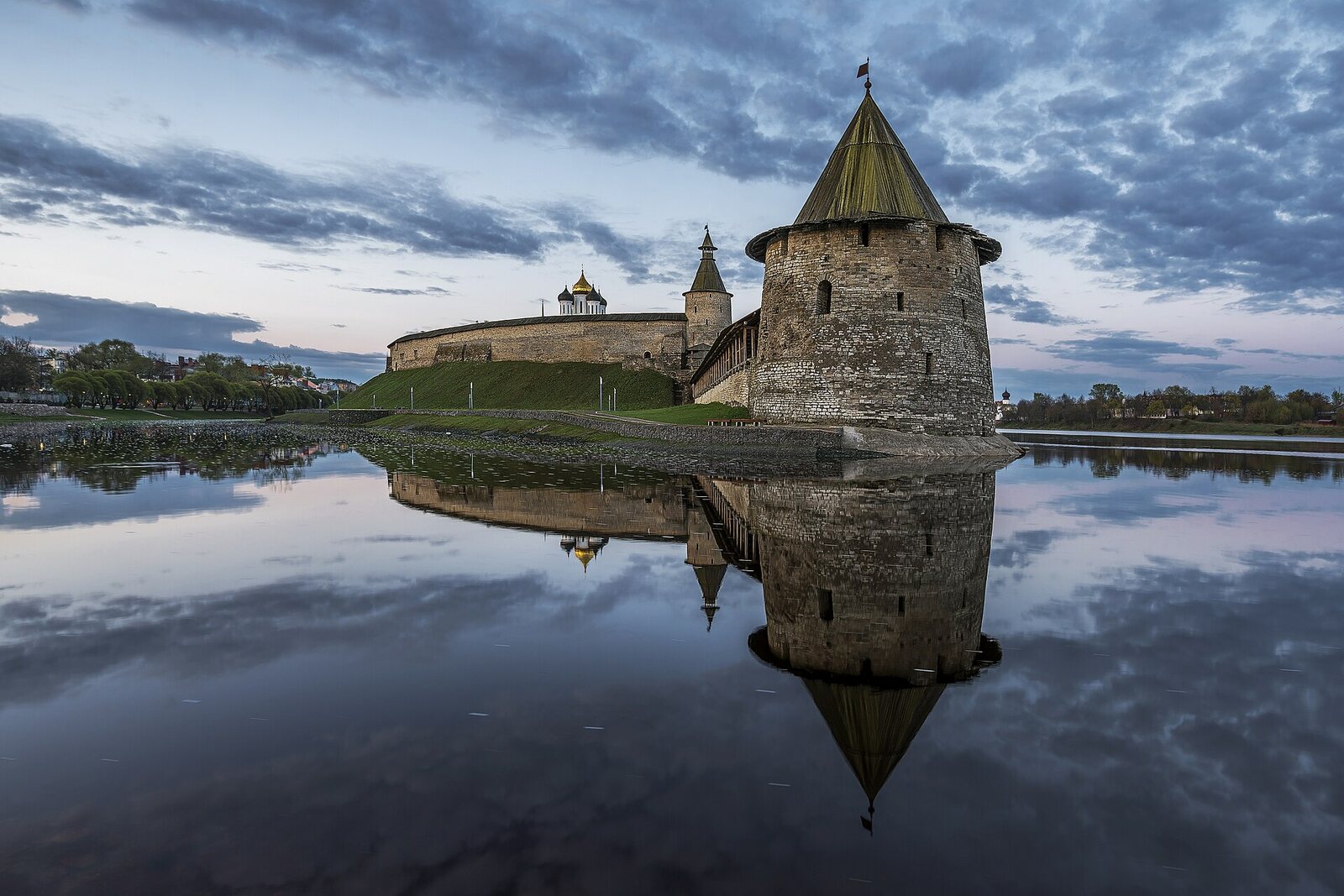
Look around first
What to notice
- The round body of the Flat Tower
- The wooden tented roof
- The mouth of the Pskova River
- The High Tower on the opposite bank
The story of the place
By the middle of the twentieth century, about a third of the Flat Tower remained. The wall on the side of the Velikaya River had collapsed, and the two lower levels were buried under earth and rubble. The restoration architect Alexey Khamtsov was assigned to bring the tower back from its ruined state. He worked at the Central Design and Restoration Workshop of the Academy of Architecture, making his living by distinguishing the ancient structure from what had been lost through surviving masonry, old images, and measurements. Here, more had to be restored than had survived.
The tower was built in the year fifteen hundred. A chronicler called it “a kostyor at the mouth of the Pskova River”: at that time, the people of Pskov used kostyor to mean a fortress tower. The site was chosen where the Pskova River flows into the Velikaya River and the waterway crosses the line of fortifications. A second tower was built on the opposite bank. Later, the Lower Grilles appeared between them, and the Flat Tower became the stone end of the river barrier.
Its name described its proportions: its broad, round body looked squat beside the tower on the opposite bank. Documents from the seventeenth century also contain another name, Ostroverkhaya, after its high tented roof. By that time, it had twenty-one firing slits, that is, weapon embrasures, distributed across three levels.
After the Great Northern War, the fortress was no longer maintained as an active defense. The tented roof disappeared, the masonry cracked, and then the part facing the river collapsed. Khamtsov and his staff could have reinforced what remained and left it as a ruin. They chose a full reconstruction: they raised the walls, built the levels, returned the tented roof to the tower, and connected it to a restored section of wall.
By the year nineteen sixty, the work was complete. The tower again had a complete silhouette, but its entrance was bricked up. For decades, Khamtsov’s project could be seen only from outside; visitors could not check from within where the old masonry ended and the restorers’ work began.
New restorers opened the tower in the twenty-first century. In June two thousand twenty-one, the public was admitted inside for the first time. The restored structure now contains an exhibition about Pskov restoration: the tower that Khamtsov assembled from the surviving third and immediately closed shows how its present appearance was created.
Useful on site
From 10:00 to 18:00 from November through April, from 10:00 to 20:00 from May through October; the last Tuesday of the month is a sanitation day. Changes are possible.
Checked: July 2, 2026. Check the official source before visiting.Listen from outside while keeping both towers in view. The grilles themselves are no longer there, so do not look for a separate mechanism: reconstruct their position along the line across the mouth.